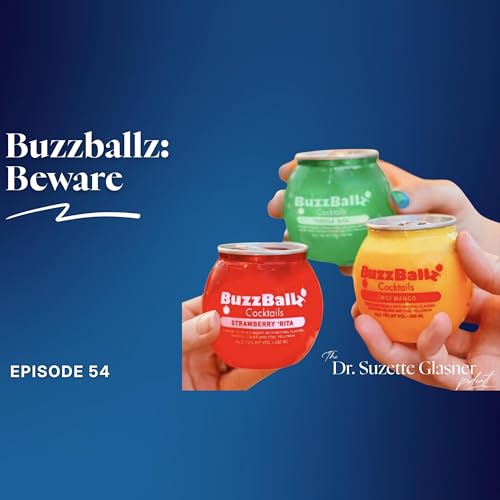
• Ep. 54: BuzzBallz: A High-Risk Gen-Z Drinking Trend
    May 16 2026

    A 13-year-old in Sheffield asked her mother to add BuzzBallz to a New Year’s Eve shopping list last December. The mother — who runs a sobriety group for women — had never heard of them. Her daughter said, “All my friends are drinking them.”

    Today, BuzzBallz are a $500 million brand. The colorful, 15% ABV cocktails in plastic balls are the second-fastest-growing prepared cocktail brand in America, stocked in convenience stores, gas stations, and supermarkets nationwide. They are sweet, single-serve, cheap (under $5), and increasingly in the hands of underage drinkers.

    In this episode, clinical psychologist and addiction scientist Dr. Suzette Glasner explains why the design of these drinks is creating the perfect conditions for a particularly dangerous drinking practice that addiction researchers call high-intensity drinking — and what that means clinically for the teenagers and young adults consuming them.

    Watch the full episode here:

    Dr. Glasner walks through the standard-drink math first. A single 200 mL BuzzBall at 15% ABV contains roughly 1.7 standard drinks — nearly two drinks of alcohol in a single ball that looks like a piece of candy. The supersize line goes further: the “Biggies” deliver the alcohol equivalent of about 17 standard cans of beer in a single two-liter container, and the recently released “Boulders” approach 25 standard drinks in a single three-liter package. The TikTok chug challenge currently trending — where influencers drink three BuzzBallz in succession — delivers over five standard drinks rapidly, already at or above the binge drinking threshold for both women and men.

    She then introduces what addiction researchers call high-intensity drinking — consumption at two or more times the binge drinking threshold (8+ drinks for women, 10+ drinks for men in a single sitting).The episode then unpacks the clinical research on rapid drinking specifically. Dr. Glasner explains why drinking the same amount of alcohol quickly produces dramatically worse cognitive and motor impairment than drinking it slowly — and why this directly translates to elevated risk for impaired driving, injury, and alcohol use disorder progression. The format of BuzzBallz — colorful, sweet, easy to chug, and impossible to count accurately — actively defeats the harm-reduction strategies that work for traditional drinking.

    The episode closes with practical guidance: how parents can have an evidence-based conversation with a teenager about BuzzBallz, the warning signs that someone you love may be developing alcohol use disorder, and the evidence-based treatments available for adolescents and young adults.

    📋 Resources mentioned in this episode:

    🔗 NIAAA’s Rethinking Drinking — standard drink sizes, low-risk drinking guidelines, and free tools to track your drinking:

    https://rethinkingdrinking.niaaa.nih.gov

    🔗 NIAAA Treatment Navigator — find evidence-based alcohol treatment near you:

    https://alcoholtreatment.niaaa.nih.gov

    🔗 Dr. Glasner’s Addiction Recovery Skills Workbook — exercises for identifying triggers and pleasurable replacement activities, available on Amazon

    If you or someone you love is in crisis: 988 Suicide & Crisis Lifeline — call or text 988, or visit

    https://988lifeline.org

    SAMHSA National Helpline 1-800-662-HELP — 24/7, English and Spanish

    The Dr. Suzette Glasner Podcast brings clinical and addiction science to the mental health stories everyone is already discussing.

    📩 Questions or topic suggestions: AskDrGlasner@gmail.com

    🧩 More: https://drglasner.com


    This is a public episode. If you would like to discuss this with other subscribers or get access to bonus episodes, visit drglasner.substack.com
    Show More Show Less
    13 mins
  • Ep. 53: Beating Phone Addiction
    May 10 2026

    For most of the past decade, the conversation about phone and social media addiction has been stuck at a single question: is this real? In March, a California jury answered it. They found Meta and Google liable for designing addictive social media platforms that harmed a young user — the first time at this scale that the companies were ruled responsible for the addictive design choices baked into their products.

    In this episode, clinical psychologist and addiction scientist Dr. Suzette Glasner takes the question the verdicts have now opened — what do we actually do about it? — and answers it from inside the science and practice of addiction treatment.

    You can watch the full episode here:

    Phone addiction, Dr. Glasner argues, is clinically a behavioral addiction with striking similarities to drug and alcohol addiction. It is driven by the same variable reinforcement schedule that makes slot machines and methamphetamine so neurologically compelling, and the same therapeutic principles that work for substance use disorders apply directly to compulsive scrolling.

    She walks through evidence-based principles, drawn from the same framework she uses with patients in her private practice. Stimulus control — the family media plan, and why the bedroom and the dining room are the two highest-yield environments for restriction. Why content matters more than minutes — the role of intermittent variable reinforcement. The replacement principle — why removing the phone without replacing the reward fails, and how to match replacement activities to the specific function the phone was serving.

    And when self-management isn’t enough — what evidence-based treatment for behavioral addiction actually looks like, and how to recognize when phone overuse is masking depression, anxiety, ADHD, autism, body dysmorphic disorder, or trauma.

    She also reacts to recent public statements from Lara Trump on her household’s no-screens policy, Bill Gates on his decision not to give his own children phones until age 14, and Jonathan Haidt’s recommendations to keep screens out of bedrooms — translating each of these positions into actionable steps.

    Tools mentioned in the episode: Brick (https://getbrick.com) — physical app blocker. Freedom — phone internet blocking app. Bloom — screen time tool.

    Further reading:

    Brian X. Chen, Phone Addiction Remedies, New York Times Personal Tech, April 30, 2026.

    Jonathan Haidt, The Anxious Generation.

    Dr. Glasner’s Addiction Recovery Skills Workbook — available on Amazon.

    The Dr. Suzette Glasner Podcast brings clinical and addiction science to the mental health stories everyone is already discussing.

    📩 Questions or topic suggestions: AskDrGlasner@gmail.com

    🧩 More: https://drglasner.com


    This is a public episode. If you would like to discuss this with other subscribers or get access to bonus episodes, visit drglasner.substack.com
    Show More Show Less
    17 mins
  • Ep. 52: The Body Dysmorphia and Addiction Risk Behind Looksmaxxing
    May 3 2026

    Most of the coverage of the looksmaxxing trend has framed it as a viral aesthetic phenomenon. From the perspective of clinical psychologist and addiction scientist Dr. Suzette Glasner, it looks like something else: the convergence of two clinical pictures — body dysmorphic disorder and stimulant use disorder — repackaged in the language of self-optimization and delivered to adolescent boys at scale.

    In this episode, Dr. Glasner discusses what the trend actually is, clinically, tracing its core practices to the diagnostic criteria for BDD — a recognized mental health condition with an elevated suicide rate, typically beginning between ages 12 and 13, and just as common in men as in women. She summarizes what published research now shows about social media and BDD, including recent work on adolescents’ use of filters and self-image. And from an addiction perspective: how the looksmaxxing community’s normalization of anabolic steroids, SARMs, peptides, and amphetamines is creating a permission structure for stimulant use in early adolescence - and the overdose risk that comes with it.

    The Clavicular case is the entry point. The 20-year-old “looksmaxxing” influencer collapsed during a livestream in Miami this month in a suspected overdose, and afterward told followers that “all of the substances are just a cope trying to feel neurotypical while being in public.” That statement has important implications self-medication framing layered on top of a community-validated drug culture, in a young man whose audience includes thirteen-year-olds.

    You can watch the full episode here:

    Dr. Glasner closes with a summary of science-based treatments for BDD and stimulant addiction — and with internist Dr. Lucy McBride’s recent framework for evaluating health information from influencers, applied to the specific case of a 20-year-old livestreamer recommending hormones, stimulants, and off-label growth hormone to minors.

    If you or someone you love is in crisis: 988 Suicide & Crisis Lifeline — call or text 988, or visit

    https://988lifeline.org

    SAMHSA National Helpline (1-800-662-HELP) — 24/7, English and Spanish.

    Further reading:

    Loannou et al. (2024), #NoFilter: The impact of social media body dysmorphic disorder in adults, Mental Health Science.

    McBride, L. (2026), Yes, Credentials Do Matter, Maria Shriver’s Sunday Paper.

    The Dr. Suzette Glasner Podcast brings clinical and addiction science to the mental health stories everyone is already talking about.

    📩 Questions or topic suggestions: AskDrGlasner@gmail.com

    🧩 More: https://drglasner.com


    This is a public episode. If you would like to discuss this with other subscribers or get access to bonus episodes, visit drglasner.substack.com
    Show More Show Less
    20 mins
  • Ep. 51: Joe Rogan on Ibogaine: What the Science Actually Says | The Dr. Suzette Glasner Podcast
    Apr 26 2026
    When Joe Rogan recently called Ibogaine a near-miraculous cure for opioid addiction — and the White House announced it would accelerate federal research into psychedelic medicines including Ibogaine — a powerful narrative took hold: one dose, addiction gone. The viral statistic? An 80% cure rate.But what does the research actually say?In this episode, addiction scientist and clinical psychologist Dr. Suzette Glasner traces that 80% number back to its potential sources in the published research literature — and walks through what the studies to date have actually shown. Dr. Glasner explains the data through the lens of conservative methodology for interpreting treatment success rates, which suggests that the outcomes are closer to 50% abstinent at one month and 30% at one year. That’s still a meaningful signal worth investing in. It’s just not a miracle cure.Watch the full episode here:Dr. Glasner also unpacks what Ibogaine is and why it’s drawn the attention of addiction researchers — particularly its action in the brain’s reward circuit. She gets into the cardiac risks and how they can be reduced before and during treatment (e.g., cardiac screening, EKG monitoring during the session, and co-administered magnesium). 🧠 Key TakeawaysThe bottom line: the scientific signal is real, and accelerated federal investment in rigorous trials is genuinely needed. But the gap between what the evidence shows and what people are hearing in viral podcast clips is where people can get hurt. And while we wait for clinical trials to be completed, FDA-approved medications for opioid use disorder already exist, save lives, and are available right now.🔍 Episode Breakdown00:00 Joe Rogan and the ibogaine "miracle" story00:47 The "80% cured, 90%+ on the second dose" claim01:22 Trump's executive order accelerating psychedelic research01:59 Why this addiction scientist is excited — and concerned04:14 Three questions this episode answers04:35 What ibogaine is06:18 How ibogaine works in the brain: GDNF and the reward circuit08:18 What the clinical evidence actually shows10:26 Breaking down the 80% figure13:50 The 2024 Stanford TBI study and the gap in the evidence15:40 The safety conversation that isn't happening: hERG and QT17:56 Documented deaths and why cardiac monitoring matters19:11 Dr. Glasner’s final take and practical guidanceListen to Episode 51 for an evidence-based look at what Ibogaine can — and can’t — do, and why the gap between the science and the headlines matters.📩 Questions or topic suggestions? Email AskDrGlasner@gmail.com 🔗 Subscribe for evidence-based discussions on addiction, recovery, and mental health : www.YouTube.com/@drglasner This is a public episode. If you would like to discuss this with other subscribers or get access to bonus episodes, visit drglasner.substack.com
    Show More Show Less
    22 mins
  • Ep. 50: Can GLP-1s Reduce Cravings? Rethinking Addiction and the Brain
    Apr 20 2026

    In this episode, Dr. Suzette Glasner explores a rapidly emerging question: could medications like Ozempic and Wegovy do more than support weight loss—and actually reduce cravings for alcohol and other substances?

    The conversation is sparked by Oprah Winfrey’s recent reflection that after starting a GLP-1 medication, she lost her desire to drink alcohol—without trying.

    Drawing on the latest research, Dr. Glasner breaks down how GLP-1 medications work in the brain, particularly their effects on dopamine and the brain’s reward system, and why this may lead to reduced cravings not just for food, but for alcohol, nicotine, and other substances.

    You can watch the full episode on The Dr. Suzette Glasner Podcast here:

    She also reviews findings from large-scale studies involving tens of thousands of individuals, showing significantly lower rates of alcohol use disorder and relapse among people taking medications like semaglutide, along with emerging evidence across other substances.

    Beyond the science, this episode explores a deeper shift in how we understand addiction—from a model centered on willpower and choice to one rooted in brain biology. As widely used medications begin to impact craving itself, they may not only change treatment approaches, but also reduce the stigma that prevents many people from seeking help.

    Finally, Dr. Glasner discusses who might benefit from these medications, important limitations of the current research, and why GLP-1s should be viewed as a potential tool—not a cure—within a broader, evidence-based approach to addiction care.

    If you or someone you care about is struggling with alcohol or substance use, this episode offers a clear, grounded, and clinically informed perspective on where this field is headed.

    Have a question about today’s episode? Or a topic you’d like me to cover in a future episode?

    Email: askdrglasner@gmail.com

    #GLP1 #Ozempic #Wegovy #Addiction #AddictionRecovery #AlcoholUseDisorder #MentalHealth #BrainHealth #Dopamine #Cravings #SubstanceUse #ObesityMedicine #HealthPodcast #Psychiatry #Wellness


    This is a public episode. If you would like to discuss this with other subscribers or get access to bonus episodes, visit drglasner.substack.com
    Show More Show Less
    11 mins
  • Ep. 49: Is It Really ADHD? How Smartphone Use and Digital Addiction are Disrupting Attention
    Apr 12 2026

    We’re seeing more attention problems than ever—especially in kids.But what if it’s not always ADHD?And what if our smartphones are playing a bigger role than we think?

    In this episode, Dr. Suzette Glasner explores the growing conversation around ADHD—highlighted in part by Mel Robbins’ reflections on the nuances of diagnosis, especially in girls — and examines an often overlooked question:

    What if some of the attention difficulties we’re seeing today are not just ADHD, but are being shaped by constant smartphone use—scrolling, notifications, and the pull to check our devices throughout the day?

    From kids who can’t sit through homework without reaching for a device, to adults who find themselves checking their phones every few minutes, these patterns are becoming so common that they can be mistaken for something else entirely.

    As rates of inattention, distractibility, and difficulty focusing continue to rise in both children and adults, this episode takes a closer look at how excessive digital media use—particularly social media, gaming, and constant device engagement—may be influencing the brain in ways that can closely resemble ADHD.

    You can watch the full episode on The Dr. Suzette Glasner Podcast here:

    Dr. Glasner breaks down the latest research on how technology affects attention, impulse control, and reward pathways, including findings that suggest high-frequency digital media use may contribute to the development of attention problems over time. She also explores how patterns of addictive behavior around technology can reinforce these symptoms, making it increasingly difficult to disengage and sustain focus.

    Through clinical examples, this episode highlights the important distinction between ADHD as a neurodevelopmental condition and attention challenges that may be learned—and potentially reversible—through environmental and behavioral factors.

    If you or someone you care about is struggling with focus, attention, or constant device use, this episode offers a thoughtful, evidence-based framework to better understand what may be driving those symptoms—and what you can do about it.

    Have a question about today’s episode? Or a topic you’d like me to cover in a future episode?

    Email: askdrglasner@gmail.com


    This is a public episode. If you would like to discuss this with other subscribers or get access to bonus episodes, visit drglasner.substack.com
    Show More Show Less
    21 mins
  • Ep. 48: Tiger Woods & Addiction: Why Success Doesn’t Prevent Relapse
    Apr 5 2026

    Has Tiger Woods finally hit rock bottom — or is that the wrong question entirely?

    In this episode, I examine Tiger Woods’ latest DUI arrest and crash through the lens of addiction science. Despite access to world-class care, financial resources, and global support, Woods continues to struggle with a pattern of substance use and high-risk behavior — raising important questions about how addiction actually works.

    As a clinical psychologist and addiction scientist, Dr. Suzette Glasner breaks down why addiction persists even in the presence of success, and why insight — not access — is often the missing piece in recovery.

    You can watch the full episode here:

    This episode explores:

    * Why addiction is a brain disease that impairs judgment and decision-making

    * The role of prescription opioids like hydrocodone in driving impairment

    * How polysubstance use significantly increases risk

    * How chronic pain, trauma, and loss contribute to relapse

    * Why practical solutions (like hiring a driver) don’t address the core issue

    * What meaningful, sustained recovery actually requires

    For those who are struggling with addiction — or who love someone who is — this episode offers a clearer understanding of why change can be so difficult, and what actually helps move the needle toward recovery.

    Tiger Woods’ story is not just about a public figure — it’s a powerful example of addiction as a human issue that can take hold of a life.

    📩 Questions or topic ideas? Reach out at: askdrglasner@gmail.com

    If you found this episode helpful, consider subscribing and sharing it with others who might benefit.


    This is a public episode. If you would like to discuss this with other subscribers or get access to bonus episodes, visit drglasner.substack.com
    Show More Show Less
    18 mins
  • RFK Jr. on Sugary Drinks: What’s Missing on Mental Health and Addiction
    Mar 29 2026

    Sugary drinks are back in the spotlight, with renewed national attention on the health risks of added sugar. But while much of the conversation—highlighted recently by RFK Jr.—has focused on obesity, diabetes, and metabolic health, there may be an important piece we’re overlooking.

    In this episode, Dr. Glasner explores the growing evidence linking sugar-sweetened beverages to mental health outcomes, including mood, anxiety, sleep, and patterns of addictive behaviors. What happens in the brain when we consume high amounts of liquid sugar? Why can these drinks be so hard to cut back on? And how much is too much?

    From Starbucks lattes and Dunkin’ iced coffees to soda, boba tea, and energy drinks, these beverages are a daily habit for many. This episode takes a closer look at how they may be affecting not just our bodies—but our minds.

    You can watch the full episode here:

    You’ll learn:

    * What current research says about sugary drinks and mental health

    * How blood sugar swings and reward pathways influence mood and cravings

    * Why sugary drinks can promote addictive behaviors

    * Practical ways to reduce intake without feeling deprived

    If you’re thinking about your own habits—or your kids’—this episode offers a thoughtful, evidence-based perspective on a very common part of modern life.

    📩 Questions or topic ideas? Reach out at: askdrglasner@gmail.com

    If you found this episode helpful, consider subscribing and sharing it with others who might benefit.


    This is a public episode. If you would like to discuss this with other subscribers or get access to bonus episodes, visit drglasner.substack.com
    Show More Show Less
    15 mins