The Dr Suzette Glasner Podcast cover art

The Dr Suzette Glasner Podcast

The Dr Suzette Glasner Podcast

By: Dr. Suzette Glasner
Listen for free

Summary

Dr. Glasner is a clinical psychologist, addiction scientist, award-winning author, and Associate Professor of Psychiatry at UCLA in the David Geffen School of Medicine. The Dr. Suzette Glasner podcast discusses the latest advances in addiction science, trends in alcohol and other substance use, misuse, and addiction across the lifespan, and how to use the science underlying addictive behaviors and the effects of substance use on the brain to shape our health behaviors and every day lives.

drglasner.substack.comDr. Suzette Glasner
Hygiene & Healthy Living Physical Illness & Disease Psychology Psychology & Mental Health
Episodes
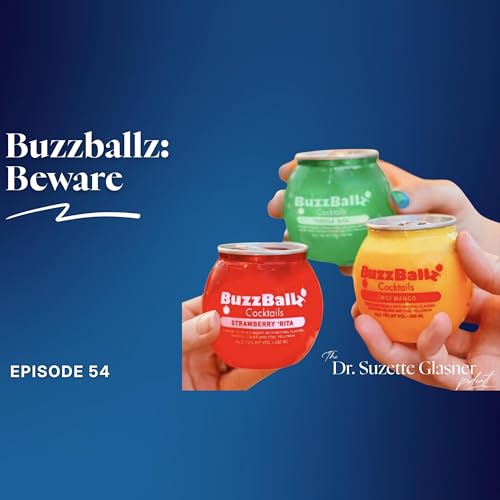
  • Ep. 54: BuzzBallz: A High-Risk Gen-Z Drinking Trend
    May 16 2026

    A 13-year-old in Sheffield asked her mother to add BuzzBallz to a New Year’s Eve shopping list last December. The mother — who runs a sobriety group for women — had never heard of them. Her daughter said, “All my friends are drinking them.”

    Today, BuzzBallz are a $500 million brand. The colorful, 15% ABV cocktails in plastic balls are the second-fastest-growing prepared cocktail brand in America, stocked in convenience stores, gas stations, and supermarkets nationwide. They are sweet, single-serve, cheap (under $5), and increasingly in the hands of underage drinkers.

    In this episode, clinical psychologist and addiction scientist Dr. Suzette Glasner explains why the design of these drinks is creating the perfect conditions for a particularly dangerous drinking practice that addiction researchers call high-intensity drinking — and what that means clinically for the teenagers and young adults consuming them.

    Watch the full episode here:

    Dr. Glasner walks through the standard-drink math first. A single 200 mL BuzzBall at 15% ABV contains roughly 1.7 standard drinks — nearly two drinks of alcohol in a single ball that looks like a piece of candy. The supersize line goes further: the “Biggies” deliver the alcohol equivalent of about 17 standard cans of beer in a single two-liter container, and the recently released “Boulders” approach 25 standard drinks in a single three-liter package. The TikTok chug challenge currently trending — where influencers drink three BuzzBallz in succession — delivers over five standard drinks rapidly, already at or above the binge drinking threshold for both women and men.

    She then introduces what addiction researchers call high-intensity drinking — consumption at two or more times the binge drinking threshold (8+ drinks for women, 10+ drinks for men in a single sitting).The episode then unpacks the clinical research on rapid drinking specifically. Dr. Glasner explains why drinking the same amount of alcohol quickly produces dramatically worse cognitive and motor impairment than drinking it slowly — and why this directly translates to elevated risk for impaired driving, injury, and alcohol use disorder progression. The format of BuzzBallz — colorful, sweet, easy to chug, and impossible to count accurately — actively defeats the harm-reduction strategies that work for traditional drinking.

    The episode closes with practical guidance: how parents can have an evidence-based conversation with a teenager about BuzzBallz, the warning signs that someone you love may be developing alcohol use disorder, and the evidence-based treatments available for adolescents and young adults.

    📋 Resources mentioned in this episode:

    🔗 NIAAA’s Rethinking Drinking — standard drink sizes, low-risk drinking guidelines, and free tools to track your drinking:

    https://rethinkingdrinking.niaaa.nih.gov

    🔗 NIAAA Treatment Navigator — find evidence-based alcohol treatment near you:

    https://alcoholtreatment.niaaa.nih.gov

    🔗 Dr. Glasner’s Addiction Recovery Skills Workbook — exercises for identifying triggers and pleasurable replacement activities, available on Amazon

    If you or someone you love is in crisis: 988 Suicide & Crisis Lifeline — call or text 988, or visit

    https://988lifeline.org

    SAMHSA National Helpline 1-800-662-HELP — 24/7, English and Spanish

    The Dr. Suzette Glasner Podcast brings clinical and addiction science to the mental health stories everyone is already discussing.

    📩 Questions or topic suggestions: AskDrGlasner@gmail.com

    🧩 More: https://drglasner.com


    This is a public episode. If you would like to discuss this with other subscribers or get access to bonus episodes, visit drglasner.substack.com
    Show More Show Less
    13 mins
  • Ep. 53: Beating Phone Addiction
    May 10 2026

    For most of the past decade, the conversation about phone and social media addiction has been stuck at a single question: is this real? In March, a California jury answered it. They found Meta and Google liable for designing addictive social media platforms that harmed a young user — the first time at this scale that the companies were ruled responsible for the addictive design choices baked into their products.

    In this episode, clinical psychologist and addiction scientist Dr. Suzette Glasner takes the question the verdicts have now opened — what do we actually do about it? — and answers it from inside the science and practice of addiction treatment.

    You can watch the full episode here:

    Phone addiction, Dr. Glasner argues, is clinically a behavioral addiction with striking similarities to drug and alcohol addiction. It is driven by the same variable reinforcement schedule that makes slot machines and methamphetamine so neurologically compelling, and the same therapeutic principles that work for substance use disorders apply directly to compulsive scrolling.

    She walks through evidence-based principles, drawn from the same framework she uses with patients in her private practice. Stimulus control — the family media plan, and why the bedroom and the dining room are the two highest-yield environments for restriction. Why content matters more than minutes — the role of intermittent variable reinforcement. The replacement principle — why removing the phone without replacing the reward fails, and how to match replacement activities to the specific function the phone was serving.

    And when self-management isn’t enough — what evidence-based treatment for behavioral addiction actually looks like, and how to recognize when phone overuse is masking depression, anxiety, ADHD, autism, body dysmorphic disorder, or trauma.

    She also reacts to recent public statements from Lara Trump on her household’s no-screens policy, Bill Gates on his decision not to give his own children phones until age 14, and Jonathan Haidt’s recommendations to keep screens out of bedrooms — translating each of these positions into actionable steps.

    Tools mentioned in the episode: Brick (https://getbrick.com) — physical app blocker. Freedom — phone internet blocking app. Bloom — screen time tool.

    Further reading:

    Brian X. Chen, Phone Addiction Remedies, New York Times Personal Tech, April 30, 2026.

    Jonathan Haidt, The Anxious Generation.

    Dr. Glasner’s Addiction Recovery Skills Workbook — available on Amazon.

    The Dr. Suzette Glasner Podcast brings clinical and addiction science to the mental health stories everyone is already discussing.

    📩 Questions or topic suggestions: AskDrGlasner@gmail.com

    🧩 More: https://drglasner.com


    This is a public episode. If you would like to discuss this with other subscribers or get access to bonus episodes, visit drglasner.substack.com
    Show More Show Less
    17 mins
  • Ep. 52: The Body Dysmorphia and Addiction Risk Behind Looksmaxxing
    May 3 2026

    Most of the coverage of the looksmaxxing trend has framed it as a viral aesthetic phenomenon. From the perspective of clinical psychologist and addiction scientist Dr. Suzette Glasner, it looks like something else: the convergence of two clinical pictures — body dysmorphic disorder and stimulant use disorder — repackaged in the language of self-optimization and delivered to adolescent boys at scale.

    In this episode, Dr. Glasner discusses what the trend actually is, clinically, tracing its core practices to the diagnostic criteria for BDD — a recognized mental health condition with an elevated suicide rate, typically beginning between ages 12 and 13, and just as common in men as in women. She summarizes what published research now shows about social media and BDD, including recent work on adolescents’ use of filters and self-image. And from an addiction perspective: how the looksmaxxing community’s normalization of anabolic steroids, SARMs, peptides, and amphetamines is creating a permission structure for stimulant use in early adolescence - and the overdose risk that comes with it.

    The Clavicular case is the entry point. The 20-year-old “looksmaxxing” influencer collapsed during a livestream in Miami this month in a suspected overdose, and afterward told followers that “all of the substances are just a cope trying to feel neurotypical while being in public.” That statement has important implications self-medication framing layered on top of a community-validated drug culture, in a young man whose audience includes thirteen-year-olds.

    You can watch the full episode here:

    Dr. Glasner closes with a summary of science-based treatments for BDD and stimulant addiction — and with internist Dr. Lucy McBride’s recent framework for evaluating health information from influencers, applied to the specific case of a 20-year-old livestreamer recommending hormones, stimulants, and off-label growth hormone to minors.

    If you or someone you love is in crisis: 988 Suicide & Crisis Lifeline — call or text 988, or visit

    https://988lifeline.org

    SAMHSA National Helpline (1-800-662-HELP) — 24/7, English and Spanish.

    Further reading:

    Loannou et al. (2024), #NoFilter: The impact of social media body dysmorphic disorder in adults, Mental Health Science.

    McBride, L. (2026), Yes, Credentials Do Matter, Maria Shriver’s Sunday Paper.

    The Dr. Suzette Glasner Podcast brings clinical and addiction science to the mental health stories everyone is already talking about.

    📩 Questions or topic suggestions: AskDrGlasner@gmail.com

    🧩 More: https://drglasner.com


    This is a public episode. If you would like to discuss this with other subscribers or get access to bonus episodes, visit drglasner.substack.com
    Show More Show Less
    20 mins
adbl_web_anon_alc_button_suppression_c
No reviews yet