

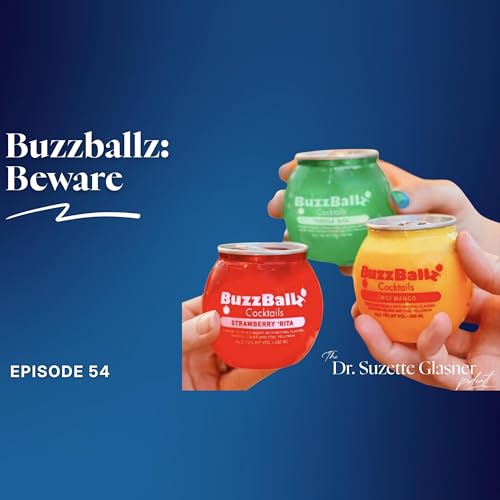
Ep. 54: BuzzBallz: A High-Risk Gen-Z Drinking Trend
Failed to add items
Add to basket failed.
Add to wishlist failed.
Remove from wishlist failed.
Adding to library failed
Follow podcast failed
Unfollow podcast failed

Ep. 54: BuzzBallz: A High-Risk Gen-Z Drinking Trend
-
Narrated by:
-
By:
Summary
A 13-year-old in Sheffield asked her mother to add BuzzBallz to a New Year’s Eve shopping list last December. The mother — who runs a sobriety group for women — had never heard of them. Her daughter said, “All my friends are drinking them.”
Today, BuzzBallz are a $500 million brand. The colorful, 15% ABV cocktails in plastic balls are the second-fastest-growing prepared cocktail brand in America, stocked in convenience stores, gas stations, and supermarkets nationwide. They are sweet, single-serve, cheap (under $5), and increasingly in the hands of underage drinkers.
In this episode, clinical psychologist and addiction scientist Dr. Suzette Glasner explains why the design of these drinks is creating the perfect conditions for a particularly dangerous drinking practice that addiction researchers call high-intensity drinking — and what that means clinically for the teenagers and young adults consuming them.
Watch the full episode here:
Dr. Glasner walks through the standard-drink math first. A single 200 mL BuzzBall at 15% ABV contains roughly 1.7 standard drinks — nearly two drinks of alcohol in a single ball that looks like a piece of candy. The supersize line goes further: the “Biggies” deliver the alcohol equivalent of about 17 standard cans of beer in a single two-liter container, and the recently released “Boulders” approach 25 standard drinks in a single three-liter package. The TikTok chug challenge currently trending — where influencers drink three BuzzBallz in succession — delivers over five standard drinks rapidly, already at or above the binge drinking threshold for both women and men.
She then introduces what addiction researchers call high-intensity drinking — consumption at two or more times the binge drinking threshold (8+ drinks for women, 10+ drinks for men in a single sitting).The episode then unpacks the clinical research on rapid drinking specifically. Dr. Glasner explains why drinking the same amount of alcohol quickly produces dramatically worse cognitive and motor impairment than drinking it slowly — and why this directly translates to elevated risk for impaired driving, injury, and alcohol use disorder progression. The format of BuzzBallz — colorful, sweet, easy to chug, and impossible to count accurately — actively defeats the harm-reduction strategies that work for traditional drinking.
The episode closes with practical guidance: how parents can have an evidence-based conversation with a teenager about BuzzBallz, the warning signs that someone you love may be developing alcohol use disorder, and the evidence-based treatments available for adolescents and young adults.
—
📋 Resources mentioned in this episode:
🔗 NIAAA’s Rethinking Drinking — standard drink sizes, low-risk drinking guidelines, and free tools to track your drinking:
https://rethinkingdrinking.niaaa.nih.gov
🔗 NIAAA Treatment Navigator — find evidence-based alcohol treatment near you:
https://alcoholtreatment.niaaa.nih.gov
🔗 Dr. Glasner’s Addiction Recovery Skills Workbook — exercises for identifying triggers and pleasurable replacement activities, available on Amazon
—
If you or someone you love is in crisis: 988 Suicide & Crisis Lifeline — call or text 988, or visit
https://988lifeline.org
SAMHSA National Helpline 1-800-662-HELP — 24/7, English and Spanish
—
The Dr. Suzette Glasner Podcast brings clinical and addiction science to the mental health stories everyone is already discussing.
📩 Questions or topic suggestions: AskDrGlasner@gmail.com
🧩 More: https://drglasner.com
This is a public episode. If you would like to discuss this with other subscribers or get access to bonus episodes, visit drglasner.substack.com