Episodes

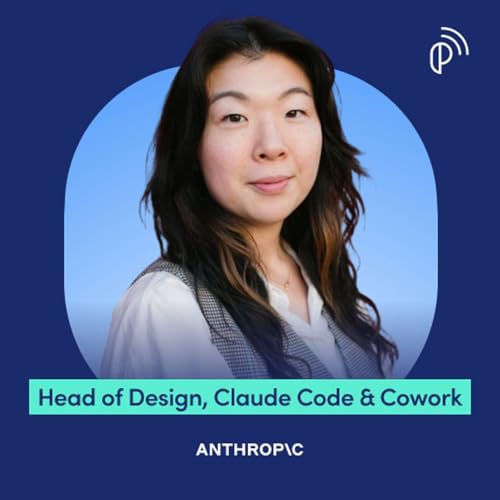
  • Anthropic Head of Design on Claude Code's Evolution from an Internal Feature into the Fastest-Growing Revenue Product in History | Meaghan Choi | E298
    Jun 3 2026

    Anthropic just closed a $65 billion Series H round at a valuation approaching one trillion dollars — and has crossed $30 billion in annualized revenue, driven largely by enterprise demand. Claude Code alone became generally available in May 2025 and reached $2.5 billion in annualized revenue in February 2026, with that figure more than doubling since the beginning of 2026.

    Meaghan Choi, Head of Design for Claude Code and Cowork at Anthropic, was in that room. This conversation goes inside the operating model behind that growth.

    What you'll learn:

    • Claude Code's evolution from an internal feature into one of the fastest-growing revenue products in history
    • Anthropic's secret sauce to shipping products at an incredibly high cadence while ensuring quality
    • How product teams get structured into small pods of 5 AI Builders and a fleet of agents, where non-engineers ship code into production
    • Driving enterprise adoption through PLG from technical teams
    • How organizations can measure AI ROI beyond AI adoption and token usage
    • Designing user interfaces for agentic capabilities, including CLI

    Key takeaways:

    • Titles and role boundaries matter less than contribution. At Anthropic, designers ship code and engineers design, and the pod owns the output collectively.
    • Quality gates have moved downstream. The richest product learnings come from working software, not from reviewing mocks or PRDs.
    • Managing a team now means managing both people and a fleet of AI agents. The skills are more similar than they appear.

    Credits:
    Host: Carlos Gonzalez de Villaumbrosia
    Guest: Meaghan Choi

    Social Links:

    • Find out more about Product School here
    • Follow our Podcast on TikTok here
    • Follow Product School on LinkedIn here


    Show More Show Less
    21 mins
  • The Lean Startup Author on New Book Incorruptible: Why Good Companies Go Bad and How Great Companies Stay Great | Eric Ries | E297
    May 26 2026

    Eric Ries wrote The Lean Startup — a book that has sold over 2 million copies and reshaped how a generation of founders and product teams build products. Fifteen years later, he's back with a new book, Incorruptible, and a harder question: not how to build a great company, but how to keep it that way.

    What you'll learn:

    • Why the forces destroying great companies are structural, not moral — and what that means for how you build
    • How Saul Price built FedMart, and Costco's Jim Sinegal each solved half the problem, and why you need both halves
    • How Anthropic used a purpose trust structure, the Long-Term Benefit Trust, to protect its safety mission from investor pressure
    • Why values on the wall fail and what the Johnson & Johnson asbestos scandal reveals about how incentives quietly overwrite principles
    • How builders at any level of an organization can start influencing governance without a title or authority

    Key takeaways:

    • Success makes you a target: the more valuable your company becomes, the more pressure it faces to betray the mission that made it valuable
    • Ethos is the real moat: the intangible system of principles that makes a company trustworthy is harder to copy than any product or contract
    • Governance is not a legal formality; it is the active, ongoing practice of protecting what you built from the forces that will try to extract it

    Credits:
    Host: Carlos Gonzalez de Villaumbrosia
    Guest: Eric Ries

    Social Links:

    • Find out more about Product School here
    • Follow our Podcast on TikTok here
    • Follow Product School on LinkedIn here


    Show More Show Less
    55 mins
  • Snowflake VP of AI on Why Enterprises Hide Behind Governance to Avoid Real AI Transformation | Baris Gultekin | E296
    May 13 2026

    Snowflake is the AI Data Cloud behind some of the world's largest enterprises — $4.68 billion in annual revenue, 29% year-over-year growth, and over 760 Forbes Global 2000 companies as customers. Baris Gultekin, VP of AI at Snowflake, leads the product efforts that sit at the center of how those enterprises actually operationalize AI. Before Snowflake, he co-founded Google Assistant and scaled it from 10 million to 500 million monthly users.

    What you'll learn:

    • Why our data isn't clean enough is a delay tactic — and the scoped approach to move past it
    • What the semantic layer is and how it lets AI answer business questions accurately, not just fluently
    • Why running AI next to data (instead of sending data to models) makes governance dramatically easier
    • How Snowflake deployed AI internally: a CEO-level non-optional mandate combined with bottom-up access to their own Cortex coding agent
    • Why context — not just data — is what agents need to operate reliably at enterprise scale

    Key takeaways:

    • Start with one scoped use case, build the semantic model around it, layer governance — don't wait for perfect data
    • Context is a shared reality for agents: unified data + business semantics + codified workflows
    • AI adoption compounds when leadership sets a hard mandate and simultaneously gives everyone a tool to experiment with

    Credits:
    Host: Carlos Gonzalez de Villaumbrosia
    Guest: Baris Gultekin

    Social Links:

    • Find out more about Product School here
    • Follow our Podcast on TikTok here
    • Follow Product School on LinkedIn here


    Show More Show Less
    27 mins
  • Superhuman Mail CEO on Rediscovering Product-Market Fit in the Age of AI, Renaming Post-Grammarly Acquisition & Competing against Google Workspace | Rahul Vohra | E295
    May 6 2026

    Superhuman Mail users respond to 72% more emails per hour and save an average of four hours every week — numbers backed by a case study from one of the Big Three strategy consulting firms. Rahul Vohra, CEO at Superhuman Mail, built the world's fastest email engine over three years without launching, held the line until the product was ready, and then productized product-market fit into a repeatable, measurable science. Following Superhuman's acquisition by Grammarly in 2025, Rahul is now steering the company toward a unified AI-native productivity suite spanning email, calendar, tasks, and agents.

    What you'll learn:

    • The 5-step PMF Engine: how to survey, segment, analyze, implement, and track your way to product-market fit with a numerical score
    • Why you should ignore the not disappointed and most somewhat disappointed users — and which signals actually tell you who to build for
    • How to use the High Expectation Customer (HXC) framework to narrow your market without changing your product
    • Why PMF is a moving target and how to defend it against commoditization and copy-cat competition
    • How Rahul operates as the editor of the product — using 20 verbatim quotes to push PMs and designers to sharper decisions

    Key takeaways:

    • If more than 40% of your users would be very disappointed without your product, you have an initial PMF — and you can measure your way there
    • Changing your market is faster than changing your product — segmentation alone can jump your PMF score 10 points overnight
    • Building for your highest-expectation customer is not the same as building for your ICP — confuse the two, and you'll optimize for the wrong signal

    Credits:
    Host: Carlos Gonzalez de Villaumbrosia
    Guest: Rahul Vohra

    Social Links:

    • Find out more about Product School here
    • Follow our Podcast on TikTok here
    • Follow Product School on LinkedIn here


    Show More Show Less
    50 mins
  • GoFundMe CPTO on Building Marketplaces Across StubHub, TheRealReal & GoFundMe | Arnie Katz | E294
    Apr 29 2026

    GoFundMe has facilitated over $40 billion in help since 2010, powering a community of more than 200 million people across 20 countries. Arnie Katz is the Chief Product and Technology Officer there — and a three-time CPTO, having previously led product and engineering at StubHub and TheRealReal. In this episode, he brings the rare perspective of someone who has built and scaled marketplaces at every stage, across multiple industries.

    What you'll learn:

    • The three failure modes every marketplace must solve — cold start, imbalance failure, and false positive growth — and how to fix each one
    • How GoFundMe is using AI agents to reduce friction for fundraisers, resulting in an expected $125 million in additional funds raised
    • Why AI is driving revenue growth at GoFundMe, not just developer productivity — and how they sequenced that deliberately
    • The real trade-offs of the CPTO model: what you gain in speed, and what you have to mitigate through hiring
    • How GoFundMe is building demand-side and matching mechanisms to grow donation volume beyond viral sharing

    Key takeaways:

    • Marketplace liquidity isn't just about having enough supply — it's about designing the right matching and demand mechanisms at every stage of scale
    • AI unlocks revenue opportunities that were previously uneconomical to pursue, especially when the customer is already in a vulnerable, high-friction state
    • The CPTO structure enables faster decision-making, but requires consciously strong functional leaders underneath to offset the natural lean toward one side

    Credits:
    Host: Carlos Gonzalez de Villaumbrosia
    Guest: Arnie Katz

    Social Links:

    • Find out more about Product School here
    • Follow our Podcast on TikTok here
    • Follow Product School on LinkedIn here


    Show More Show Less
    41 mins
  • Robinhood VP of Product on Prediction Markets, AI-Native Investing Tools, and Social Trading for the Next Generation | Abhishek Fatehpuria | E293
    Apr 22 2026

    Robinhood posted $4.5 billion in revenue in 2025, up 52% year-over-year, while growing its Gold subscriber base 58% to 4.2 million paid members. Abhishek Fatehpuria, VP of Product at Robinhood, joined the platform as an intern in 2016 and has built the brokerage business from a single-product equities app into a multi-product financial platform. This episode is a detailed look at how Robinhood structures product thinking at scale — without sacrificing the UX moat that made it win in the first place.

    What you'll learn:

    • How Robinhood uses two leading indicators, net deposits and Gold subscriptions, to measure long-term customer commitment before revenue shows up
    • Why treating legal and compliance partners as product owners, not blockers, is the unlock for shipping fast in a regulated market
    • The "barbell strategy" for UX: design for the newest user and the most advanced user simultaneously, and let the middle take care of itself
    • How the early-stage ideation sprint has compressed from 4–5 weeks to 2–3 days with AI tools
    • Why Robinhood Social is built on verified identity and real trades — and what that unlocks for the future of retail investor relations


    Key takeaways:

    • Paid subscriptions aren't just a revenue line — they're the connective tissue that drives multi-product adoption across a platform
    • Pride is a scalable quality standard: when teams enforce it themselves, quality and speed stop being in conflict
    • AI embedded into workflows moves faster than AI bolted on as a standalone feature

    Credits:
    Host: Carlos Gonzalez de Villaumbrosia
    Guest: Abhishek Fatehpuria

    Social Links:

    • Find out more about Product School here
    • Follow our Podcast on TikTok here
    • Follow Product School on LinkedIn here


    Show More Show Less
    38 mins
  • Zoom CPO on Rebuilding the Future of Work Collaboration with Agentic AI — From Meeting Transcripts and Recordings to a System of Action | Jeff Smith | E292
    Apr 15 2026

    Zoom generates $4.87B in annual revenue and powers modern work for hundreds of millions of users worldwide. In this episode, Carlos González de Villaumbrosia, CEO at Product School, sits down with Jeff Smith, Chief Product Officer at Zoom.
    Jeff joined Zoom in 2019 and has led product through three distinct eras — COVID hypergrowth, multi-product expansion, and the current agentic AI shift. In this conversation, he breaks down what actually changes when AI becomes core infrastructure for how teams work.

    What you'll learn:

    • How Zoom tripled headcount in under a year during COVID and what breaks at that scale
    • Why expanding into mail, calendar, and documents was never about copying Google or Microsoft — it was about owning the full work lifecycle around meetings
    • How AI Companion 3.0 performs agentic retrieval across first- and third-party tools to surface insights and produce work product from a single prompt
    • Why MCP and open integrations are non-negotiable when you can't afford to be siloed
    • How to move from personal AI productivity gains to real, measurable business outcomes


    Key takeaways:

    • When engineering velocity is abundant, strategic direction becomes the scarce resource
    • The right engagement metric isn't more meetings — it's whether users produced something valuable as a result
    • Agentic AI is the first real opportunity to disrupt entrenched productivity tools that switching costs have protected for decades

    Credits:
    Host: Carlos Gonzalez de Villaumbrosia
    Guest: Jeff Smith


    Social Links:

    • Find out more about Product School here
    • Follow our Podcast on TikTok here
    • Follow Product School on LinkedIn here


    Show More Show Less
    36 mins
  • TikTok VP of Product on Turning Video-First Feeds into a Full E-Commerce Platform | David Kaufman | E291
    Apr 8 2026

    TikTok has officially crossed 200 million monthly active users in the US — but the real story is what they've built underneath the surface.

    In this episode, Carlos González de Villaumbrosia, CEO at Product School, sits down with David Kaufman, Vice President of Product at TikTok, to go deep on the platform's transformation into a full end-to-end commerce engine. David breaks down how TikTok is using AI to automate everything from creative generation to affiliate-based promotion — so merchants can upload a catalog and let the platform handle the rest.

    If you want to understand where social commerce is heading, this one is essential listening.

    What you'll learn:

    • Why removing steps from the purchase funnel is the single biggest growth lever for modern product teams.
    • How TikTok's generative AI tools allow merchants to produce high-performing video creative at scale without a production team.
    • The shift from spontaneous live streams to scheduled commercial events driving $1M per hour in sales.
    • How TikTok balances feed, commerce, search, and messaging as four distinct monetization pillars.

    Key takeaways:

    • The most successful products in the AI era put the user directly at the point of transaction.
    • Organic creator content consistently outperforms traditional high-production advertising.
    • A long-tail creator ecosystem can promote a 100,000-item catalog automatically through affiliate-based commission.

    Credits:
    Host: Carlos Gonzalez de Villaumbrosia
    Guest: David Kaufman

    Social Links:

    • Find out more about Product School here
    • Follow our Podcast on TikTok here
    • Follow Product School on LinkedIn here


    Show More Show Less
    41 mins