SoCCC Pre-Rounds: Bite-Sized Critical Care Cardiology Topics Delivered By Experts cover art

SoCCC Pre-Rounds: Bite-Sized Critical Care Cardiology Topics Delivered By Experts

SoCCC Pre-Rounds: Bite-Sized Critical Care Cardiology Topics Delivered By Experts

By: Dr. Balim Senman Dr. Elliott Miller Dr. Simon Parlow Dr. Anthony Carnicelli
Listen for free

SoCCC Pre-Rounds is your go-to for quick, high-yield insights in critical care cardiology, hosted by members of the Society of Critical Care Cardiology (SoCCC). With only 160 specialists in the U.S., mentorship is rare. This podcast bridges the gap with bite-sized episodes featuring clinical pearls, expert tips, and real-world answers on topics like cardiogenic shock, ECMO, and resuscitation. Perfect for pre-rounds, night shifts, or leveling up anytime. Listen in. Level up. Join the SoCCC community.Dr. Balim Senman, Dr. Elliott Miller, Dr. Simon Parlow, Dr. Anthony Carnicelli Hygiene & Healthy Living Physical Illness & Disease
Episodes
  • The Story of DanGer Shock and the Future of the Microaxial Flow Pump with Dr. Jacob Møller
    Jun 5 2026
    After more than two decades without a major positive randomized trial in cardiogenic shock, is the evidence finally catching up to the technology? In this episode of SoCCC Pre-Rounds, Dr. Simon Parlow sits down with Dr. Jacob Møller, critical care cardiologist and professor at the University Hospital Copenhagen, to unpack microaxial flow pumps and the landmark DanGer Shock trial. Dr. Møller shares how persistence, collaboration, and a bit of luck helped drive a breakthrough in a field that has long needed one.They explore how these devices work at the bedside, from unloading the left ventricle to reducing myocardial oxygen demand, and what that means in real-world care. The conversation also dives into the challenges of running a high-stakes trial in critically ill patients, along with practical insights on patient selection, complications, lactate trends, and weaning strategies. It’s a sharp look at one of the most important recent advances in cardiogenic shock and where clinicians are still forced to operate without clear evidence.Microaxial flow pumps unload the left ventricle: By reducing preload and stroke work, they may lower myocardial oxygen demand and support recovery in shock states.The DanGer Shock trial changes the landscape: It’s the first major positive randomized trial in cardiogenic shock in over 20 years, targeting a highly selected STEMI population.Patient selection is everything: Only a small fraction of shock patients were eligible, highlighting how precise clinicians must be when applying this therapy.Weaning starts earlier than we thought: The most critical window may be the first 12–24 hours, with earlier reassessment for device removal.Evidence is still evolving: Outside of trial populations, clinicians must rely on judgment when considering use in non-STEMI or non-ischemic shock.[00:00] Introduction to SoCCC Pre-Rounds[00:57] Live from ACVC 2026: introducing Dr. Jacob Møller[01:15] What are micro axial flow pumps and how do they work?[03:52] The origin and evolution of the DanGer Shock trial[06:39] Trial results and why they were unexpected[07:48] Expanding beyond STEMI: real-world patient selection[09:44] Monitoring patients: lactate and hemodynamic trends[10:20] Early management challenges and complications[11:36] Rethinking weaning strategies[12:05] Role of guideline-directed therapy during support[12:57] Lessons from running a major clinical trial[14:03] Building a research culture in critical care[07:51] "After seeing the results of DanGer, we have probably become a little bit more liberal in using the device in other forms of ischemic, like non-STEMI shock." — Dr. Jacob Møller[09:46] "We look at trajectories, and we look a lot at lactate. Lactate has to go down in these patients; otherwise, something is wrong." — Dr. Jacob Møller[10:33] "You look at the trajectory, so if it goes from 1.5 and starts going down, then you know there's something wrong." — Dr. Jacob Møller[13:57] "I'm working in a very small cardiac ICU; we only have seven beds, but we randomized more than 100 patients with out-of-hospital cardiac arrest every year." — Dr. Jacob MøllerBecome a member of the Community: https://www.soccc.org/subscribeDr. Jacob Møllerhttps://www.linkedin.com/in/jacob-eifer-m%C3%B8ller-1b2398300/?locale=enhttps://www.rigshospitalet.dk/Dr. Simon Parlowhttps://www.ottawaheart.ca/profile/parlow-simonSupported By:This episode is made possible by unrestricted support from Zoll LifeVest — thanks for keeping high-impact education free for our community.DisclaimerThis podcast is not medical advice, just candid, practical discussions about what your hosts do every day in the CICU. Always consult your supervising team and current guidelines before applying any interventions.
    Show More Show Less
    15 mins
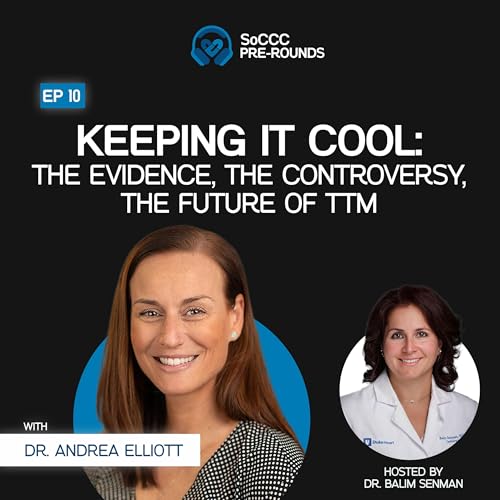
  • Keeping It Cool: The Evidence, the Controversy, the Future of TTM with Dr. Andrea Elliott
    May 1 2026
    In this episode of SoCCC Pre-Rounds, Dr. Balim Senman and Dr. Andrea Elliott, a cardiologist and critical care physician at the University of Minnesota, dive into the evolving landscape of targeted temperature management (TTM) after cardiac arrest. They explore how temperature control strategies have shifted from early hypothermia trials to modern fever-avoidance methods, with ongoing debates around TTM in critical care. Dr. Elliott discusses landmark studies like Bernard, HACA, TTM, Hyperion, and TTM2, highlighting their impact and limitations.The conversation delves into the real-world application of temperature targets, considering patient severity, neurologic injury, and the unique challenges posed by ECPR patients. Dr. Elliott also covers the physiological costs of hypothermia, common complications, and practical aspects of managing shivering, devices, and protocols. Whether you're a trainee or an experienced clinician, this episode offers evidence-based insights and practical guidance for optimizing post-arrest care.TTM is for comatose survivors: Only patients who remain unresponsive after ROSC benefit; awake patients do not.Fever prevention matters most: Trial data on hypothermia vs normothermia are mixed, but fever (>37.7°C) is consistently harmful and must be aggressively avoided.One size does not fit all: Patients with longer downtimes or more severe neurologic injury may benefit more from active cooling. Allowing spontaneous hypothermia is reasonable.ECPR patients are different: Prolonged CPR and ECMO-based temperature control make them physiologically distinct from patients in major TTM trials.In This Episode[00:00] Introduction[02:16] Historical background of TTM[03:13] Early human studies and mechanisms[04:17] Landmark trials Bernard and HACA[06:06] TM1 Hyperion and TM2 trials[10:25] Patient selection for TTM[11:39] Personalized temperature targeting[13:21] Management of hypothermic and normothermic patients[15:47] TTM in ECPR and ECMO patients[18:09] Drawbacks and risks of hypothermia[19:19] Protocols and cooling devices[21:59] ECPR-specific cooling techniquesNotable Quotes[16:04] "ECPR patients by definition have had refractory arrest, not attaining ROSC. So that 20- 25 minute time is blown out of the water. Our ECPR population has an average of 60 minutes of CPR time, so more than double. So the time for that neurologic injury is extensive." — Dr. Andrea Elliott[18:43] "You can actually get into trouble if with some under-resuscitation and some patients, if you get them too cold too quickly, and so you'll have to give extra volume back."— Dr. Andrea Elliott[22:37] "The most important thing is to make sure that you avoid fevers in our ECPR patients. We also use cooling towers, so we basically cool the fluid or the blood that is in the tubing outside of the patient so that it goes through a cooling bath."— Dr. Andrea ElliottResources and LinksBecome a member of the Community: https://www.soccc.org/subscribeDr. Andrea Elliotthttps://med.umn.edu/bio/andrea-elliotthttps://www.linkedin.com/in/andrea-elliott-5575b4267/Dr. Balim Senmanhttps://www.linkedin.com/in/balim-senman-7561436b/https://x.com/BalimSenmanMDhttps://www.soccc.org/Supported By:This episode is made possible by unrestricted support from Zoll LifeVest — thanks for keeping high-impact education free for our community.DisclaimerThis podcast is not medical advice, just candid, practical discussions about what your hosts do every day in the CICU. Always consult your supervising team and current guidelines before applying any interventions.
    Show More Show Less
    22 mins
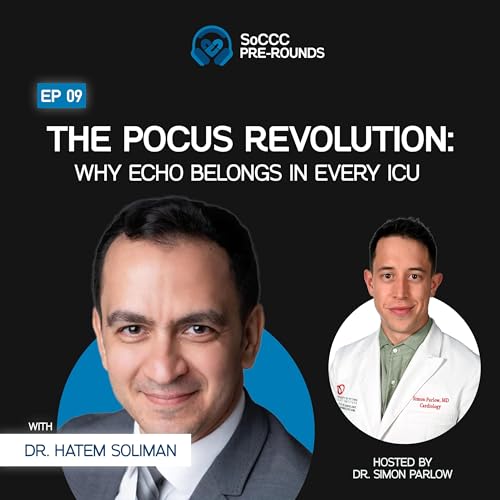
  • The POCUS Revolution: Why Echo Belongs in Every ICU with Dr. Hatem Soliman
    Apr 3 2026
    In this episode of SoCCC Pre-Rounds, Dr. Simon Parlow is joined by Dr. Hatem Soliman, a leading expert in critical care echocardiography, for a deep dive into the game-changing role of point-of-care ultrasound or POCUS in resuscitation and cardiac intensive care.Together, they unpack how resuscitative echocardiography can help identify reversible causes of cardiac arrest, like pericardial tamponade or tension pneumothorax, and even guide real-time chest compression placement to improve CPR effectiveness.Dr. Soliman highlights two must-have views: the apical five-chamber for stroke volume and the short-axis great vessels view to assess RV function and pulmonary pressures.If you're looking to sharpen your bedside skills and bring more precision to your resuscitation toolkit, this episode is packed with insights you won’t want to miss.Key TakeawaysMove beyond the IVC: Hepatic, portal, and renal vein Doppler give a clearer picture of systemic venous congestion than IVC alone.Cardiac output needs context: Doppler VTI can mislead unless combined with views like apical five-chamber and timing indices like isovolumetric contraction time.Every echo parameter has a pitfall: Never interpret one measure in isolation; always integrate findings with clinical judgment.His go-to views in shock? Apical 5 chamber (LVOT VTI) and parasternal short axis of great vessels (PA flow) to assess perfusion and RV afterload.In This Episode[00:00] Introduction to the podcast[02:24] Role of echo in cardiac arrest[03:43] Training and cautions with echo in CPR[06:19] Key skills for new trainees in critical care echo[07:33] Physiological assessment in critical care echo[09:21] Multi-organ ultrasound and venous congestion[11:45] Systemic venous congestion in post-ICU patients[12:18] Comprehensive cardiac output assessment[15:50] Pitfalls and dangers of critical care POCUS[17:18] Favorite echo views in cardiac ICUNotable Quotes[06:33] "Critical care echo is actually complex... you need to further proceed from this basic level to intermediate and then advanced levels in which you will be able to assess physiological changes in the heart." — Dr. Hatem Soliman[09:22] "The practice of multi-organ ultrasound and looking beyond the chest cavity for congestion is a very important advancement in point-of-care ultrasound." —Dr. Hatem Soliman[17:24] "If I have two views to look at in a very short time... the apical five chamber view to get the LVO TVTI because that immediately gives you a clue about stroke volume and cardiac output." — Dr. Hatem SolimanDr. Hatem SolimanDr. Hatem Soliman is a cardiac intensivist at Harefield Hospital and senior lecturer at King’s College London. He serves on the executive board of the European Association of Cardiovascular Imaging and the editorial board of JACC: Cardiovascular Imaging. A global educator and author of key POCUS textbooks, Dr. Suleiman is renowned for advancing the use of bedside echocardiography in critical care to improve hemodynamic assessment and patient outcomes.Resources and LinksBecome a member of the Community: https://www.soccc.org/subscribeDr. Hatem Solimanhttps://www.escardio.org/https://www.linkedin.com/in/hatemsoliman/Dr. Simon Parlowhttps://www.ottawaheart.ca/profile/parlow-simonMentioned Doyen A. et al. Portal Doppler Ultrasound in Congestion Assessment (André Denault’s work)JACC Imaging, Journal of Cardiovascular UltrasoundEuropean & American Resuscitation GuidelinesSupported By:This episode is made possible by unrestricted support from Zoll LifeVest — thanks for keeping high-impact education free for our community.DisclaimerThis podcast is not medical advice, just candid, practical discussions about what your hosts do every day in the CICU. Always consult your supervising team and current guidelines before applying any interventions.
    Show More Show Less
    19 mins
adbl_web_anon_alc_button_suppression_t1
No reviews yet