• Israel, America, and the Ahmadinejad Option
    Jul 13 2026

    What if one of Israel's greatest enemies suddenly became part of a plan to reshape Iran?

    A remarkable report from The New York Times claims that Israel and the United States explored the possibility of former Iranian President Mahmoud Ahmadinejad playing a role in a post-Islamic Republic transition.

    In this episode of Middle East Brief with Avi Kaner, I examine:

    • Why Ahmadinejad, a Holocaust denier and longtime adversary of Israel, was considered as a possible transitional figure.
    • The strategic challenge of removing a regime without creating chaos.
    • Lessons from Iraq and other attempts at regime change.
    • Whether intelligence agencies sometimes have to work with deeply flawed individuals to achieve a larger objective.
    • The difference between military victory and political transition.
    • Why legitimacy, not military power alone, ultimately determines whether a new government can survive.

    This episode isn't about defending or condemning the reported plan. It's about exploring one of the oldest dilemmas in statecraft:

    When confronting a dangerous regime, how far should democracies go - and who, if anyone, should help build what comes next?

    Middle East Brief with Avi Kaner delivers historical context, geopolitical analysis, and thoughtful conversations on the events shaping Israel, the Middle East, and the world.

    Show More Show Less
    11 mins
  • The Bazaar Is Closed: Trump's Message to Iran
    Jul 8 2026

    A few weeks ago, I introduced what I called "The Bazaar Strategy" - the idea that President Donald Trump's negotiating style mirrors the bargaining culture of a Middle Eastern marketplace: maximum pressure, strategic unpredictability, and always leaving room for a deal.

    Has that strategy now reached its limit?

    In this episode of Middle East Brief with Avi Kaner, I examine President Trump's latest remarks from Türkiye, where he declared, "I think it's over," describing the Iranian regime as "liars," "cheats," and "sick people," while questioning whether any future agreement is possible.

    Has the negotiation truly ended, or is this simply another chapter in a high-stakes strategy?

    Join me as we examine one of the most consequential shifts in U.S.-Iran relations - and what it could mean for Israel, the Middle East, and the wider world.

    Middle East Brief with Avi Kaner delivers concise historical context and geopolitical analysis on the events shaping Israel, the Middle East, and global affairs.

    Show More Show Less
    8 mins
  • October 7: Israel Deserves the Truth
    Jul 7 2026

    Nearly three years after the October 7 massacre, Israel still has not established a truly independent national commission of inquiry.

    Instead, the Knesset has advanced legislation to create a politically appointed commission.

    Should a government investigate itself?

    In this episode of Middle East Brief with Avi Kaner, Avi argues that the victims, the hostages, the families of fallen Israeli soldiers, and every Israeli citizen deserve an independent, impartial investigation that follows the evidence wherever it leads.

    The episode examines:

    • Why an independent commission is essential to a healthy democracy
    • The political divisions, judicial reform protests, and internal turmoil that gripped Israel before October 7
    • Questions about intelligence sharing, warning signs, and military preparedness
    • Lessons from Israel's own Agranat, Kahan, and Winograd Commissions
    • International examples, including the U.S. 9/11 Commission and other independent national inquiries
    • Why delaying an investigation risks losing evidence, fading memories, and eroding public trust

    This episode is not about assigning political blame. It is about ensuring that Israel learns every possible lesson from the darkest day in its history and honors those who paid the ultimate price by seeking the truth.

    Middle East Brief with Avi Kaner delivers thoughtful analysis of Israel, the Middle East, and the geopolitical events shaping our world through historical context and informed discussion.

    Show More Show Less
    10 mins
  • The Evian Conference: When the World Closed Its Doors
    Jul 6 2026

    On July 6, 1938, representatives from 32 nations gathered in Evian-les-Bains, France, to address the growing refugee crisis as Jews desperately sought to flee Nazi Germany and Austria.

    The world expressed sympathy.

    But when it came time to act, almost every nation refused to open its doors.

    In this episode of Middle East Brief with Avi Kaner, we examine one of history's greatest diplomatic failures and explain why the Evian Conference became a defining moment in modern Jewish history.

    Topics include:

    • Why the Evian Conference was convened
    • The worsening persecution of Jews before World War II
    • Which countries refused to accept Jewish refugees—and why
    • The Dominican Republic's unique offer to welcome refugees
    • How the conference emboldened Nazi Germany
    • The connection between Evian and the founding of the State of Israel
    • Why Israel's Law of Return remains central to Jewish self-determination today

    The Evian Conference is more than a forgotten historical event. It is a powerful reminder that compassion without action can carry unimaginable consequences—and why the Jewish people concluded they must always have a homeland capable of protecting its own.

    Middle East Brief with Avi Kaner explores the history, geopolitics, and current events shaping Israel and the Middle East through historical context and informed analysis.

    Show More Show Less
    5 mins
  • The Forgotten History of Palestinian Workers in Israel
    Jul 2 2026

    For decades, hundreds of thousands of Israelis and Palestinians interacted every day - not across battle lines, but in workplaces.

    Before the First Intifada, nearly 40% of the Palestinian workforce in the West Bank and Gaza was employed inside Israel. By the late 1990s, 140,000 Palestinians worked in Israel, contributing to both the Israeli and Palestinian economies.

    So what changed?

    In this episode of Middle East Brief with Avi Kaner, we trace the history of Palestinian employment in Israel and explain how decades of economic integration gradually gave way to security separation following waves of terrorism.

    A thoughtful look at how security, economics, and trust have shaped one of the most important, and often misunderstood, aspects of the Israeli-Palestinian conflict.

    Middle East Brief with Avi Kaner explores the history, geopolitics, and current events shaping Israel and the Middle East through historical context and informed analysis.

    Show More Show Less
    8 mins
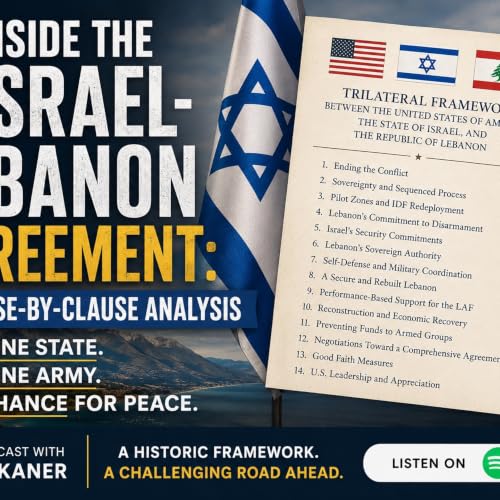
  • Inside the Israel-Lebanon Agreement: A Clause-by-Clause Analysis
    Jun 28 2026

    Israel and Lebanon have signed a historic framework agreement that could eventually end nearly eight decades of conflict.

    But what does the agreement actually say?

    In this episode of Middle East Brief with Avi Kaner, we walk through all 14 clauses of the agreement, explaining what each provision means, why it matters, and what it could mean for the future of Israel, Lebanon, and the broader Middle East.

    Topics include:

    • The declaration to end the state of war
    • Why this is more than a ceasefire
    • Lebanon's commitment to one government and one army
    • The plan to disarm Hezbollah and restore Lebanese sovereignty
    • Israel's pledge that it has no territorial ambitions in Lebanon
    • The U.S. role in verification, reconstruction, and implementation
    • Why reconstruction funding is tied to measurable progress
    • The agreement's biggest strengths - and its biggest risks
    • Whether this framework can truly bring lasting peace

    A deep dive into one of the most consequential diplomatic agreements in the Middle East in decades.

    Show More Show Less
    9 mins
  • The Armenian Genocide: Why Now?
    Jun 26 2026

    For nearly eighty years, Israel stopped short of officially recognizing the Armenian Genocide, despite broad historical consensus that approximately 1.5 million Armenians were systematically murdered by the Ottoman Empire during World War I.

    In this episode of Middle East Brief with Avi Kaner, Avi explores the history of the Armenian Genocide, why Israel delayed recognition for decades, and what has changed politically and strategically.

    He examines Israel's past relationships with Turkey and Azerbaijan, the growing deterioration in Israel-Turkey relations, and why Foreign Minister Gideon Sa'ar now calls recognition a moral and historical duty.

    The episode also explores which countries have recognized the Armenian Genocide, which have not, and how geopolitics has often influenced historical recognition.

    Finally, Avi discusses why the word "genocide" carries extraordinary legal and moral weight, why precision in its use matters, and how remembering one genocide strengthens, rather than diminishes, the universal promise of "Never Again."

    Middle East Brief with Avi Kaner provides thoughtful analysis of Israel, the Middle East, history, diplomacy, and current events.

    Show More Show Less
    8 mins
  • The UN's Latest Blood Libel Against Israel
    Jun 24 2026

    A new United Nations report accuses Israel of deliberately targeting Palestinian children and committing some of the gravest violations of international law.

    Within hours, the allegations spread across global media outlets, political circles, universities, NGOs, and social media platforms.

    But how was the report compiled?

    Who supplied the information?

    What role did Hamas-controlled institutions play?

    And why do many Israelis view reports like this with profound skepticism?

    In this episode, Avi Kaner examines the UN report's methodology, sourcing, conclusions, and broader implications for public opinion and international diplomacy.

    Topics include:

    • The UN's accusations against Israel
    • The role of the Independent International Commission of Inquiry
    • The UN Human Rights Council's unique treatment of Israel
    • The Palestinian Authority's absence from Gaza since 2007
    • Hamas control of Gaza's ministries and institutions
    • Claims regarding child casualties, hospitals, and humanitarian conditions
    • Israel's official responses and denials
    • How mainstream media often amplifies UN findings as established fact

    A discussion about evidence, bias, media amplification, and the responsibility of international institutions.

    Show More Show Less
    10 mins