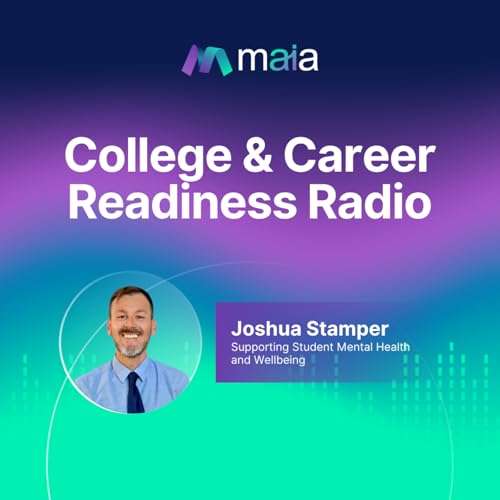
College & Career Readiness Radio cover art

College & Career Readiness Radio

College & Career Readiness Radio

By: T.J. Vari
Listen for free

College & Career Readiness Radio with T.J. Vari

A podcast about all things career and college readiness. Brought to you by MaiaLearning.

MaiaLearning Inc. 2024
Episodes
  • Supporting Student Mental Health and Wellbeing with Joshua Stamper
    Jun 9 2026

    Our guest for this episode of College & Career Readiness Radio is Joshua Stamper, author of The Language of Behavior.

    Josh says that student behavior should be read as communication, not just defiance, because students often signal unmet needs, stress, or trauma through what they do in class.

    He explains that many behavior issues start when students are in survival mode, which makes it hard for them to regulate emotions, listen, or hold a conversation.

    Stamper says educators should first consider the environment, since classroom setup, wall clutter, furniture placement, and other sensory factors can make students feel unsafe or overstimulated.

    He notes that the second step is exploring the breakdown, meaning adults should identify what a behavior might actually be communicating instead of assuming it is simple disruption or boredom.

    Stamper argues that responding intentionally means using consequences that match the behavior, helping the student take ownership, teaching the replacement skill, and avoiding punishments that only increase fear.

    He describes check-ins as a practical way to track student well-being over time and catch changes in baseline before problems escalate.

    Josh tells listeners that trusted adult relationships are essential, because students are more likely to disclose hard situations and accept help when they feel safe with someone at school.

    He notes that counselors and schools should use data, in-person check-ins, and follow-up conversations to respond early when a student’s baseline shifts.

    Stamper says students also need direct teaching about their brains, emotions, and self-regulation so they can build control and coping skills for school and life.

    He connects this work to post-secondary readiness, saying students need durable life skills like empathy, communication, relationship-building, and stress management to succeed in college, careers, and adulthood.

    His closing message is that schools should ask whether they truly treat behavior as communication, and if so, respond with compassion, empathy, and a focus on decoding student needs.

    "The best way to get knowledge to the brain is through the heart." ~ Joshua Stamper

    This episode of College & Career Readiness Radio is brought to you by MaiaLearning, a fully comprehensive college and career readiness platform. If you want a demo of the features of MaiaLearning that support what was discussed in this episode, including wellbeing assessments, data collection, and student flourishing results, schedule your demo today.

    Show More Show Less
    28 mins
  • Solving and Dissolving School and Community Problems with Frank Polen
    May 26 2026

    Our guest for this episode of College & Career Readiness Radio is Frank Polen, assistant superintendent and director of adult education at the Buckeye Career Center in Ohio.

    Frank explains that Buckeye Career Center is a joint vocational school district and a career technical planning district serving 11 partner schools across three counties. Students can complete academics and career-technical training in one place, and the center also serves open-enrolled, homeschool, and digital academy students.

    He highlights Buckeye's flexible pathways for students, including full academics, lab time, credit-plus options, online coursework, and school-to-work opportunities. He emphasizes that students can earn industry credentials, graduate early, work in their field, or continue into more training and college credit.

    Frank stresses that CTE and college are not competing ideas. His view is that “training is for everybody,” and that education should be treated as a long-term pathway with multiple on-ramps and off-ramps.

    He describes the need for strong articulation between high school, adult programs, and higher education. He points to credit opportunities through certifications and industry credentials that can apply toward associate degrees and beyond.

    Frank says that workforce shortages are best addressed through collaboration, not silos. In his region, educators, business leaders, economic developers, legislators, and higher education partners work together through an industry sector partnership and a Civic Lab initiative to solve manufacturing and healthcare labor gaps.

    Polen also emphasizes the importance of a dedicated point person, clear goals, and regular meetings to keep problem-solving moving. He says the goal is not just to solve workforce problems, but to dissolve them through long-term, community-based action.

    Frank closes with a simple message: “We’re all in this together.” He encourages leaders to connect with one another, build teams, and keep finding ways to say yes for students and communities.

    College & Career Readiness Radio is brought to you by MaiaLearning--a completely comprehensive college and career readiness platform. Schedule your demo today.

    Show More Show Less
    27 mins
  • If Kids Can See It, They Can Be It with Marlon Styles
    May 12 2026

    In this episode of College & Career Readiness Radio, Dr. TJ Vari sits down with Marlon Styles to discuss how schools can build stronger connections between students, business partners, and future careers. Marlon shares how his district reimagined career exploration through the Ready Now 100 initiative and why early, meaningful exposure matters for every student.

    Marlon explains that the work began with a simple but powerful idea: if kids can see it, they can be it. Through Ready Now 100, the district created a “Passport to Tomorrow” model that gave students access to career-based experiences from kindergarten through high school, with the goal of helping them see themselves in future career clusters and build the skills to thrive.

    A major theme of the conversation is partnership. Marlon describes how the district worked with business and community partners not just for funding, but for human capital—employees, experts, facilities, and real-world experiences that students could engage with both inside and outside school. He also shares how small-group meetings, follow-up conversations, and clear communication helped build trust and secure long-term support.

    The episode also explores accountability and student agency. Marlon explains that students created portfolio artifacts to show what they learned and to reflect on their interests, confidence, and growth. He emphasizes that career exposure at younger ages helps students become more self-aware and can even drive academic engagement by connecting classroom learning to future goals.

    Finally, Marlon reminds listeners that this kind of work cannot be done alone. Schools of any size or setting can build strong partnerships by taking an asset-based approach and inviting community organizations to co-create opportunities for students.

    Guest takeaway: If kids can see it, they can be it—and every student deserves access to adults and experiences that help them imagine and pursue their future.

    College & Career Readiness Radio is brought to you by MaiaLearning.

    Show More Show Less
    38 mins
adbl_web_anon_alc_button_suppression_t1
No reviews yet