Wait! That Actually Happened? cover art

Wait! That Actually Happened?

Wait! That Actually Happened?

By: Daniel P. Douglas
Listen for free

Podcast about history's most unbelievable true stories. From wars against birds to dancing plagues, discover the absurd events your teacher never mentioned.

authordanielpdouglas.substack.comDaniel P. Douglas
Social Sciences World
Episodes
  • The Great Canadian Maple Syrup Heist
    Jun 7 2026
    The Barrel That WobbledIn July of 2012, a man named Michel Gauvreau climbed a stack of barrels inside a giant warehouse in Quebec, Canada. His job was simple. Count the barrels. Make sure the numbers matched the records.The warehouse held maple syrup. Thousands and thousands of barrels of it. Each full barrel weighed about 620 pounds. That is heavier than a refrigerator. Much heavier. These barrels did not move. They just sat there, stacked high, full of sweet amber syrup worth a fortune.So when Gauvreau put his weight on one of the barrels, he expected it to be solid as a rock.Instead, it wobbled.He stopped. That was wrong. A full barrel of syrup does not wobble. He knocked on the side of it. Instead of a dull thud, he heard a hollow echo, like banging on an empty drum.He opened it up.The barrel was empty.He checked another one. Empty. He checked a third. This one was full, but not with syrup. It was full of water.Michel Gauvreau had just stumbled onto one of the strangest burglaries in history. Over many months, thieves had quietly drained millions of dollars worth of maple syrup from this warehouse, one barrel at a time, and almost nobody had noticed.Welcome to the ShowYou are listening to Wait, That Actually Happened?, the podcast where we prove history is stranger than fiction. I am your host, author Daniel P. Douglas, and today we are heading to Quebec for a crime that sounds made up but is completely real.This is the story of the Great Canadian Maple Syrup Heist. It has a secret reserve most people never knew existed. It has a gang of thieves with trucks and hoses. It has 18 million dollars worth of syrup vanishing into thin air. And yes, it really happened.So grab a stack of pancakes and settle in.Canada Has a Strategic Maple Syrup ReserveTo understand this heist, you first need to know one wild fact. Canada has a strategic reserve of maple syrup.You have probably heard of the strategic oil reserve. Countries keep huge stores of oil tucked away in case of an emergency. Well, the province of Quebec does the same thing with maple syrup.Here is why. Quebec is the maple syrup capital of the world. The province makes about 70 percent of all the maple syrup on Earth. That is a giant chunk of a global business. So a group called the Federation of Quebec Maple Syrup Producers decided to take control of the whole thing.The Federation works almost like a club that every syrup farmer has to join. It sets the price of syrup. It tells farmers how much they are allowed to sell each year. Some people even called it a syrup cartel, like an oil cartel, but for breakfast food.Now, maple trees do not cooperate with this plan. Some years they make tons of syrup. Other years they barely make any. It all depends on the weather.So the Federation built a strategic reserve. In good years, they store the extra syrup. In bad years, they release it. This keeps the price steady and stops the market from going crazy.By 2011, they had so much extra syrup that they needed more space. So they rented a big red brick warehouse in a small town called Saint-Louis-de-Blandford. It sits right next to a highway, about two hours from Montreal.And here is the part that made the whole thing possible. That warehouse had almost no security. No cameras. No alarms. The syrup sat in plain white barrels that looked like every other barrel. And the barrels were only checked once a year.Picture it. A building stuffed with tens of millions of dollars worth of product. Barely a lock on the door. Checked once every twelve months.To a thief, that is not a warehouse. That is an invitation.The Slow and Sticky CrimeThe plan was simple, patient, and very sneaky.Some of the thieves were insiders. They knew the syrup business. They knew how the reserve worked. And they figured out something clever. If the syrup was only checked once a year, then they had a whole year to work without getting caught.So they rented space in a building right near the reserve. Then they got to work.At first, the plan went like this. They would load full barrels of syrup onto trucks. They would drive the barrels to a quiet sugar shack out in the country. A sugar shack is a small cabin where farmers usually boil sap into syrup. But this one was used for stealing.At the shack, they used hoses to siphon the syrup out of the barrels. Then they refilled the empty barrels with water and trucked them right back to the warehouse. From the outside, nothing looked different. A barrel full of water sat in the exact same spot as before.But this method took forever. Driving barrels back and forth, draining them, filling them with water, driving them back. It was slow.So the thieves got bolder. They started siphoning the syrup straight from the barrels right there in the reserve. Sometimes they did not even bother refilling them with water. They just left them empty and hoped nobody would notice.For months, this worked perfectly.The stolen syrup was loaded up and shipped out. The thieves ...
    Show More Show Less
    11 mins
  • Podcast - The Pig War of 1859
    Apr 18 2026
    A Pig Walks into a Potato Patch…On the morning of June 15th, 1859, an American farmer named Lyman Cutlar walked out of his cabin on San Juan Island. He saw a large black pig rooting around in his potato patch. Again.This pig had been eating his potatoes for weeks. Cutlar had chased it off. He had complained about it. He had asked the pig’s owner to control it. Nothing worked. The pig kept coming back for the potatoes.So Cutlar grabbed his rifle and shot the pig.That single shot almost started a war between the United States and the British Empire. Within weeks, 461 American soldiers and 2,140 British troops would face each other across the island. Five British warships would be anchored offshore. Cannons would be aimed. Orders would be shouted.All because of one hungry pig and some potatoes.Welcome to the ShowYou’re listening to, Wait! That Actually Happened?, the podcast where we prove history is stranger than fiction. I’m your host, author Daniel P. Douglas, and today we’re heading to the Pacific Northwest in 1859 for the weirdest war that almost happened.This is the story of the Pig War. A 12-year military standoff between two global superpowers over a single dead hog. It has warships. It has angry generals. It has a kaiser from Germany who had to come settle the whole mess. And it all started with some potatoes and a pig.How Two Countries Ended Up Sharing an IslandFirst, let’s figure out where the heck we are.San Juan Island sits in the Pacific Northwest, tucked between the Washington mainland and Canada’s Vancouver Island. It’s part of an archipelago of over 400 islands and rocks known as the San Juan Islands. Only about 128 of them are named. Only 4 are big enough to get regular ferry service. The whole group sits in the Salish Sea, which is the shared name for the waters between Washington and British Columbia.Here’s where the geology starts making trouble. These islands are actually the tops of a sunken mountain range. About 17,000 years ago, during the last ice age, a massive glacier called the Vashon covered this whole area. The ice was 4,200 feet thick. As the glacier moved south, it scraped, carved, and gouged out the landscape like a giant bulldozer made of ice.When the glacier finally melted, it left behind deep canyons that filled with seawater. It left behind a scattered mess of mountain tops poking out of the waves. And it left behind not one, not two, but several different channels running through the islands.This is the geological headache at the heart of the Pig War. When Britain and the United States later tried to draw a border through “the middle of the channel,” they had a problem. The glacier had carved multiple channels. The two big ones were Haro Strait on the west side of the islands and Rosario Strait on the east side. Either one could reasonably be called the middle channel. There was even a third option running right between the islands themselves.Whichever channel got picked would decide who owned the islands. Pick Haro Strait? The Americans get them. Pick Rosario Strait? The British get them. Pick the middle option? Everybody gets confused and it goes to court.So when we say the Pig War started because of a pig, that’s only half true. It really started because of a glacier that carved a mess of channels 17,000 years too early and left two empires with an unsolvable geography problem.To understand why a dead pig almost triggered a war, we need to back up 13 years.In 1846, the United States and Great Britain signed the Oregon Treaty. This was supposed to settle a big argument about who owned the Pacific Northwest. Both countries had been arguing over the land for decades. The treaty drew a border along the 49th parallel. That’s the line you see today between Washington State and Canada.Simple enough, right? Well, no.The treaty said the border would run west along the 49th parallel, then drop south through the middle of the channel between the mainland and Vancouver Island. But as we just covered, the glaciers had left behind more than one channel to choose from. The treaty writers didn’t specify which one. They probably didn’t even realize the problem existed.Nobody could agree. So both countries just started acting like they owned the islands.By the 1850s, the British Hudson’s Bay Company had set up a large sheep farm on San Juan Island called Belle Vue Farm. They had thousands of sheep, plus pigs, cattle, and crops. An Irish man named Charles Griffin ran the whole operation. He let his pigs roam free across the island.Meanwhile, American settlers started showing up too. Most of them were failed gold miners. They were tired, broke, and looking for free land. One of them was a 27-year-old farmer from Kentucky named Lyman Cutlar.In April of 1859, Cutlar staked a claim to 160 acres on the island. He built a little cabin. He planted a potato patch. He did not build a fence around that patch. This would turn out to be a problem.The American ...
    Show More Show Less
    18 mins
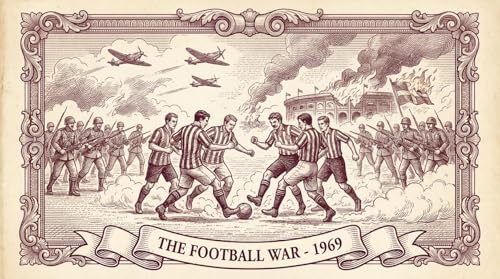
  • Podcast - The Football War of 1969
    Mar 17 2026

    In June 1969, El Salvador and Honduras played three World Cup qualifying matches that spiraled into riots, a national martyr, and ultimately a real shooting war. The underlying causes were decades of tension over immigration, land reform, and poverty, but the soccer matches lit the fuse. After fans on both sides attacked visiting teams, burned flags, and killed spectators, El Salvador invaded Honduras on July 14th with World War II-era planes and tanks. The “100 Hour War” killed thousands, displaced up to 300,000 people, and featured the last propeller-plane dogfights in military history. The Football War proved that sports rivalries can mask deeper conflicts, and that when politicians use nationalism as a weapon, everyone loses.

    This is an episode of “Wait, That Actually Happened?” a podcast exploring history’s most unbelievable true stories.

    Be sure to check out my Substack (Intelligence Bulletin from Author Daniel P. Douglas) for more podcast episodes, written articles with full sources, and links to my books. Thanks for listening!

    Subscribe to never miss history’s weirdest moments.


    This is a public episode. If you would like to discuss this with other subscribers or get access to bonus episodes, visit authordanielpdouglas.substack.com
    Show More Show Less
    17 mins
adbl_web_anon_alc_button_suppression_t1
No reviews yet