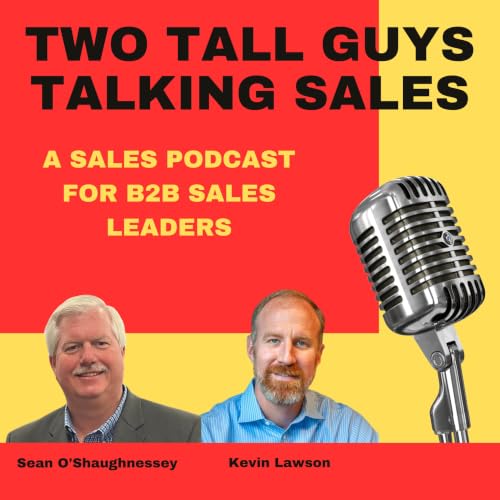
Two Tall Guys Talking Sales cover art

Two Tall Guys Talking Sales

Two Tall Guys Talking Sales

By: Kevin Lawson and Sean O'Shaughnessey
Listen for free

"Two Tall Guys Talking Sales," where Sean O'Shaughnessey and Kevin Lawson discuss a single sales topic. Kevin and Sean together have about 60 years of experience in professional selling. This podcast helps people in sales, sales leadership, and business leadership or company owners realize the maximum value of their company by improving their revenue generation capability. This podcast is designed to help those people enhance their companies' sales management practices, methodologies, processes, teams, and messaging. Sean O'Shaughnessey and Kevin Lawson are Fractional Vice Presidents of Sales. They operate their own companies separately but have partnered for this podcast to advise salespeople and SMB companies on successful strategies and methodologies. Kevin is the CEO of Lighthouse Sales Advisors. Lighthouse Sales Advisors is a sales leadership solution provider for small businesses. Lighthouse helps business owners navigate the potential pitfalls around sales growth, sales turnaround, or scaling up by leveraging sales acumen and decades of experience to build effective sales teams. https://www.lighthousesalesadvisors.com/ Sean is the CEO of New Sales Expert. He helps company owners realize the maximum value of their company by improving their revenue generation capability. He helps owners enhance their sales management, methodologies, processes, teams, and messaging.2024 Economics Management Management & Leadership
Episodes
  • From Marine Recon to Venture Capital: Paul Claxton on Sales Strategy, AI, and Founder Readiness
    Jun 23 2026
    In this episode of Two Tall Guys Talking Sales, hosts Kevin Lawson and Sean O'Shaughnessey sit down with Paul Anthony Claxton of Digirati Investments for a sharp conversation on venture capital, founder readiness, sales architecture, and why early-stage companies cannot hide behind product obsession or incomplete data. Paul brings a rare blend of Marine Corps reconnaissance discipline, sales leadership, investment judgment, and AI perspective to the table. The result is a fast-moving discussion about Business acumen, customer conversations, market intelligence, Sales processes, and the practical realities of Revenue generation when founders are trying to build something the market may not yet know it needs. Key Topics Discussed Founder adaptability and the path from Marine to venture capitalist — 00:20 Paul explains how adaptability, opportunity recognition, and power networking shaped his move from the Marines into venture capital. His point lands hard for anyone in sales management: the best salespeople and founders do not simply follow the plan. They adjust when the market, the customer, or life changes direction. Why investors look beyond the product — 02:19 Paul discusses what he looks for when evaluating founders and companies. Product matters, but it is not enough. Founders need to understand macroeconomics, microeconomics, contracts, deal structure, customer impact, and the broader commercial environment. That is where Business acumen becomes a serious differentiator. Inventing necessity and creating surrounding market demand — 03:24 Paul introduces Digirati Investments' phrase "inventing necessity" and explains why strong products do more than solve one isolated problem. They create adjacent needs, new sub-industries, and additional opportunities for Revenue generation. This is a useful framing for founders, sales leaders, and anyone building Sales strategies around emerging markets. The danger of product-centric founders — 04:43 Sean pushes into a critical founder question: how often do companies believe they have a market-changing product before they have validated the market? Paul's answer is direct. Too many founders are product-centric instead of people-centric. Real Sales success starts with human conversations long before the product is fully built. Data, AI, and consultative selling in modern sales ecosystems — 05:33 Paul argues that strong data flow is essential, but data alone cannot replace human interaction. He connects AI, CRM automation, customer engagement, and consultative selling to a broader point: modern Sales processes need both high-quality data and high-quality conversations. Reconnaissance, competitor intelligence, and explainable AI — 09:15 Drawing from his Marine background, Paul explains why companies must gather intelligence from both customers and competitors. AI can support that work, but leaders must understand where the data came from and whether it reflects the actual market. Bad assumptions create bad Messaging, weak qualification, and flawed Revenue management decisions. Key Quotes Paul Anthony Claxton — 00:35 "The best salespeople are the most adaptable people." Paul Anthony Claxton — 05:33 "A lot of times I'll run across founders that are product-centric instead of being people-centric." Sean O'Shaughnessey — 08:41 "How do you know that what you're doing is going to work if you don't have salespeople out pre-talking and pre-building up what that problem is?" Paul Anthony Claxton — 09:15 "If you don't have people gathering reconnaissance, it's not just talking to who you think your prospective customers are, but it's also understanding how your competitors qualify." Kevin Lawson — 11:49 "Not only do we have to know as sellers who our total addressable market is, but our service obtainable market is, but it's important to keep that data current." Additional Resources Paul Anthony Claxton — Venture capitalist, U.S. Marine, sales architecture thinker, and guest on this episode. https://www.linkedin.com/in/businessmanathletemarine/ Digirati Investments — Paul's investment firm, discussed in the episode through the lens of "inventing necessity." Explainable AI — Paul's podcast, referenced during the conversation about understanding the origin, quality, and accuracy of AI-driven data. PaulClaxton.io — Paul's personal website, where you can learn more about his work, investments, and related ventures. A Significant Actionable Item from this Podcast Before investing more time, money, or sales effort into a product, schedule direct market conversations with prospective customers and competitive intelligence reviews. Do not rely only on internal conviction, CRM data, AI summaries, or founder enthusiasm. Validate the problem, study how competitors qualify and sell, and pressure-test whether your Value selling story connects to a real business need. This one discipline improves Sales strategies, sharpens Messaging, and prevents companies ...
    Show More Show Less
    16 mins
  • Stop Wasting Time on Bad Deals: Sales Management Lessons for a Cleaner Pipeline
    Jun 16 2026
    In this episode of Two Tall Guys Talking Sales, hosts Kevin Lawson and Sean O'Shaughnessey take on one of the most expensive problems in B2B selling: pipeline clutter. Sellers have limited customer-facing time, and too much of it gets wasted chasing deals that were never truly qualified, never aligned with the ideal client profile, or never likely to close. Kevin and Sean dig into the math, mindset, and sales management discipline required to protect selling time, improve forecast accuracy, and focus on the right opportunities. This conversation connects time management, Business acumen, Sales strategies, Sales processes, Value selling, Messaging, Revenue management, and Revenue generation into one practical question: Are you spending your limited sales time on deals that can actually produce Sales success? Key Topics Discussed Why seller time is the most valuable sales resource — 00:00 Kevin opens the episode by pointing out that only a fraction of a seller's week is spent directly with customers. The rest disappears into research, reporting, scoping, internal meetings, travel, and administrative drag. That makes time management a revenue issue, not a productivity slogan. How to identify deals that do not belong in your pipeline — 01:14 Sean challenges sellers to open their CRM and look honestly at the deals expected to close in the next quarter or six months. Do they fit the ideal client profile? Do they look like the kinds of customers the company wins? Or are they sitting in the pipeline because the seller hopes they might become something? Using quota math to evaluate opportunity cost — 02:45 Sean breaks the problem down to simple math: take the seller's annual working hours, divide by the quota, then adjust for actual customer-facing time. The farther a prospect is from the ideal client profile, the more time it typically consumes. That raises the real question: could the seller create more revenue by focusing on easier, better-fit deals? The danger of an aspirational pipeline — 04:12 Kevin explains how inflated pipelines create false confidence, poor forecasting, and bad leadership conversations. A pipeline full of hope does not create commissions. A pipeline full of qualified, workable, attainable deals gives sales leaders and sellers better data for decision-making. Discovery discipline and hard qualification questions — 07:07 Kevin emphasizes the importance of asking hard questions early. Budget, business pain, decision authority, and the pain of change must be tested before a deal moves too far forward. If a seller has issued a proposal to someone who cannot buy, does not control the budget, or cannot define the business problem, the sales process has already drifted. Becoming your own sales manager — 08:48 Sean pushes sellers to manage their own pipeline with the same honesty they would expect from a strong sales leader. The best salespeople ask themselves whether a deal is real, whether it is efficient, whether it has access, whether the buyer is engaged, and whether it belongs in this year's forecast at all. Key Quotes Kevin Lawson — 00:00 "As sellers, people who are chasing a quota every year, we have one thing that is so precious that it is absolutely paramount for us to pay attention to, and that's our time." Sean O'Shaughnessey — 01:14 "We all know that if we had more time to call on great customers, we'd probably make more money. So let's talk about calling on great customers." Kevin Lawson — 05:46 "Your commission is driven by your accuracy of closes, not your aspirations. Aspirational deals don't turn into commissions." Sean O'Shaughnessey — 09:09 "The best salespeople are great independent sales managers of themselves." Kevin Lawson — 12:09 "Simply quota, close rate, number of deals, average deal size. That's really all you need, and it's all stuff that's in your pipeline now." Additional Resources B2B Sales Lab — Sean mentions that sellers can use the B2B Sales Lab to pressure-test pipeline questions, get peer feedback, and discuss whether specific opportunities deserve more time and attention. Join the Lab at b2b-sales-lab.com CRM pipeline review — The episode repeatedly encourages sellers to use their CRM as the source of truth for examining deal fit, timing, stage accuracy, close probability, and forecast quality. Ideal Client Profile — Kevin and Sean reinforce the importance of understanding which prospects fit the company's best customer profile and which ones sit too far outside the target to justify the time required. Customer Interaction Hours episode — Kevin refers listeners back to a previous discussion in which Sean explained customer interaction hours and why increasing time in front of the right buyers improves the win position. Quarterly Business Reviews — Kevin notes that past customers and QBRs can help sellers and sales leaders identify strategic conversations, referral opportunities, and ways to generate more of the right pipeline...
    Show More Show Less
    17 mins
  • Are Your Salespeople in the Wrong Roles? How to Match Talent to Revenue Growth
    Jun 9 2026
    Two Tall Guys Talking Sales takes a practical look at one of the most common sales management mistakes: assuming all salespeople are built for the same job. Sean O'Shaughnessey and Kevin Lawson use a basketball analogy to unpack the difference between hunters, farmers, lone wolves, challengers, relationship sellers, transactional sellers, and trappers. This episode challenges owners, sales leaders, and frontline sellers to examine whether their sales processes, compensation plans, and revenue management expectations actually match the type of salesperson required for Sales success. If your team is underperforming, the issue may not be a lack of effort. It may be role design. Key Topics Discussed 01:00 — Why Sales Roles Need Clear Definitions Sean opens with a basketball analogy: if you do not understand the positions, the game becomes harder to follow. The same is true in sales. Confusing labels like hunter, farmer, challenger, lone wolf, and trapper can create bad hiring decisions, poor coaching, and broken sales strategies. 02:50 — Do Not Confuse Seller Type with Business Model Kevin draws an important distinction between the kind of salesperson you have and the kind of business you operate. A transactional sales model, a relationship-driven sales model, and an enterprise sales model each require different selling behaviors, messaging, and support structures. 06:20 — Hunters, Farmers, and the Cost of Misalignment Sean explains why a one-time ERP-style sale usually requires a hunter, while repeat-purchase relationships often require a farmer. Asking one type of salesperson to behave like another may be possible, but it is rarely efficient. Sales leaders need Business acumen to know what role the business actually requires. 08:25 — Lone Wolves, Challengers, and Unsupported Sales Teams The discussion turns to lone wolves and challengers, especially in organizations that give salespeople little infrastructure, weak marketing, poor sales processes, or minimal sales enablement. If leadership expects sellers to "just figure it out," they may be selecting for independence while unintentionally creating risk. 09:50 — How to Reshape a Sales Team Without Blowing It Up Kevin warns against the instinct to immediately replace the team. The better move is to take an intellectually honest look at the team's structure, upskill where possible, and decide whether the business needs account managers, customer service support, hunters, or relationship-focused sellers. 12:50 — The Trapper: Building Toward Enterprise Revenue Generation Sean closes by describing the trapper: the salesperson who can hunt, farm, lead, challenge, and plan proactively for larger future opportunities. This is where Value selling becomes more than a technique. It becomes a disciplined approach to expanding from a pilot project to departmental adoption, divisional traction, and eventually enterprise-level revenue generation. Key Quotes Sean O'Shaughnessey — 01:07 "Not knowing what the roles are is a big deal. So that same kind of thing happens in a sales arena, where you may not understand what type of salesperson you have or what type of salesperson you need." Kevin Lawson — 02:51 "It's important to note that just because somebody looks like something doesn't mean that's actually what they are." Kevin Lawson — 03:51 "You, as a seller, need to understand your business model so that you know how to sell." Sean O'Shaughnessey — 08:08 "Asking one type of salesperson to be another is really difficult to do. That's like asking that point guard to be the center." Kevin Lawson — 10:39 "Change people before you have to change people." Sean O'Shaughnessey — 14:15 "How do you become proactive? How do you plan for the deal that's going to happen in nine months?" Additional Resources The Challenger Sale — Referenced during the discussion of lone wolves and challengers, especially the idea that some sellers succeed by taking control of complex customer conversations. Eliminate Your Competition by Sean O'Shaughnessey — Sean refers to the "trapper" concept from his book as the more complete sales archetype for complex, enterprise-level selling. B2B Sales Lab — Kevin mentions that this topic will be explored further in B2B Sales Lab office hours, where sellers and sales leaders can dig into the practical work of assessing team fit, role design, and sales execution. A Significant Actionable Item from this Podcast Audit your current sales team against the sales motion your business actually requires. Do not start with personality labels. Start with the business model. Are you selling once and moving on? Are you expanding accounts over years? Are your deals transactional, relationship-driven, enterprise-level, or a mix? Then map each salesperson against the role the business needs: hunter, farmer, account manager, challenger, lone wolf, or trapper. The decision that follows is the real work. Some people need coaching. Some need a ...
    Show More Show Less
    18 mins
adbl_web_anon_alc_button_suppression_t1
No reviews yet