• Reform or be defunded: The Trump administration’s demands for the UN
    Apr 30 2026
    In an internal memo seen by Devex, the Trump administration has threatened to withhold hundreds of millions of dollars in funding to the United Nations unless it adopts a slate of nine “quick win” reforms. We break down the demands and what they reveal about the United States’ new road map for multilateral engagement.

    We also received a recent congressional notification which reveals that USAID has up to $19.2 billion to close out terminated foreign assistance awards. We explore what that funding would be spent on.


    To discuss these stories and others, Devex Business Editor David Ainsworth speaks with reporters Colum Lynch and Elissa Miolene for the latest episode of our weekly podcast series.


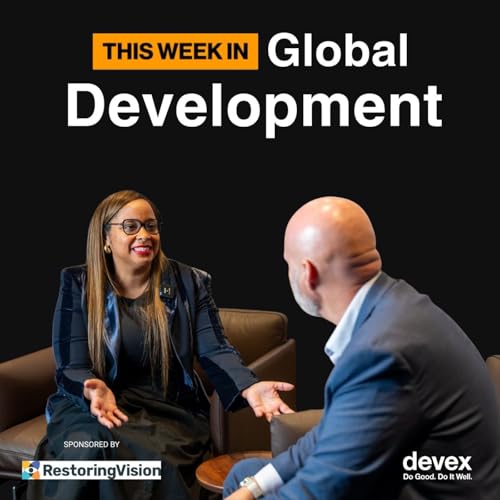
    During the sponsored segment of the This Week in Global Development podcast, brought to you by The Fred Hollows Foundation, Devex Executive Vice President Kate Warren sits down with Dr. Caroline Casey, president of the International Agency for the Prevention of Blindness, to discuss why restoring sight is not just a health intervention, but a critical lever for unlocking women’s economic participation, reducing unpaid care burdens, and accelerating progress on gender equality.

    Sign up to the Devex Newswire and our other newsletters.
    Show More Show Less
    34 mins
  • The new world order of aid: Inside the Skoll World Forum
    Apr 23 2026
    This week, we are on the ground in Oxford for the Skoll World Forum, an annual international convening of social entrepreneurs, philanthropists, and leaders across government and civil society. While the global development community faced significant headwinds from foreign aid cuts this time last year, the atmosphere at this year’s forum remains optimistic and focused on resilient solutions.

    During the conversation, we explore why the forum remains a cornerstone for the global development community, as well as share what we are learning about how philanthropic organizations see their role evolve in the post-aid era.


    To discuss the latest news from the Skoll World Forum, Senior Editor Rumbi Chakamba sits down with Devex President and Editor-in-Chief Raj Kumar and Business Editor David Ainsworth for this edition of our weekly podcast series.


    Sign up to the Devex Newswire and our other newsletters.
    Show More Show Less
    28 mins
  • Special edition: Visionomics - how eyeglasses drive economic growth
    Apr 21 2026
    In a special edition of the This Week in Development podcast, Devex Executive Vice President Alan Robbins sits down with Ambassador Keisha McGuire, chief global affairs officer at RestoringVision, to explore the profound economic ripple effects of addressing near-vision loss, or presbyopia.

    While often dismissed as a mere "annoyance," age-related vision loss is a significant barrier to global health and economic development. RestoringVision has coined the term "visionomics" to describe the vital intersection of vision, health, and the economy. For millions in low- to middle-income countries, the inability to see clearly can lead to a devastating economic impact on households, communities, and countries.

    The case for investing in vision is mathematically undeniable: For every $1 invested in vision services in these regions, there is a $28 return on investment. Despite this, eye health has historically lagged behind other global health priorities. However, the tide is turning with major new funding commitments and increased political mobilization leading up to the first-ever Global Summit for Eye Health in November 2026 in Antigua and Barbuda. By treating vision not just as a medical cost but as a catalytic investment, organizations can advance at least seven Sustainable Development Goals, proving that a simple pair of reading glasses can be one of the most cost-effective tools for reducing global poverty.

    Listen to this episode of This Week in Global Development to hear the whole discussion.
    Show More Show Less
    22 mins
  • Global Progress in the AI Era: The future of AI will be decided by small choices with big stakes
    Apr 21 2026
    In this episode of Global Progress in the AI Era, a government minister and tech entrepreneur argue that the future of AI will be determined by thousands of small choices.

    Taking part in the conversation hosted by Devex Senior Editor for Special Coverage Catherine Cheney were Amini founder and CEO Kate Kallot, as well as Bosun Tijani, Nigeria’s minister of communications, innovation, and digital economy.
    Show More Show Less
    30 mins
  • Inside the World Bank Spring Meetings
    Apr 17 2026
    Against the backdrop of the World Bank and IMF Spring Meetings, Devex reporters Adva Saldinger, Michael Igoe, and Ayenat Mersie dissect the stories they’ve been hearing on the ground this week. That includes the latest OECD figures showing a staggering 25% drop in official development assistance, the ripple effects of the conflict in the Middle East, and a newfound focus on rebuilding public consensus.

    The discussion also looks at the World Bank’s bold new “sector-first” strategy, highlighted by the launch of Water Forward — an ambitious initiative aiming to provide one billion people with access to clean water through country-led compacts. The return of African trade corridors enters the discussion as well, along with the International Monetary Fund’s scramble for concessional funding.

    To dig into these stories, listen to this episode of This Week in Global Development.
    Show More Show Less
    27 mins
  • Special edition: Every crisis is political - redefining humanitarian response
    Apr 14 2026
    The international aid system has long operated on the ideal of "neutrality," but our latest episode of This Week in Global Development, sponsored by the Urgent Action Sister Funds, challenges this deeply embedded notion.

    Devex Executive Editor and Executive Vice President Kate Warren is joined by the Urgent Action Sister Funds’ Jean Kemitare and Johnny Tohme, as well as Lucy Martin of the Centre for Applied Human Rights at the University of York, for the conversation. Over the course of the episode, our guests discuss the idea that no crisis happens in a vacuum. Instead, crises are shaped by history, power dynamics, and the strategic allocation of resources. By pretending aid is neutral, the current system risks repeating the same patterns that leave communities vulnerable in the first place.


    The centerpiece of the discussion is the Feminist Crisis Response Model, a flagship research initiative that highlights how grassroots feminist movements are uniquely equipped to navigate the entire "crisis continuum" — from prevention and survival to long-term transformation. Unlike traditional models that treat crises as isolated events to be managed, the feminist lens views them as visible ruptures of long-term structural issues such as patriarchy, colonialism, and economic injustice. This approach shifts the center of gravity from large external institutions to local partners who are already embedded in their communities and accountable to them.


    By recognizing that "every crisis is political," the model encourages donors to move beyond simple quantifiable metrics, such as the number of aid parcels delivered, and instead invest in intangible yet critical resources such as community care, solidarity, and structural systemic change. Listen to this episode of This Week in Global Development to hear the whole discussion.


    Explore the report that fully explicates the Feminist Crisis Response Model: “Resourcing Strategies in an Age of Permacrisis: Critical Lessons from Feminist Philanthropy" - https://feministcrisisresponse.org/?fbclid=PAZXh0bgNhZW0CMTEAc3J0YwZhcHBfaWQMMjU2MjgxMDQwNTU4AAGnBQe3qpHdPMB4gBlhz7ORmPBUBI61wUJR-pKhqEO7vQUJs36us-nFPvQpIZU_aem_oe4R1ClbuCTgE1cZHz5Geg.
    Show More Show Less
    44 mins
  • A look at the United States' new foreign aid strategy
    Apr 9 2026
    This week, we discuss the United States’ new highly targeted approach to humanitarian aid, showcased in a $2 billion agreement with the U.N. Office for the Coordination of Humanitarian Affairs, or OCHA.

    Designed for rapid impact, the funds are strictly earmarked for direct, lifesaving assistance over a short six-month window across 18 crisis-affected countries. We explore the implications of this strategy, which signals a significant shift in U.S. foreign aid toward fast-tracked, tightly scoped interventions focused on immediate survival.


    During the conversation, we also take a look at the details of the Trump administration’s budget request, which calls for a 30% cut to foreign affairs spending and increased funding to rebuild and secure critical mineral supply chains.


    To dig into these stories, and others, Devex Business Editor David Ainsworth sits down with Adva Saldinger and Elissa Miolene for the latest episode of our weekly podcast series.


    To find out more about how the U.S. budget works, check out our special explainer episode.


    Sign up to the Devex Newswire and our other newsletters.
    Show More Show Less
    33 mins
  • Special edition: Breast cancer as a global development challenge
    Apr 8 2026
    In this special episode of This Week in Global Development, we explore breast cancer not just as a health challenge, but as a critical development challenge. In low- and middle-income countries, or LMICs, a breast cancer diagnosis can have a devastating ripple effect that extends far beyond the clinic, impacting households, communities, and entire systems.

    Hosted in partnership with The Pfizer Foundation, Devex Executive Vice President and Executive Editor Kate Warren speaks with Darren Back, Dr. Loice Sitienei, and Dr. Patrick Loehrer to explore why integrated breast cancer care strengthens both health systems and economic resilience, ultimately improving outcomes for women facing this disease.

    The conversation underscores the systemic barriers to breast cancer care in LMICs, where limited infrastructure and high costs often lead to delays in diagnosis. The Pfizer Foundation's Action and Impact initiative, a philanthropic investment now totaling $25 million across five sub-Saharan African countries, aims to expand access to timely breast cancer diagnosis, treatment, and care. By supporting partners working with local and national governments to advance access to care, the initiative seeks to not only improve breast cancer outcomes but also strengthen overall health systems and long-term prosperity.

    To hear more, listen to this on This Week in Global Development.

    The Pfizer Foundation is a charitable organization established by Pfizer Inc. and is a separate legal entity with distinct legal restrictions. To learn more about The Pfizer Foundation, click here.
    Show More Show Less
    33 mins