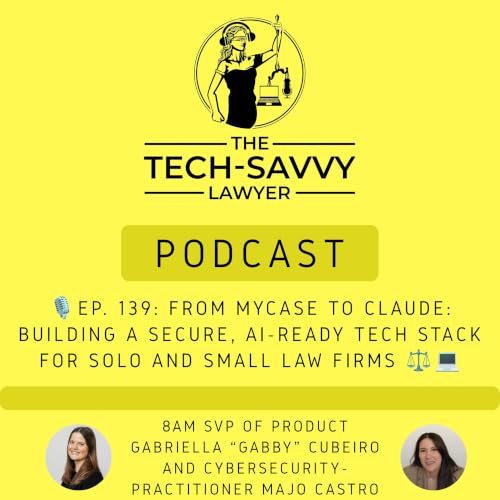
The Tech Savvy Lawyer cover art

The Tech Savvy Lawyer

The Tech Savvy Lawyer

By: Michael D.J. Eisenberg
Listen for free

The Tech Savvy Lawyer interviews Judges, Lawyers, and other professionals discussing utilizing technology in the practice of law. It may springboard an idea and help you in your own pursuit of the business we call "practicing law". Please join us for interesting conversations enjoyable at any tech skill level!© ℗ 2020 Michael D.J. Eisenberg Politics & Government
Episodes
  • 🎙️ Ep. 139, From MyCase to Claude: Building a Secure, AI-Ready Tech Stack for Solo and Small Law Firms.
    Jun 23 2026
    My next guests are Gabriella "Gabby" Cabero, Senior Vice President of Product at 8am — the legal tech company behind MyCase, LawPay, CASEpeer, and DocketWise — and Majo Castro, founder and managing attorney at CastroMand Legal in Austin, Texas. 🌟 Gabby brings over 16 years of legal tech experience, including co-founding CASEpeer, and today leads product strategy for one of the most widely used law practice management ecosystems in the country. Majo is a Venezuelan-born cybersecurity and AI attorney whose firm helps growing companies navigate AI implementation, data management, and cybersecurity — and she's also the voice behind The Cyber Law Gal on Substack. 🔐 Together, they deliver a frank, peer-level conversation about building a tech stack that's both AI-ready and genuinely secure — without the hype and without the hand-holding. Join Gabriella Cabero, Majo Castro, and me as we discuss the following three questions and more! What are the top three integrations or workflows a solo, small, or midsize firm should expect from a modern cloud-based LPM platform like 8am — and what's missing that signals a real red flag around efficiency, cash flow, or security?As AI gets baked into cloud LPM tools like 8am, what are the top three day-to-day tasks that will change most for solo and small firm lawyers — and what basic security or ethical guardrails should they put in place to use those AI features without putting client data at risk?For solo and small firms without a CISO or CTO, what are the top three cybersecurity mistakes you see over and over again? In our conversation, we cover the following: [00:00:00] 🪝 Show Hook — Gabby's critical warning: if your firm hasn't "adopted" AI, your employees probably already have — on free consumer tools[00:00:00] Title read — Episode 139[00:01:00] Host intro: why this conversation goes tactical on AI, security, and LPM workflows[00:02:00] Guest introductions — Gabriella Cabero (8am/MyCase) and Majo Castro (CastroMand Legal / The Cyber Law Gal)[00:03:00] Majo celebrates 1.5 years as a solo practitioner 🎉[00:03:00] Ad: Five-star review request for The Tech-Savvy Lawyer.Page[00:03:30] Tech setups — Gabby's MacBook Air (M4 chip), iPhone Max, Slack, Zoom, Google Drive, Claude Enterprise[00:06:00] Gabby's portable USB-C external monitor for travel (Amazon, highest-rated)[00:09:00] Majo's MacBook Pro 14" M4 (16GB RAM), performance issues, upgrade path discussion[00:10:00] Michael recommends Onyx (free Mac maintenance utility); Michael's Mac Studio M3 Ultra with 256GB[00:11:00] Mac Mini and Mac Studio as desktop alternatives; MacRumors Buyer's Guide tip[00:13:00] Apple Business Account benefits — small discounts + white-glove service[00:15:00] Majo's full setup: iPhone 16 Pro Max, Google Workspace + Gemini (team account with DPA), DJI Osmo Pocket 3, Hollyland wireless mic[00:16:00] Q1: Top three LPM workflows — intake, secure client communication (client portal), and getting paid (trust accounting + automated invoicing)[00:19:00] Majo on switching from QuickBooks to MyCase after discovering QuickBooks mishandles trust accounting[00:20:00] 🎉 Gabby announces: AI case summary features are now LIVE in 8am/MyCase[00:21:00] Cloud vs. local access debate — SaaS uptime, SLAs, and asking vendors for proof[00:23:00] Michael's redundant backup strategy: Backblaze + Dropbox + local Mac Mini[00:25:00] Cautionary tale: ransomware attack converts a server-based firm to the cloud overnight[00:28:00] Majo's Google Drive third-party backup with 2-hour recovery window[00:29:00] Q2: How AI changes daily workflows — drafting, case summaries, surfacing critical info fast[00:30:00] Why reading vendor Terms of Service and activating Data Processing Agreements (DPAs) is non-negotiable[00:31:00] 8am's SOC 2 Type 2 compliance; updated AI terms and opt-in controls coming[00:32:00] SOC 2, HIPAA, end-to-end encryption as baseline vendor security requirements[00:34:00] AI as the great equalizer — leveling the playing field for solo firms vs. BigLaw[00:35:00] Majo's real data: ~12 hours saved last month across 27 consultations using Gemini for proposals[00:36:00] Plaud and Pocket AI recording devices — data retention, PII, and DPA concerns[00:37:00] Majo's stance on wearable AI recorders; Apple Watch comparison; one-party vs. two-party consent[00:39:00] Plaud's terms say no AI training — but it's not a DPA; terms can change without notice 🚨[00:40:00] Google Workspace DPA must be manually activated — most users don't know; creating user friction around protection[00:41:00] Q3: Top cybersecurity mistakes — shadow AI, no MFA, undertrained employees[00:42:00] Majo's checklist: DPA + no model training on client data + enterprise/team-tier subscriptions + MFA[00:43:00] Gabby: employees are the #1 security risk; fractional IT and CISO options for small firms[00:44:00] AI-powered phishing attacks on law firms will only intensify[00:45:00] Majo's training ...
    Show More Show Less
    50 mins
  • TSL.P Labs 🧪: Google Quick Share for Lawyers — Cross-Platform File Sharing Without Compromising Ethics
    Jun 17 2026
    Join us for an AI-powered deep dive into the ethical challenges facing legal professionals in the age of generative AI. 🤖 In this episode, host Michael D.J. Eisenberg breaks down Google Quick Share's new cross-platform capability — the feature that finally lets Android and Apple devices share files directly, peer-to-peer, without routing data through third-party servers. And yes, we cover every ABA rule you need to know before you touch that share button. In our conversation, we cover the following · [00:00] 📖 The problem: Why Android-to-iPhone file transfers have been a frustrating workflow bottleneck for law firms — and how Google Quick Share's latest update changes everything · [01:00] 🗺️ Road map overview — the six sections of today's explainer: The Tech Bridge, Step-by-Step Workflows, Real-World Law Practice scenarios, ABA Rules & Compliance, Practical Security Settings, and the Firm Roll-Out Checklist · [01:30] 🌉 Section 1 — The Tech Bridge: How Quick Share's peer-to-peer architecture works and why files never touch Google or Apple servers — a critical distinction for client data privacy · [02:00] 📱 Compatible hardware: Samsung Galaxy S and Z series, Google Pixel 8, 9, and 10, Vivo devices, and iPhones running the latest AirDrop enhancements · [02:30] 🔄 Section 2 — Step-by-Step Workflows: Sending from Android to iPhone in four steps — open the item, tap Share, select Quick Share, tap the iPhone's name; recipient taps Accept · [03:00] ↔️ Reversing the transfer — sending from iPhone to Android using AirDrop's new interoperability, where the Android device appears as a viable AirDrop target · [03:30] ⚖️ Section 3 — Real-World Law Practice: Actionable scenarios including beaming a signed retainer agreement from an Android phone to an iPhone-toting intake coordinator, and cross-platform trial prep for last-minute demonstratives · [04:00] 📋 Sharing documents directly to a client's phone in a meeting — regardless of operating system · [04:15] 🔍 Section 4 — ABA Rules & Compliance: ABA Model Rule 1.1 (Competence) — why not understanding Quick Share's privacy and visibility settings is an ethical violation, not just a tech oversight · [04:45] 🔐 ABA Model Rule 1.6 (Confidentiality) — why you must double-check the recipient device name before hitting send, and when peer-to-peer sharing is not appropriate for your most sensitive materials · [05:30] 👥 ABA Model Rule 5.3 (Supervision) — why you carry ultimate responsibility for how your staff uses mobile sharing tools, and the written BYOD policy you must have in place · [06:00] 🛡️ Section 5 — Practical Security Settings (Android): Three non-negotiable settings: change Quick Share visibility to Contacts Only or Hidden; require device unlock to accept transfers; immediately move received client files into your secure document management app · [06:30] 🍎 Practical Security Settings (iPhone): Set AirDrop to Contacts Only as your baseline default; if you temporarily open to Everyone, switch it back immediately; train staff to decline all unexpected AirDrop requests · [07:00] 📋 Section 6 — Firm Roll-Out Checklist: Five-step tactical deployment plan: (1) inventory devices, (2) force OS updates firmwide, (3) mandate default privacy settings, (4) hold a 30-minute staff training session, (5) define in writing which file types may and may not be shared via Quick Share · [08:00] 💡 Closing challenge: The technology to bridge Android and Apple is already in your pocket — the only barrier left is implementation. How will you lead the charge to modernize your firm's cross-platform collaboration without sacrificing your ethical shield? RESOURCES Mentioned in the episode · ABA Model Rule 1.1 — Competence: https://www.americanbar.org/groups/professional_responsibility/publications/model_rules_of_professional_conduct/rule_1_1_competence/ · ABA Model Rule 1.6 — Confidentiality of Information: https://www.americanbar.org/groups/professional_responsibility/publications/model_rules_of_professional_conduct/rule_1_6_confidentiality_of_information/ · ABA Model Rule 5.3 — Responsibilities Regarding Nonlawyer Assistance: https://www.americanbar.org/groups/professional_responsibility/publications/model_rules_of_professional_conduct/rule_5_3_responsibilities_regarding_nonlawyer_assistance/ Hardware mentioned in the conversation · Samsung Galaxy S Series: https://www.samsung.com/us/smartphones/galaxy-s/ · Samsung Galaxy Z Series (foldables): https://www.samsung.com/us/smartphones/galaxy-z/ · Google Pixel 8: https://store.google.com/us/category/phones · Google Pixel 9: https://store.google.com/us/category/phones · Google Pixel 10 (Pixel 1000 series): https://store.google.com/us/category/...
    Show More Show Less
    9 mins
  • 🎙️ Ep. 138: How US Legal Support Integrates AI, Security, and Remote Depositions into Your Litigation Tech Stack ⚖️💻
    Jun 9 2026
    My next guest is Jimmy Bridwell, an executive with US Legal Support, a nationwide litigation support company headquartered in Houston, Texas that provides remote deposition solutions, transcription services, record retrieval, trial technology, and graphics generation for law firms of all sizes. In this episode, we unpack how US Legal Support's technology platform integrates with law firm systems, why security and data management are non‑negotiable, and how AI‑assisted transcript and deposition tools are reshaping trial preparation and remote proceedings for modern litigators.📜🤖 Join Jimmy Bridwell and me as we discuss the following three questions and more! What are the top three ways lawyers should expect companies like US Legal Support's technology platforms — whether remote deposition solutions, transcription services, or document management — to integrate seamlessly into a law firm's existing tech stack to eliminate duplicative data entry and streamline trial preparation? What are the top three technology investments or skillsets that lawyers consistently overlook, but would dramatically improve their practice efficiency and client services in 2026? Based on US Legal Support's experience facilitating over 245,000 remote events annually, what are the top three technology mistakes you see lawyers making during remote depositions or virtual proceedings, and how can they course correct to deliver more efficient client representation? In our conversation, we cover the following [00:00:00] Jimmy's current tech setup: Surface Pro laptop, 47‑inch curved Samsung monitor, HyperCast standalone microphone, and Logitech Brio camera in a Microsoft‑based office using Microsoft Cloud.📺🖥️ [00:00:45] Working with both Android and Apple smartphones, and why Jimmy uses Apple for work due to perceived security and litigation hold considerations. [00:01:20] How US Legal Support deploys Apple computers in graphics studios while running a primarily Microsoft infrastructure and cloud environment across the enterprise. [00:02:00] Question 1 introduction: how US Legal Support's platforms should integrate into law firm tech stacks to reduce duplicate data entry and streamline trial workflows. [00:02:15] Why integration, security, and data management are the three primary pillars when transmitting client information between firms and service providers. [00:03:00] The risks of multiple data entry points and why centralized, consistent first input across the litigation lifecycle is critical. [00:03:40] US Legal Support's security posture: internal SOC 2 Type 2 validation, HIPAA compliance, NIST protocols, and reliance on Microsoft and Amazon cloud with SOC 2 Type 2 security. [00:04:40] Practical security questions solo and small firm attorneys should ask vendors about encryption at rest and in transit, security reviews, and penetration testing. [00:06:00] Data breach reporting expectations and the need for a published, timely breach notification process for clients. [00:07:30] Data management concerns: how vendors use client data, prohibitions on reselling data, and the importance of 24/7 self‑service access to discovery materials and litigation documents. [00:08:30] Integration realities: standard and customized APIs, multipoint‑to‑endpoint data flows, and why experience with case management integrations matters. [00:11:00] Question 2 introduction: the top three overlooked technology investments and skillsets that could dramatically improve practice efficiency and client service in 2026. [00:11:15] AI‑assisted transcript review: summarizing long depositions, key‑noting, keywording, and surfacing strategic themes to accelerate trial preparation. [00:12:20] Validating AI outputs, the attorney's continuing liability, and why AI‑assisted transcript review pulls from the deposition record rather than external sources, reducing hallucination risk. [00:14:10] AI‑assisted deposition preparation tool: ingesting exhibits, medical records, and discovery into a secure portal, generating case outlines, identifying pre‑existing conditions, and suggesting deposition questions in minutes instead of hours. [00:15:40] How Jimmy and Michael compare legacy OCR workflows with modern AI, and why AI no longer depends on rigid templates to extract key data. [00:17:00] The importance of partnering with holistic solution providers who can address multiple points of the litigation lifecycle rather than just one narrow problem. [00:18:00] How the market has evolved from mom‑and‑pop shops with limited tech budgets to larger litigation support organizations that invest heavily in technology and continuous development. [00:19:10] The tension between long‑term SaaS contracts and rapidly evolving legal tech, and why Jimmy favors transactional, "pay as you...
    Show More Show Less
    33 mins
adbl_web_anon_alc_button_suppression_t1
No reviews yet