• Why Problem Solving Needs to be Taught - AfterMaths
    May 22 2026

    In this Aftermaths episode of The Primary Maths Podcast, Jon and Becky chat about the strange, busy, slightly chaotic stretch of the school year just before half term, from transition days and sports events to staffing conversations and year group changes.

    They reflect on how different primary teaching can feel from one year group to another, and why every phase, from EYFS and Key Stage 1 through to Year 6, needs strong subject knowledge and careful teaching.

    The main discussion focuses on working systematically as a key problem solving strategy in primary maths.

    Jon and Becky explore why pupils are often told to “work systematically” without necessarily being taught what that actually means. They discuss how the skill develops from early sorting and ordering in Key Stage 1, through to recording possibilities, finding combinations, identifying factor pairs, proving that all solutions have been found, and eventually supporting algebraic thinking.

    They also consider why working systematically is not just a SATs strategy, but an important part of pupils’ wider mathematical toolkit.

    Topics include:

    • why summer term can feel particularly busy in primary schools
    • the challenge of year group moves and staffing decisions
    • why early maths teaching matters so much
    • how gaps in Key Stage 1 can affect later success in Key Stage 2
    • what working systematically looks like in primary maths
    • why problem solving strategies need to be explicitly taught
    • using sorting, ordering and recording to support systematic thinking
    • factor pairs, common multiples and combinations
    • helping pupils prove they have found all possible solutions
    • the role of manipulatives, representations and talk
    • Twinkl’s new problem solving collection
    • upcoming TeachMeet CPD on working systematically and using models

    Show More Show Less
    34 mins
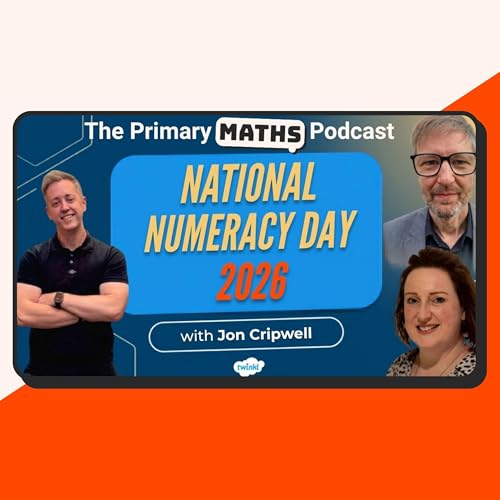
  • Building Maths Confidence with National Numeracy
    May 19 2026

    In this episode of The Primary Maths Podcast, Jon is joined by Paul Milner and Julie Pompa from National Numeracy to talk about number confidence, family engagement and the role schools can play in helping children and adults feel more positive about maths.

    Paul and Julie share the story behind National Numeracy’s work, including why adult numeracy matters and how confidence can be just as important as skill. They discuss the idea that many adults carry negative experiences of maths with them, and how those messages can shape the way children see themselves as mathematicians.

    The conversation explores National Numeracy’s model of value, belief and persistence, and why adults need to see a reason to improve, believe that improvement is possible, and understand that mistakes and discomfort are part of learning.

    Jon, Paul and Julie also discuss the Schools and Families Programme, which supports primary schools to work with families so that pupils feel more positive about maths and understand the value of numeracy beyond the classroom.

    There is also a focus on National Numeracy Day 2026, which takes place on Wednesday 20 May 2026. This year’s theme is Count on Your Community, encouraging schools, workplaces, organisations and community groups to help children and adults feel more confident with numbers at work, at home and at school.

    In this episode, we discuss:

    • why confidence is such an important part of numeracy
    • how adults’ experiences of maths can affect children
    • the difference between maths as a school subject and numeracy in daily life
    • why parents and carers do not need to be “maths people” to support their children
    • the role of mistakes, persistence and positive talk in maths learning
    • how schools can engage families without adding unnecessary workload
    • what National Numeracy Day offers to schools and communities

    Useful links

    National Numeracy

    National Numeracy Day 2026

    National Numeracy Day 2026 schools sign-up

    Schools and Families Programme

    To get in touch with the podcast, email primarymathspodcast@twinkl.co.uk. Becky and Jon will be back on Friday with another Aftermaths episode.

    Show More Show Less
    44 mins
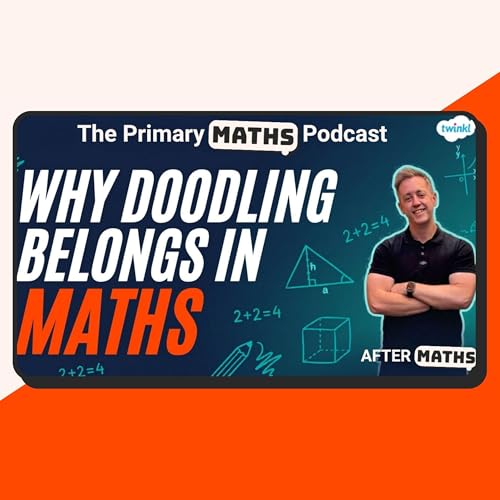
  • Why Doodling Belongs in Maths Lessons - AfterMaths
    May 15 2026

    In this Aftermaths episode of The Primary Maths Podcast, Jon and Becky reflect on a very maths-filled week, from Key Stage 2 SATs to International Women in Mathematics Day, with a little bit of football stadium chat thrown in for good measure.

    Jon and Becky begin by talking about SATs week and the difficult balance teachers face in preparing children well without making the tests feel bigger than they are. They consider the early reactions to this year’s papers, the pressure pupils can feel, and why the final memories of primary maths really matter.

    They also look ahead to the Year 4 Multiplication Tables Check. Jon discusses why fluency with multiplication facts matters, but also why recall alone is not the whole story. Knowing a fact is useful, but pupils also need to understand how to use it.

    Jon then shares reflections from an early maths conference at the King Power Stadium in Leicester, including sessions on maths at home, oracy, bilingual learners and mathematical language. There is plenty to think about here for teachers and maths leads, especially around the role of families in noticing and talking about numbers in the world around them.

    Becky’s Maths of Life segment marks International Women in Mathematics Day by looking at the work of Maryam Mirzakhani, the first woman to win the Fields Medal. This leads to a lovely discussion about doodling, jotting, visualising and why mathematical thinking does not always need to be neat, polished or trapped inside the squares of a maths book.

    As ever, there are practical reflections for teachers, school leaders and anyone interested in how children come to see themselves as mathematical thinkers.

    Listen, subscribe and get in touch:

    Email: primarymathspodcast@twinkl.co.uk

    Jon on LinkedIn: https://www.linkedin.com/in/joncripwell/

    Primary Maths Podcast Substack: https://primarymathspodcast.substack.com/

    Show More Show Less
    38 mins
  • Time Zones, Test Week and Teaching with Representations - AfterMaths
    May 8 2026

    Becky is back from America, which means Aftermaths is back to its usual rhythm of maths chat, gentle chaos and slightly overconfident linking between topics.

    In this episode, Jon and Becky begin by looking ahead to Key Stage 2 SATs week, reflecting on the pressure pupils, parents and schools can feel, while also remembering some of the stranger moments from past SATs papers, including giraffes, warthogs and the famous “bewilderment” question.

    Jon then shares a staff meeting idea about representations in maths, using improper fractions, mixed numbers and counters to explore when manipulatives help children see the structure of the mathematics, and when they can become an inefficient crutch. It leads into a wider discussion about fluency, efficiency, conceptual understanding and the importance of moving pupils intentionally from representation towards more efficient methods.

    For this week’s Maths of Life, Becky brings back some travel-inspired mathematics from her trip to Washington State. A flight from London to Seattle leads to a conversation about time zones, longitude, negative numbers, the international date line, China’s single time zone, and why France technically has more time zones than Russia.

    Finally, Jon and Becky return to the recent EEF and UCL research on mixed attainment grouping and setting. They discuss why the headline findings need careful interpretation, the importance of what actually happens in the classroom, and why access to high-quality teaching matters for all pupils, particularly those with gaps to close.

    You can find the updated Twinkl PlanIt Maths time units here: https://www.twinkl.co.uk/l/dltpv

    You can connect with Jon on LinkedIn here: https://www.linkedin.com/in/joncripwell/

    You can subscribe to the Primary Maths Podcast Substack here: https://primarymathspodcast.substack.com/

    And you can get in touch with the show by emailing: primarymathspodcast@twinkl.co.uk

    Show More Show Less
    41 mins
  • Why Active Primary Maths Lessons Work
    May 5 2026

    In this episode of The Primary Maths Podcast, Jon is joined by Bryn Llewellyn from Move and Learn, Paula Manser, headteacher at Birkby Infant and Nursery School, and Danielle Laramie, maths lead and assistant headteacher at Birkby.

    Together, they explore what active learning really means in primary maths and, just as importantly, what it does not mean. This is not about children running around the classroom for the sake of it. It is about purposeful movement that supports attention, participation, memory, oracy and mathematical thinking.

    Paula and Danielle share how active learning has become part of the everyday culture at Birkby Infant and Nursery School, a large, diverse school with high levels of EAL, SEND and pupil mobility. They explain how carefully chosen games and routines help children engage with mathematical ideas, demonstrate understanding, talk in full sentences and take part without always relying on spoken answers.

    Bryn explains the thinking behind Move and Learn, including how movement can support retrieval, modelling, connection and creation. He also discusses the importance of simple routines, low-cost resources and building a classroom culture where children understand why movement is being used to support learning.

    The conversation includes practical examples such as cone games, tick and cross activities, yoga poses for multiple choice answers, partner talk and sentence stems. It also explores how active learning can fit naturally within a mastery approach, supporting small steps, rehearsal, reasoning and whole-class participation.

    This episode is especially useful for primary teachers, maths leads, senior leaders and anyone interested in making maths lessons more active, inclusive and engaging without losing sight of the learning intention.

    You can find out more about Move and Learn here:

    https://moveandlearn.co.uk/

    Bryn also mentions the book How to Move and Learn, written by Ian Holmes, Bryn Llewellyn and Rich Allman, published by Crown House. https://www.crownhouse.co.uk/how-to-move-learn

    TEDx Talk with Prof Andy Daly-Smith - https://youtu.be/tARSCzHLF5g?si=4tH_WZEYtkgLgzEo

    Birkby Infant & Nursery School (Centre of Excellence video) - https://moveandlearn.co.uk/case-studies

    You can get in touch with the podcast by emailing:

    primarymathspodcast@twinkl.co.uk

    You can connect with Jon on LinkedIn here:

    https://www.linkedin.com/in/joncripwell/

    And you can subscribe to the Primary Maths Podcast Substack here:

    https://primarymathspodcast.substack.com/

    If you enjoyed this episode, please subscribe or follow the podcast wherever you listen, leave a rating or review, and share it with a colleague who might be interested in making maths lessons more active, purposeful and engaging.

    Show More Show Less
    38 mins
  • Attainment Grouping vs Setting in Primary Maths - AfterMaths Episode
    May 1 2026

    In this Aftermaths episode of The Primary Maths Podcast, Jon is joined by returning guest Ash Morris for a Friday conversation that begins with National Space Day and ends with one of the most talked-about education reports of the week.

    Ash shares some suitably mind-bending space facts, including moon rocks, sunlight, Apollo, Artemis and why the Moon might be thought of as Earth’s child. Jon also remembers the author he forgot during the episode: Andy Weir, who wrote The Martian and Project Hail Mary, both brilliant examples of science-rich storytelling.

    The second half of the episode turns to the new Student Grouping Study from the Education Endowment Foundation and UCL Institute of Education. The study looked at Year 7 and Year 8 maths classes, comparing pupils taught in mixed attainment groups with those taught in sets by prior attainment.

    Jon reflects on what the findings might mean for primary maths, especially for teachers and leaders thinking carefully about mixed attainment teaching, challenge, lesson design and pupil confidence. The episode does not treat the report as a simple argument for or against setting. Instead, it asks a more useful question: what does any grouping model require teachers to think about?

    If mixed attainment teaching is going to work well, pupils need access to the lesson, but they also need sufficient challenge. That means thinking carefully about pitch, representations, questioning, task design and how deeper thinking is built into the learning, rather than added on as a disconnected extension task.

    The episode also considers the impact that grouping can have on pupils’ mathematical identity. In primary classrooms especially, children are often very aware of who is seen as “good at maths” and who is not. So the way we group pupils is never just a logistical decision. It can shape confidence, opportunity and how children see themselves as mathematicians.

    You can read the EEF Student Grouping Study here:

    https://educationendowmentfoundation.org.uk/projects-and-evaluation/projects/student-grouping-study

    You can find Ash on STEM Conversations, another Twinkl podcast, available on YouTube, Spotify, Apple Podcasts and wherever you usually get your podcasts.

    You can find Jon on LinkedIn here:

    https://www.linkedin.com/in/joncripwell/

    You can subscribe to the Primary Maths Podcast Substack here:

    https://primarymathspodcast.substack.com/

    And you can listen to The Primary Maths Podcast on Spotify, Apple Podcasts, YouTube or wherever you usually get your podcasts. If you enjoy the episode, please subscribe, leave a rating or review, and share it with a colleague who is thinking carefully about grouping, challenge and mixed attainment teaching.

    Show More Show Less
    33 mins
  • How to Encourage Mathematical Thinking In Primary Maths Lessons
    Apr 28 2026

    In this episode of The Primary Maths Podcast, Jon is joined by Kate Henshall and Kat Martin from Rethink Maths for a conversation about lesson design, task design and how we help children move beyond simply completing work towards deeper mathematical thinking.

    Kate and Kat share their own experiences of maths at school, including how conceptual understanding, representations and manipulatives transformed the way they thought about the subject. The conversation then explores what we really mean by foundational knowledge in maths, and why that phrase needs careful thought if it is to be useful in classrooms rather than just another piece of educational terminology.

    They discuss the importance of knowing what we want children to notice, how teachers can adapt schemes and resources without losing sight of the underlying principles, and why intellectual preparation matters even when high-quality materials are already available. There is also a strong focus on slowing down, asking better questions, choosing representations carefully and creating space for pupils to reason, explain and explore.

    Along the way, Jon, Kate and Kat consider the tension between coverage, accountability and deep understanding, as well as the role of oracy, manipulatives, scaffolding and authentic questions in helping children engage more meaningfully with mathematics.

    If you are interested in helping pupils think more deeply, make connections and experience maths as something to explore rather than simply complete, this episode is well worth a listen.

    Kate Henshall is Education Director at Rethink Maths. She has previously worked as Deputy Director of Education and has experience as a primary teacher, maths leader and mastery specialist.

    Kat Martin is Director of Foundations at Rethink Maths. She has previously worked as Head of International Development, supporting foundational numeracy work internationally, and has a background as a primary teacher and senior leader.

    You can find out more about Rethink Maths at rethinkmaths.co.uk.

    You can connect with Jon on LinkedIn at https://www.linkedin.com/in/joncripwell/

    You can subscribe to the Primary Maths Podcast Substack at https://primarymathspodcast.substack.com/

    To suggest a topic or guest for the podcast, email primarymathspodcast@twinkl.co.uk

    Show More Show Less
    57 mins
  • AfterMaths: How To Teach Primary Maths Problem Solving
    Apr 24 2026

    In this Aftermaths episode, Jon and Becky dig into one of the biggest ongoing challenges in primary maths: problem solving.

    Despite being one of the three core aims of the curriculum, problem solving is still too often treated as something we “do at the end” rather than something we explicitly teach. Drawing on classroom experience, research, and a classic article by Mike Askew, they explore the difference between routine and non-routine problems, and why that distinction matters more than ever.

    The conversation unpicks a familiar issue. Children can often perform well in lessons, yet struggle when faced with unfamiliar problems. The issue isn’t always the maths itself, but the lack of a clear approach to tackling problems. As Jon puts it, we’ve been doing lots of solving of problems, but not enough teaching of problem solving as a skill.

    Becky shares insights from her work developing new problem solving resources, including the importance of explicitly teaching strategies, building a toolkit of approaches, and creating opportunities for discussion, curiosity, and resilience. They also reflect on the reality of packed curricula, teacher confidence, and why “Fun Friday” problem solving didn’t always deliver what we hoped.

    You’ll hear about:

    • The difference between routine and non-routine problems and why it matters
    • Why word problems are only a small part of true problem solving
    • How approaches like pattern spotting and working systematically can provide a way in
    • The role of resilience, discussion, and mistakes in developing confident problem solvers
    • What it actually looks like to teach problem solving, not just assign it

    The episode also introduces Twinkl’s new problem solving resource, designed to support both teachers and pupils with structured strategies, modelled approaches, and rich tasks that build understanding over time.

    If problem solving has ever felt like the missing piece in your maths teaching, this is a great place to start.

    🔗 Links and Resources

    Mike Askew article: https://www.teachprimary.com/learning_resources/view/ks1-and-ks2-maths-problem-solving

    Twinkl Problem Solving Guide: https://www.twinkl.co.uk/resource/maths-problem-solving-product-guide-t-m-1776075213

    Twinkl TeachMeet page (for upcoming webinars):

    hhttps://www.twinkl.co.uk/events/teachmeet

    📩 Get Involved

    Got a question, reflection, or classroom story?

    Email: primarymathspodcast@twinkl.co.uk

    Connect with Jon:

    https://www.linkedin.com/in/joncripwell/

    Substack:

    https://primarymathspodcast.substack.com/

    Show More Show Less
    35 mins