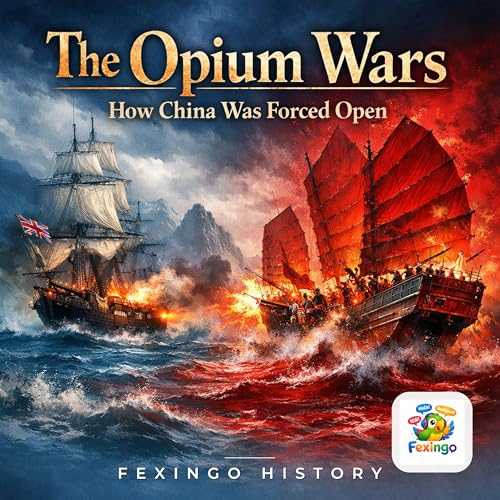
• The Opium Wars: The Battle of Chuenpi and the Nemesis
    Jun 7 2026
    In this episode, Lucas and Luna turn to the first major naval clash of the Opium War: the Battle of Chuenpi, fought in January 1841. They explore how the East India Company's iron-hulled steamship HMS Nemesis — a revolutionary vessel built in secret — changed naval warfare forever. Lucas walks through the tactical decisions of Captain William Hutcheon Hall, the desperate defense of the Chinese forts under Admiral Guan Tianpei, and the devastating effects of Congreve rockets on bamboo-and-junk fleets. They also unpack the broader implications: how British technological supremacy broke the Qing coastal defense system, and how the victory at Chuenpi cleared the way for the later capture of the Bogue Forts and the Treaty of Nanking. Along the way, they linger on the human cost — the Chinese casualties, the destruction of the Humen arsenal, and the stunned reaction from the Daoguang Emperor's court. This is a battle-by-battle look at how one steamship forced open a door that diplomacy had failed to budge. #OpiumWars #HMSNemesis #BattleOfChuenpi #GuanTianpei #WilliamHutcheonHall #NavalWarfare #Steamships #CongreveRockets #QingDynasty #DaoguangEmperor #BritishEmpire #ChinaHistory #19thCentury #MilitaryHistory #Humen #BogueForts #EastIndiaCompany #FexingoHistory Keep every episode free: buymeacoffee.com/fexingo
    Show More Show Less
    8 mins
  • The Opium Wars: The Secret Treaty of Whampoa
    Jun 7 2026
    In 1844, as Britain and China signed the Treaty of Wanghia, a lesser-known agreement was quietly being negotiated aboard a French warship anchored in the Pearl River. The Treaty of Whampoa, signed by French diplomat Théodore de Lagrené and Chinese official Qiying, gave France the same privileges Britain had won by force — but with a surprising twist. Lagrené insisted on including a clause protecting Catholic missionaries, which would later fuel French imperial ambitions in Indochina. This episode explores how France piggybacked on British military victories, the role of the French navy in East Asia, and why the treaty clauses on religious freedom set the stage for future conflicts. We also look at the unexpected figure of Joseph-Marie Callery, a French missionary who acted as interpreter and cultural broker, and how his knowledge of Chinese language and politics shaped the negotiations. What did the Qing court think of these 'most-favored-nation' demands, and why did they agree? The Treaty of Whampoa is a crucial but often overlooked piece of the Opium Wars story. #OpiumWars #TreatyOfWhampoa #ThéodoreDeLagrené #Qiying #JosephMarieCallery #FrenchImperialism #QingDynasty #MostFavoredNation #CatholicMissions #WhampoaAnchorage #PearlRiver #DaoguangEmperor #1844 #CantonSystem #Extraterritoriality #Indochina #History #FexingoHistory Keep every episode free: buymeacoffee.com/fexingo
    Show More Show Less
    7 mins
  • The Treaty of Wanghia: America's Opium War Opportunity
    Jun 6 2026
    In 1844, while Britain was still digesting its gains from the Treaty of Nanking, a new player slipped through the door: the United States. This episode follows Caleb Cushing, the Massachusetts lawyer and diplomat who sailed to Macau with warships and a bold demand: equal treatment with Britain. We explore the Treaty of Wanghia (望厦条约), the first formal diplomatic agreement between the US and China, and how it secured 'most-favored-nation' status for America — giving it all the trade privileges Britain had fought for, without firing a shot. We talk about the Qing negotiator Qiying (耆英), who faced a vastly different cultural challenge than he had with the British, and how the treaty's provisions on extraterritoriality and fixed tariffs became templates for later unequal treaties. We also touch on the treaty's little-known stipulations, like banning opium (a clause China insisted on but Americans ignored) and the curious story of how Cushing's presents — a carriage and pistols — nearly derailed the negotiations. It's a story of diplomacy, opportunism, and the quiet expansion of Western power in East Asia. #TreatyOfWanghia #CalebCushing #Qiying #OpiumWars #UnequalTreaties #USChinaRelations #MostFavoredNation #Macau #QingDynasty #DaoguangEmperor #Extraterritoriality #TariffAutonomy #CantonSystem #WhampoaAnchorage #AmericanDiplomacy #OpiumTrade #FexingoHistory #History Keep every episode free: buymeacoffee.com/fexingo
    Show More Show Less
    8 mins
  • The Opium Wars: The Tanka Boat Women Who Smuggled Opium
    Jun 6 2026
    This episode zooms in on the Tanka boat women of the Pearl River delta — a community of outcasts who became the backbone of the illicit opium trade in the decades before the Opium Wars. The Tanka lived on junks and sampans, barred from owning land or taking imperial exams. When the Daoguang Emperor banned opium in 1820 and Lin Zexu cracked down in 1839, the Tanka women — with their nimble crab boats and deep knowledge of local waterways — turned into the most effective smugglers on the coast. We tell the story of Ah Lan, a Tanka woman who made dozens of runs from Lintin Island to Canton, hiding opium chests under fish and vegetables, bribing corrupt Green Standard Army patrols, and outrunning imperial junks. Her life reveals the hidden economics of the opium trade: the role of women, the collaboration between Chinese outcasts and British merchants like Jardine & Matheson, and the brutal choices forced on communities who had no other path to survival. We also consider how the Chinese state criminalized an entire ethnic group, creating the very smugglers it tried to suppress. #Tanka #OpiumWars #AhLan #CrabBoats #PearlRiver #Lintin #LinZexu #DaoguangEmperor #JardineMatheson #GreenStandardArmy #Humen #Canton #Sycee #ChineseSmuggling #WomenSmugglers #QingDynasty #History #FexingoHistory Keep every episode free: buymeacoffee.com/fexingo
    Show More Show Less
    7 mins
  • The Opium Wars: How the Crab Fleet Outran an Empire
    Jun 5 2026
    When Emperor Daoguang banned opium in 1839, he didn't just ban a drug — he outlawed an entire economy that had been running for decades. But the ban didn't stop the trade. It pushed it underground, into the hands of Cantonese smugglers who built a fleet of fast, shallow-draft crab boats that could outrun Qing patrol boats and British warships alike. In this episode, Lucas and Luna explore the hidden world of the Tanka boat people, the junk-owning merchant families who financed the fleet, and the cat-and-mouse game played on the Pearl River delta. We follow the rise of the Ho clan's smuggling network, the daily reality of Tanka women like Ah Lan who concealed opium on their boats, and the staggering sums of sycee silver that changed hands in a single night. How did a patchwork of local fishermen and clan syndicates outmaneuver both the emperor's Green Standard Army and the Royal Navy? And what happened when the crab boats collided with the British blockade? This is the shadow war that defines the Opium Wars — the war on the water that no treaty ever mentioned. #OpiumWars #CrabBoats #Tanka #PearlRiver #CantonSystem #Lintin #DaoguangEmperor #LinZexu #JardineMatheson #smuggling #sycee #QingDynasty #EastAsia #BritishEmpire #History #FexingoHistory #China #19thCentury Keep every episode free: buymeacoffee.com/fexingo
    Show More Show Less
    5 mins
  • The Opium Wars: How the Parsees Became Opium Kings
    Jun 5 2026
    In this episode of The Opium Wars, Lucas and Luna explore the pivotal role of the Parsee community in the opium trade that led to war with China. The Parsees, Zoroastrian refugees from Persia who settled in Bombay and Calcutta, became the indispensable middlemen between the British East India Company and the Chinese market. They financed cultivation, shipped the drug on their own clippers, and dominated the supply chain from India to Canton. We meet key figures like Jamsetjee Jejeebhoy, who rose from selling bottles to become the wealthiest Parsee in Bombay, and the trading houses of Tata and Wadia. We also discuss the Parsees' unique cultural position — neither fully British nor Indian — and how their wealth shaped both colonial India and the conflict that forced China open. This is a fresh angle on the Opium Wars, focusing on the merchants who ran the trade but are often left out of the story. #OpiumWars #Parsees #JamsetjeeJejeebhoy #Bombay #Calcutta #EastIndiaCompany #Canton #OpiumTrade #Zoroastrian #BritishEmpire #QingDynasty #DaoguangEmperor #LinZexu #JardineMatheson #TradeHistory #ColonialIndia #19thCentury #FexingoHistory Keep every episode free: buymeacoffee.com/fexingo
    Show More Show Less
    8 mins
  • The Opium Wars: The Women Who Smuggled Opium
    Jun 4 2026
    In this episode of Fexingo History, Lucas and Luna explore the hidden role of women in the opium trade during the Opium Wars. While official histories focus on male merchants and officials, women—particularly the Tanka boat women of the Pearl River delta—were essential to smuggling opium from Lintin into Canton. Lucas explains how these women, often from marginalized fishing communities, navigated the river in crab boats, evading Qing patrols and British warships alike. He also discusses the legendary female smuggler Ah Lan, who led a fleet of Tanka boats and outwitted both Chinese imperial forces and British commanders. The episode examines how the Tanka women's unique social status, outside the Confucian family system, allowed them to operate in spaces forbidden to elite Chinese women. Lucas and Luna also reflect on the long-term consequences: the opium trade devastated Chinese society, but for the Tanka, it was a means of survival. The conversation ends with a look at how these women have been erased from mainstream narratives, and why recovering their stories matters for understanding the full complexity of the Opium Wars. #OpiumWars #Tanka #AhLan #CrabBoats #PearlRiver #Lintin #QingDynasty #Smuggling #Guangdong #WomenInHistory #MaritimeHistory #BritishEmpire #ChinaHistory #OpiumTrade #FexingoHistory #19thCentury #EastAsia #History Keep every episode free: buymeacoffee.com/fexingo
    Show More Show Less
    8 mins
  • The Opium Wars and the Chinese Rival Traders the British Overlooked
    Jun 4 2026
    In this episode of Fexingo History, Lucas and Luna explore a neglected angle of the Opium Wars: the Cantonese rival trading syndicates that the British East India Company dismissed as pirates. While Jardine and Matheson dominate the story, families like the Hos of Macau and the Wus of Canton ran parallel smuggling networks using fast 'crab boats' and deep ties to Tanka fisherfolk. When Lin Zexu clamped down in 1839, these syndicates didn't collapse — they adapted, bribing Qing officials and even trading with British crews under the noses of Chinese authorities. Lucas unpacks how the Ho family's wealth dwarfed many British merchants, why the Daoguang Emperor's crackdown missed them, and how their operations foreshadowed the Treaty Port system. A surprising look at the local capitalists who thrived in the chaos of war. #OpiumWars #CantoneseSmugglers #HoFamily #WuFamily #CrabBoats #Tanka #LinZexu #DaoguangEmperor #JardineMatheson #Macau #Canton #Lintin #Cohong #Sycee #QingDynasty #EastIndiaCompany #FexingoHistory #History Keep every episode free: buymeacoffee.com/fexingo
    Show More Show Less
    9 mins