• The rigged game of digital feudalism
    May 20 2026

    This podcast analyzes the erosion of democratic stability caused by extreme wealth inequality and the rapid advancement of artificial intelligence. Author Donald Harvey Marks argues that concentrated capital has transformed the United States into a plutocracy, where elite interests supersede the needs of the average citizen. This economic shift creates a "pathology of despair," characterized by housing crises, stagnant wages, and a declining sense of institutional legitimacy. The texts further explore the potential for Universal Basic Income (UBI) to provide a stable floor for a post-labor economy as AI threatens traditional jobs. However, the author distinguishes a true UBI from the current "patchwork" safety net, criticizing existing social programs for being inefficient, paternalistic, and difficult to access. Ultimately, the materials advocate for a fundamental redesign of the social contract to prevent total societal collapse in an increasingly automated world. This podcast is developed from my article: The UBI Illusion: Why Our Patchwork Safety Net of SNAP food stamps, section 8 housing and Medicaid Is still NOT Universal Basic Income. https://dhmarks.blogspot.com/2025/11/the-ubi-illusion-why-our-patchwork.html?m=1


    Show More Show Less
    23 mins
  • The end of Seeing is Believing
    May 19 2026

    From subtle disinformation campaigns to the fabrication of political reality, deepfakes are rapidly evolving from a technical curiosity into a severe threat to democratic elections, particularly in the United States. In this newest version 2 of my 2019 article on Deep Fakes, now version 2, I examine the sophisticated new tools and predictive analytics being used to manipulate voter behavior.

    This is an audio discussion based upon my blogpost The Weaponization of Synthetic Media: Deepfakes and the Erosion of Democratic Integrity., found on my Substack and on my personal blog ⁠The Weaponization of Synthetic Media: Deepfakes and the Erosion of Democratic Integrity. V2

    Show More Show Less
    22 mins
  • Deepfakes and the death of evidence
    May 19 2026

    From subtle disinformation campaigns to the fabrication of political reality, deepfakes are rapidly evolving from a technical curiosity into a severe threat to democratic elections, particularly in the United States. In this newest version 2 of my 2019 article on Deep Fakes, now version 2, I examine the sophisticated new tools and predictive analytics being used to manipulate voter behavior.

    This is an audio discussion based upon my blogpost The Weaponization of Synthetic Media: Deepfakes and the Erosion of Democratic Integrity., found on my Substack and on my personal blog The Weaponization of Synthetic Media: Deepfakes and the Erosion of Democratic Integrity. V2

    Show More Show Less
    24 mins
  • Software Obsolescence and the Crisis of Wasteful Windows Digital Ownership
    Dec 27 2025

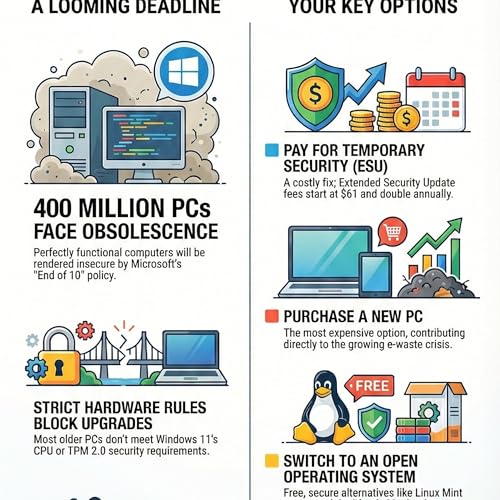
    I examine the widespread issue of planned obsolescence, specifically focusing on Microsoft's decision to end Windows 10 support in October 2025. This transition forced a massive hardware turnover because many existing computers lack the TPM 2.0 chips and specific CPU requirements necessary to officially run Windows 11. Experts warn this policy could lead to hundreds of millions of functional devices becoming e-waste, while also creating significant cybersecurity vulnerabilities for those who cannot afford to upgrade. To combat these issues, users are exploring alternatives such as Linux distributions, specialized IoT Enterprise editions, and third-party tools like Rufus to bypass installation restrictions. Simultaneously, international advocacy groups like Euroconsumers are pushing for right-to-repair legislation and mandatory software update durations to protect consumers from artificial product lifespans. Ultimately, the texts highlight a growing tension between corporate security standards and the environmental and economic impact of forced technological aging.

    Show More Show Less
    35 mins
  • Capitalism's_Endgame: AI, Inequality, and the Battle for a Post-labor world
    Dec 27 2025

    This conversation draws on my analysis covering general questions regarding major economic and societal challenges. Common themes include the analysis of wealth and income inequality, lack of affordability, critiques of prevailing economic systems, and the disruptive impact of technological change, particularly concerning Universal Basic Income in a post-labor economy, its application to vulnerable populations like the unemployed and the homeless, A.I., and the sustainability of crucial social systems like US Healthcare. I add general reflections on the negative effects upon social stability. LMK your reaction.

    Show More Show Less
    13 mins
  • Twilight Before the Storm: Neoliberalism, Crisis of Capitalism, and the 1930s Parallel
    Dec 27 2025

    Review by Donald Harvey Marks concerning Viktor Shvets' fantastic recent book: The Twilight Before the Storm. I analyze the book's central arguments, which posit that the world is in a dangerous transitional period marked by the decline of neoliberalism - an ideology rooted in free-market capitalism that sounds reasonable, but went astray. A core concept in the book is the "Fujiwara Effect," describing how advanced technology combined with financialization is reshaping the global economy and creating abundance. Shvets draws historical parallels to the 1930s to illustrate today's social and political fractures, warning of potential conflict unless we can reach a new societal consensus.

    Show More Show Less
    15 mins
  • Fixing USA Healthcare v3. Obstructive payers, ridiculous drug companies and dangerous hospitals.
    Dec 25 2025

    The United States healthcare system faces a dual crisis of unsustainable spending and suboptimal outcomes. Despite spending nearly one-fifth of its GDP—approximately $4.8 trillion in 2023—on healthcare, the U.S. ranks last among ten high-income nations in health equity, access, and outcomes. I propose a cogent, six-point reform strategy designed to restore systemic health by mandating universal participation, lowering the age of federal coverage, expanding the provider network, and drastically reducing administrative complexity. Discussed ACA, affordability crisis, drug prices, pharma benefit managers, expensive insurance options and needing to go without.

    Show More Show Less
    38 mins
  • Fixing USA Healthcare v1
    Dec 24 2025

    The United States healthcare system faces a dual crisis of unsustainable spending and suboptimal outcomes. Despite spending nearly one-fifth of its GDP—approximately $4.8 trillion in 2023—on healthcare, the U.S. ranks last among ten high-income nations in health equity, access, and outcomes. I propose a cogent, six-point reform strategy designed to restore systemic health by mandating universal participation, lowering the age of federal coverage, expanding the provider network, and drastically reducing administrative complexity.

    Show More Show Less
    16 mins