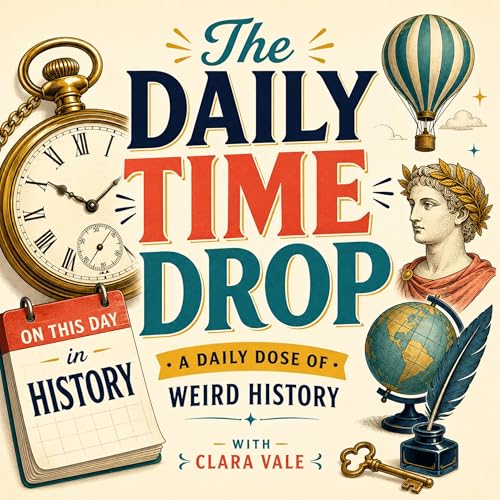
The Daily Time Drop cover art

The Daily Time Drop

The Daily Time Drop

By: Clara Vale
Listen for free

The Daily Time Drop is a daily ten minute trip through the stranger corners of history, hosted by Clara Vale.

Every episode takes one moment from this day in history and turns it into a sharp, funny, and surprising story. Expect odd inventions, bad decisions, forgotten scandals, accidental genius, royal weirdness, animal chaos, scientific breakthroughs, and the occasional reminder that humans have always been winging it with alarming confidence.

This is not a dusty history lesson. It is history with raised eyebrows, proper facts, and just enough sarcasm to keep the cobwebs off.

Perfect for your morning coffee, your commute, or that small window of time when you want to learn something without being trapped under a textbook.

Come back daily for strange events, clever context, and one excellent fact worth repeating later.

World
Episodes
  • When George Bush Was President for Eight Hours
    Jul 13 2026
    When George Bush Was President for Eight Hours

    On 13 July 1985, Vice President George H. W. Bush became Acting President of the United States for approximately eight hours whilst Ronald Reagan underwent surgery under general anaesthetic. It was the first time the Twenty-Fifth Amendment’s provisions for voluntary transfer of power had been used in practice, if not technically invoked. Bush spent his brief tenure playing golf in Maine, a masterclass in constitutional restraint. The episode also explores a failed 2003 French intelligence operation to rescue hostage Íngrid Betancourt from FARC guerrillas, the 645 CE Isshi Incident that reshaped Japanese imperial politics through assassination and reform, and the 1925 discovery of the Venus of Dolní Věstonice, one of the oldest known ceramic objects in the world, dating back some 26,000 to 31,000 years. From presidential procedures to ice age artistry, the thirteenth of July offers a cross-section of human decision-making at its most careful, most violent, and most enduring.

    Chapters
    • Intro What happens when the most powerful office in the world goes under general anaesthetic? The answer involves paperwork, a golf course in Maine, and one very calm vice president.
    • The Day Bush Was President (Sort Of) On 13 July 1985, Ronald Reagan signed a carefully worded letter transferring presidential authority to George H. W. Bush for eight hours during surgery. It was the first practical use of the Twenty-Fifth Amendment’s voluntary transfer provisions, though Reagan was careful not to formally invoke it. Bush played golf.
    • CTA Follow the show and share with a curious friend.
    • The French Rescue That Became a Scandal On 13 July 2003, French intelligence aborted a rescue operation for hostage Íngrid Betancourt, held by FARC guerrillas in Colombia. When details leaked, it became a political scandal. Betancourt was eventually freed in 2008.
    • The Isshi Incident On 13 July 645 CE, Soga no Iruka was assassinated at court in Japan, triggering the Isshi Incident and subsequent Taika Reforms. The conspirators included Nakatomi no Kamatari, whose reward was the Fujiwara surname. The Fujiwara clan would dominate Japanese politics for centuries.
    • The Venus of Dolní Věstonice On 13 July 1925, archaeologists in Czechoslovakia unearthed a ceramic figurine dating to between 26,000 and 31,000 years ago. The Venus of Dolní Věstonice is one of the oldest known ceramic objects in the world, proof that humans were firing clay millennia before the advent of agriculture or writing.
    • Outro The thirteenth of July reminds us that human capacity for care, craft, and survival spans from ice age figurines to constitutional golf games.
    Links
    • https://www.reaganlibrary.gov/archives/speech/letter-speaker-house-representatives-and-president-pro-tempore-senate-july-13-1985
    • https://constitutioncenter.org/blog/when-ronald-reagan-had-a-colon-surgery-the-25th-amendment-was-almost-invoked
    • https://www.nytimes.com/1985/07/14/us/reagan-transfers-power-to-bush-for-8-hour-period-of-incapacity.html
    • https://www.bbc.co.uk/news/world-latin-america-10520780
    • https://www.theguardian.com/world/2008/jul/03/colombia.france
    • https://www.liberation.fr/international/2003/07/17/ingrid-betancourt-la-dgse-aurait-tente-une-operation-de-sauvetage_439638/
    • https://www.britannica.com/event/Taika-era-reforms
    • https://www.worldhistory.org/Fujiwara_Clan/
    • https://www.britishmuseum.org/collection/term/x13408
    • https://www.moravianmuseum.cz/en/dolni-vestonice
    • https://www.sciencedirect.com/science/article/abs/pii/S0305440398903263
    Show More Show Less
    11 mins
  • Shipwrecked Bureaucrats, Burning Books, and Berlin's Very Angry Rave
    Jul 12 2026
    Shipwrecked Bureaucrats, Burning Books, and Berlin’s Very Angry Rave

    On 12 July 1488, Korean official Choe Bu returned home after an extraordinary accidental journey across Ming Dynasty China, having documented everything he saw. His diary remains one of the most valuable accounts of fifteenth-century Chinese life ever written. Four centuries later, on the same date in 1562, Franciscan friar Diego de Landa presided over the burning of Maya codices in Yucatán, destroying centuries of astronomical and religious knowledge. Only four Maya manuscripts are known to have survived. In 1995, Chinese seismologists successfully predicted a major Myanmar-China border earthquake, saving hundreds of lives through timely evacuation. And in 1997, Berlin’s ninth Love Parade was met with a counter-protest called the Hateparade, organised by those who felt the techno scene had been commercialised beyond recognition. Four stories about what gets recorded, what gets destroyed, and what survives long enough to matter.

    Chapters
    • Introduction Clara introduces the theme of documenting disaster and sets up the story of Choe Bu, a Joseon Dynasty official who survived shipwreck and captivity to write one of history’s great travel accounts.
    • Choe Bu’s Impossible Journey Home In 1488, Korean official Choe Bu was shipwrecked off the coast of China while returning home for his father’s funeral. Detained by Ming authorities suspicious of pirates, he used his literacy in classical Chinese to prove his identity. He was then escorted across the breadth of China via the Grand Canal, observing everything from infrastructure to daily life. His resulting fifty-thousand-character diary became one of the most valuable accounts of Ming society ever written.
    • Fray Diego de Landa Burns the Maya Books On 12 July 1562, Franciscan friar Diego de Landa ordered the burning of Maya sacred objects and codices in Maní, Yucatán. Between 27 and 40 manuscripts containing astronomical knowledge, religious ritual, and calendrical systems were destroyed. Only four Maya codices survived the Spanish colonial period. Ironically, De Landa later wrote one of the most important accounts of Maya culture and helped preserve elements of their writing system.
    • Chinese Seismologists Predict the Myanmar-China Earthquake On 12 July 1995, Chinese seismologists successfully predicted a major earthquake on the Myanmar-China border, allowing evacuations that limited casualties to eleven people. This stands as one of the clearest documented cases of successful earthquake prediction, a feat that remains exceptionally rare in modern seismology.
    • Berlin’s Love Parade Gets a Rival On 12 July 1997, Berlin’s ninth Love Parade was met with a counter-protest called the Hateparade, organised by those who felt the techno festival had become too commercial and had abandoned its underground roots. The protest later evolved into the annual Fuckparade, which continues as a demonstration against corporate takeover of countercultural spaces.
    • Outro Clara reflects on what survives in history: the records we make, the knowledge we destroy, and the arguments we preserve.
    Links
    • https://en.wikipedia.org/wiki/Choe_Bu
    • https://www.jstor.org/stable/2719418
    • https://en.wikipedia.org/wiki/Diego_de_Landa
    • https://en.wikipedia.org/wiki/Maya_codices
    • https://www.britannica.com/topic/Maya-codex
    • https://en.wikipedia.org/wiki/1995_Myanmar%E2%80%93China_earthquake
    • https://www.sciencedirect.com/science/article/abs/pii/0040195196000637
    • https://en.wikipedia.org/wiki/Loveparade
    • https://en.wikipedia.org/wiki/Fuckparade
    Show More Show Less
    14 mins
  • Frobisher's Ghost Island, El Chapo's Tunnel, and the First Phone Photo
    Jul 11 2026
    Frobisher’s Ghost Island, El Chapo’s Tunnel, and the First Phone Photo

    On 11 July across three centuries, three men made their mark through confidence, ingenuity, and technological ambition. In 1576, explorer Martin Frobisher sighted Greenland but mistakenly identified it as Frisland, a non-existent island shown on the influential but fictional Zeno Map. His error illuminates the challenges of 16th-century navigation and the consequences of cartographic fiction. In 2015, drug lord Joaquín ‘El Chapo’ Guzmán escaped Mexico’s Altiplano maximum security prison through a sophisticated 1.5-kilometre tunnel, exposing security failures and triggering an international manhunt. In 1997, Philippe Kahn shared the first photograph from a mobile phone, an image of his newborn daughter sent while waiting in a California hospital, prefiguring the instant visual communication now used by billions daily. Three stories of exploration, escape, and innovation reveal the enduring human capacity for ambition, both misguided and transformative.

    Chapters
    • Introduction Clara Vale introduces three 11 July moments spanning exploration, escape, and technological innovation, each shaped by human confidence and miscalculation.
    • Martin Frobisher Finds the Island That Wasn’t There In 1576, English explorer Martin Frobisher sighted Greenland but identified it as Frisland, a fictional island on the Zeno Map. His voyages, funded partly on false promises of gold, nevertheless opened early English exploration of the Canadian Arctic despite reliance on misleading cartography.
    • El Chapo’s Second Disappearing Act On 11 July 2015, Joaquín ‘El Chapo’ Guzmán escaped Mexico’s Altiplano maximum security prison through a 1.5-kilometre tunnel equipped with lighting, ventilation, and a rail-mounted motorcycle. He was recaptured in 2016 and extradited to the United States.
    • The First Phone Photograph In 1997, Philippe Kahn transmitted the first photograph from a mobile phone, an image of his newborn daughter Sophie, while in a California hospital. The demonstration established the foundation for instant visual communication now used globally.
    • Outro Clara reflects on how three moments of discovery, escape, and invention reveal the gap between human confidence and reality, shaping the future in unexpected ways.
    Links
    • https://www.britannica.com/biography/Martin-Frobisher
    • https://www.rmg.co.uk/stories/topics/zeno-map-fake-or-genuine
    • https://www.thecanadianencyclopedia.ca/en/article/sir-martin-frobisher
    • https://www.bbc.co.uk/news/world-latin-america-33479289
    • https://www.theguardian.com/world/2015/jul/12/el-chapo-escape-tunnel-mexico-prison
    • https://www.nytimes.com/2019/07/17/nyregion/el-chapo-sentencing.html
    • https://www.wired.com/2016/06/philippe-kahn-first-camera-phone/
    • https://www.cnn.com/2013/06/13/tech/mobile/first-camera-phone-photo/index.html
    Show More Show Less
    12 mins
adbl_web_anon_alc_button_suppression_t1
No reviews yet