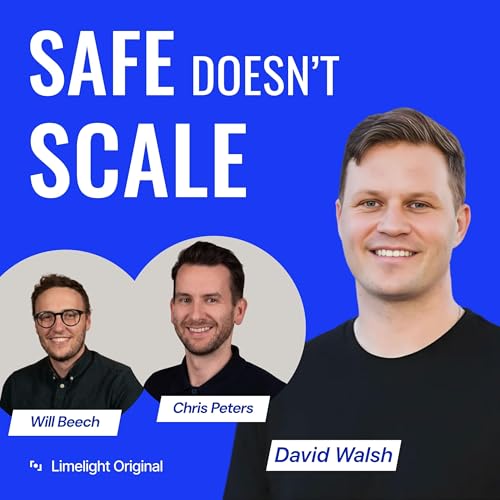
Safe Doesn't Scale cover art

Safe Doesn't Scale

Safe Doesn't Scale

By: David Walsh
Listen for free

"What's the ROI?" Those three words kill more creative marketing ideas than bad execution ever will. Not here. Safe Doesn't Scale is a weekly podcast for marketing and growth leaders. We’ll be interviewing Heads of Marketing, Unicorn Founders, and Revenue Leaders at B2B companies to prove that the riskiest marketing campaigns drive the biggest returns. While brands are burning $500K on LinkedIn ads that are generating zero demos, there’s someone out there who closed a $2M deal they sourced from a meme. Host David Walsh, Founder of Limelight, breaks down real examples from brands spending less and converting more by leaning into creator-led growth, unconventional distribution, and campaigns that make traditional marketers panic. You’ll learn: How growth leaders sell “unsafe” ideas to the C-suite How to attribute sales pipeline to content, creators, and social signals Why the campaigns that feel uncomfortable often drive the most revenue No e-book downloads. No buzzwords. This show is for marketers with a chip on their shoulder who are tired of playing it safe. We celebrate the campaigns that make legal sweat and sales teams crush quota. Because marketers who don't take risks won't exist in 2027.Copyright 2026 David Walsh Economics Leadership Management & Leadership Marketing Marketing & Sales
Episodes
  • The Biggest Risk on LinkedIn Isn't What You Post (with Dani Markovits from Shake Content) | Ep. 16
    Jun 18 2026
    Everyone can make content now, so everyone does. The result is a feed full of posts that read like they came out of the same prompt: same hooks, same tidy takeaways, same manufactured vulnerability. The part nobody mentions is that LinkedIn has quietly started grading the person behind the post, not just the words in it.ㅤDavid Walsh, founder of Limelight, sat down with Dani Markovits, who spent four years building LinkedIn's creator program before joining Shake Content as chief commercial officer. They get into what actually works on LinkedIn now, why the same post lands differently depending on who hits publish, and how to keep a posting habit from eating your week. You'll leave with a system that fits in an hour.ㅤDani brings the view from inside the platform: how the creator team thought about the feed, what the new algorithm changes reward, and why he almost turned down the agency job. He also talks through the moment early on when he sat down to post and could not think of a single thing to say.ㅤGuest BioDani Markovits is chief commercial officer at Shake Content, a LinkedIn-first B2B marketing agency based in London. Before joining Shake, he spent four years at LinkedIn as one of the first members of its creator team, working across Europe with hundreds of executives, founders, and athletes as the platform reshaped itself from a job board into a place people return to daily. He's now building content programs for B2B tech companies, professional services firms, and a growing roster of athletes. Somewhere along the way he picked up the nickname "the LinkedIn whisperer," which he says he wasn't a fan of at first and has since decided to own. He'll also admit, freely, that he still struggles with video.ㅤWhat We CoverWhy he left a big-name role: Dani explains why he turned down Shake at first, thinking it was too small a move from LinkedIn, and what changed his mind. He frames it as a mutual risk: he bet on them, they bet on him.What a "creator" actually is: He never felt like a creator, because he pictured polished YouTube video. His reframe: if you share your thoughts and expertise, you're already one, and it doesn't have to be your whole career.The authenticity premium: With AI slop flooding the feed, the content that stands out is the stuff only you can write. David adds the contextual-storytelling angle: "I was actually there, I actually did this."Why slop is an opportunity: Dani argues the flood of generic content is good news for anyone willing to play the long game without cutting corners. More noise raises the payoff for real insight.Beating the blank page: His fix for "what do I post about" is to stop hunting for original ideas. Look at your calendar, who you spoke to last week, what you're reading, then bring it back to your own lens.The one-hour-a-week system: Block an hour. Get one post out without overthinking it. Spend the rest leaving real comments and sending ten connection requests to ICPs, prospects, and people you respect.Sweated posts underperform: The posts you edit five times and sleep on are often not the ones that work. A quick thought or something funny frequently does better.Who's posting now matters: Under LinkedIn's new changes, the platform weighs the author as much as the content. The same post about running a business does better from someone who has actually run one.Comments as a strategy: A good comment is content in itself, and LinkedIn is prioritizing it. Many people now get more growth from commenting than from posting.The anti-pitch-slap: Cold DMs work, but engaging with someone's content for two weeks before reaching out makes a positive reply roughly ten times more likely.Boring industries win: The duller the field, the more room to stand out. A tax accountant who posts has far less competition than yet another marketing voice.The real risk: Dani's closing line is that the biggest risk on LinkedIn isn't picking the wrong thing to post. It's not posting at all.ㅤResources MentionedShake Content: Dani's LinkedIn-only agency, discussed throughout as the home for the founder and executive content programs he now runs.LinkedIn: the platform at the center of the conversation, where Dani spent four years on the creator team before advising clients on it.SaaStock: the SaaS conference where David first met Shake's CEO, James, who later pitched him on the business.ㅤSafe Doesn't Scale is hosted by David Walsh, founder of Limelight. New episodes drop weekly.
    Show More Show Less
    26 mins
  • Why Most B2B Influencer Reports Don't Survive a CFO Meeting (with Will Beech and Chris Peters from Moon at Dawn) | Ep. 15
    Jun 11 2026

    Most B2B influencer reports celebrate impressions and call it a campaign. The CFO signs off because the spend sits inside marketing. Nobody walks into the renewal confident about what the money actually bought.

    On this episode, David Walsh, founder of Limelight, talks with Will Beech and Chris Peters, co-founders of Moon at Dawn, a tech-first B2B influencer agency built around outcome-based pricing. They get into ICP resonance, attribution, and what it takes to put guarantees on an influencer campaign.

    Guest Bio

    Will Beech is co-founder of Moon at Dawn, leading client strategy and product. He spent eight years in B2B influence at Onalytica, working on programs for Siemens, IBM and AWS.

    Chris Peters is co-founder of Moon at Dawn, with 15 years in agency land, most recently as B2B Global Client Lead at Wavemaker (WPP). He writes the B2B Excellence newsletter.

    What We Cover
    • Who Moon at Dawn sells to: The three personas they target: enterprise brands, mature brands already running programs, and mid-market companies. Each measures success differently.
    • Influencer, not creator: Why they treat "influencer" as an umbrella covering subject matter experts and executives, which lands better with enterprise buyers.
    • What outcome-based pricing means: Guarantees on impressions against ICP accounts, frequency, and lead volume at a cost competitive with paid media.
    • The $20K floor: Around $20K for an outcome-priced engagement, $10K to $15K for an organic-only pilot. Below that, the data won't support a guarantee.
    • Resonance over reach: Why a single CEO like is happenstance, and how depth across the full buying committee is a better signal of commercial impact.
    • The Cyber Things campaign: A cybersecurity pilot tied to the Stranger Things finale that doubled the previous agency's metrics through ICP-based selection.
    • Aurora Scouts: The platform that surfaces collaboration opportunities, flags risk signals, and alerts the account lead when a client gets acquired.
    • The agency of the future: Chris on why 30 people and £3M turnover is the dead zone, and why the next acquisition cycle rewards service businesses with real tech inside.

    ㅤResources Mentioned
    • Onalytica: where Will built his B2B influencer career.
    • B2B Excellence newsletter: Chris's Substack, recommended by David on air.
    • Riverside and Gamma: cited as examples of mature brands running sophisticated programs.

    Safe Doesn't Scale is hosted by David Walsh, founder of Limelight. New episodes drop weekly.

    Show More Show Less
    32 mins
  • $700K in Nine Months: What a B2B Creator Talent Agency Actually Does (with Thibaut Souyris from Sales Creator Collective) | Ep. 14
    Jun 4 2026
    B2B creator marketing has a pricing problem nobody wants to admit. Brands don't know what to pay, creators don't know what to charge, and the gap between expectations is wide enough that deals collapse before they start. Meanwhile, creators are leaving money on the table every time a brand DM slides in with a lowball offer.ㅤDavid Walsh, founder of Limelight, sits down with Thibaut Souyris, founder of Sales Creator Collective, to break down how talent representation actually works in B2B influencer marketing and what brands running creator programs are getting wrong. Walk away with a concrete playbook for structuring creator campaigns, tracking ROI, and thinking about pricing in a market with no established rules.ㅤThibaut brings a decade of B2B sales training and three years of personal experience monetizing his own LinkedIn audience. He's now the agent for nearly 70 B2B creators, has closed over $700,000 in brand partnerships since founding Sales Creator Collective nine months ago, and has seen deals go from $200 to $200,000.ㅤGuest BioThibaut Souyris is the founder of Sales Creator Collective, a talent agency representing nearly 70 B2B LinkedIn creators in negotiating and closing brand partnerships. Before pivoting to talent representation, he spent nearly a decade as founder and CEO of SalesLabs, a Berlin-based B2B sales training company where he built a LinkedIn Top Voice following of 43,000+ and became known for the T-shaped SDR framework. He has been featured in HubSpot's blog, Sell Better, and G2, and publishes the Sales Creator Revenue Engine newsletter on Substack. He splits his time between Berlin, Switzerland, and San Miguel de Allende, Mexico.ㅤWhat We CoverHow Sales Creator Collective was born by accident: Thibaut organized a sales creator party in Berlin in the summer of 2025 to see his friends without paying the bill. Creators kept telling him they couldn't get good brand deals. Three months later, he had an agency. Nine months in, he has nearly 70 creators and $700,000 in closed deals.Talent agency vs. brand agency: the structural difference: Most creator agencies work for brands and find creators to fill a brief. Thibaut works for the creators. When a brand reaches out to one of his creators, the creator introduces Thibaut as their agent. He then handles negotiation, contracts, exclusivity clauses, usage rights, and invoicing so the creator can focus on content.Why B2B creators are undercharging: Thibaut's view is unambiguous: creators are leaving money on the table. The ROI brands get from creator campaigns significantly outpaces what they get from paid ads, yet creator rates have not caught up. When demand spikes, Thibaut doubles prices. When performance is down, he negotiates creators toward accepting lower rates rather than walking away empty-handed.How Limelight thinks about marketplace pricing: David shares the behind-the-scenes logic of how Limelight sets benchmarks in their annual pricing report. The goal is not to publish the highest or lowest number but to publish the number that gets a brand to reach out, allowing the creator to negotiate up from there. Both sides have been confused about rates for two and a half years, and that has not changed.Three-month contracts as the right starting point: Thibaut's recommended entry structure for brands new to influencer marketing is a three-month contract with one LinkedIn post per month per creator. With 20 creators, roughly five will perform well, 10 will perform okay, and five won't work. Renew the top performers on six to twelve-month contracts at higher rates. Let the bottom go.The affiliate link strategy brands are sleeping on: Brands consistently tell David that links don't work on LinkedIn. Thibaut disagrees with the framing. A single post with a dropped link performs poorly. A long-term creator strategy built around content bundles — webinars, videos, lead magnets with embedded affiliate links — creates a trackable path from curiosity to conversion. Thibaut helped one sales engagement platform generate $200,000 in trackable revenue against a $20,000 spend using this approach.How Thibaut tracks and reports creator performance: Sophia, his head of creator partnerships, collects impression data seven to ten days after every post and delivers reports to brands in near real time. The agency also manages the draft approval process and posting timing. Thibaut describes the ongoing management of paid creators as "a lot of babysitting."The campaign Thibaut is most proud of: Lovable: Sales Creator Collective ran a creator video campaign for Lovable, the AI app builder. Thibaut describes it as a defining example of what creator-brand alignment looks like when the product has authentic stories to tell. He also learned on this campaign that brand agencies and talent agencies are not competitors: they are partners.The creator tier system and the 80/20 reality: Twenty percent of Thibaut's creators generate eighty percent of revenue...
    Show More Show Less
    28 mins
adbl_web_anon_alc_button_suppression_t1
No reviews yet