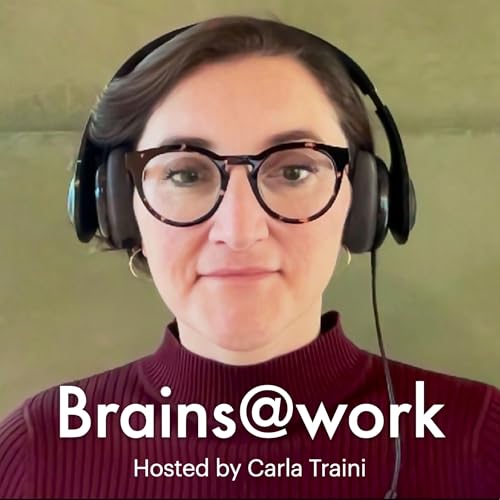
• Cristina Andersson & Human Centric Tech Futures
    May 6 2026

    Today, our focus is on human centric tech futures, robotics and AI. AI and Robotics is topic most of us are thinking and worried about and so it is great to have an expert like Cristina Andersson on the podcast.

    Show More Show Less
    41 mins
  • "Aren't We All a Little Neurodivergent?" | Why the Answer is No.
    Apr 26 2026

    In a world of shrinking attention spans and digital burnout, the phrase "everyone is a little bit neurodivergent" has become a common refrain. But is it accurate? And more importantly, is it helpful?

    In this episode of Brains at Work, we tackle one of the most persistent myths surrounding neurodiversity. We draw a clear, binary line between experiencing "symptoms" of a modern, fast-paced world and having a neurodivergent brain. Using a powerful metaphor, we explain why this distinction is vital for a respectful and effective workplace.

    Inside the Episode:

    • The Binary Reality: Why neurodivergence isn't a "mood" or a "phase," but a structural difference in how the brain is wired. It's a Yes or No answer.

    • The Erasure of Experience: How the "we are all a bit like that" narrative unintentionally neutralizes and invalidates the lived reality of those navigating profound, daily challenges.

    • Common Struggle vs. Neurological Condition: Acknowledging the middle ground—yes, we all face reduced attention spans and sensory overload today, but that is a byproduct of our environment, not our biology.

    • Cumulative Load: Understanding how neurodivergent difficulties stack up, creating a weight that goes far beyond the occasional distraction of a neurotypical professional.

    Key Strategic Insight:

    Validating everyone's struggle shouldn't come at the cost of erasing someone's identity. When we stop saying "everyone is a little neurodivergent," we can finally start providing the specific, targeted support that neurodivergent talent actually needs to thrive.

    Show More Show Less
    6 mins
  • The Architecture of Learning | Personal Styles and Leadership Strategy
    Apr 17 2026

    We are often taught what to learn, but rarely how we learn. Understanding your cognitive learning style is the ultimate career cheat code.

    In this episode of Brains at Work, we explore the mechanics of individual learning. We dive into why self-awareness in learning isn't just a personal growth tool, but a fundamental business asset. If you don't know how you learn, you can't accurately define where you struggle—and that makes growth nearly impossible.

    Inside the Episode:

    • Identifying Your Cognitive Signature: A deep dive into different learning modalities (visual, kinesthetic, social, or analytical) and how to identify yours.

    • The Vulnerability of Learning: How to ask for help when you hit a wall, and why "not knowing how you learn" is often mistaken for a lack of ability.

    • Learning as a Team Contribution: Understanding that your specific way of processing information is part of your unique value proposition to the team.

    • The Leader as a Talent Architect: Why modern leadership requires the ability to identify and support the diverse learning styles of every team member to maximize operational efficiency.

    Strategic Insight:

    For a leader, knowing how your team learns is as important as knowing their job description. When you align tasks with a person's natural learning architecture, you don't just improve performance—you eliminate the friction of "failure" and replace it with a culture of continuous evolution.

    Show More Show Less
    7 mins
  • The Multitasking Myth | Context Switching and Cognitive Load
    Apr 10 2026

    We've been told that being able to "do it all at once" is a badge of honor. The truth? Your brain is physically incapable of it.

    In this episode of Brains at Work, we dismantle the urban legend of multitasking. Whether you are neurotypical or neurodivergent, the cognitive mechanics are the same: your brain cannot perform two high-level cognitive tasks simultaneously. What we call multitasking is actually Multi-threading—and it's costing you more than you think.

    Inside the Episode:

    • The Biology of Focus: Why the prefrontal cortex can only handle one complex stream of information at a time.

    • Multi-threading vs. Multitasking: Understanding the "switching cost"—the invisible tax of mental energy lost every time you jump between an email, a meeting, and a spreadsheet.

    • The Illusion of Efficiency: Why we feel more productive when we are busy with multiple tasks, even though our actual output quality and speed are dropping.

    • Neurodivergence and the Attention Trap: How fragmented attention impacts ADHD and neurodivergent brains differently, and why "deep work" is the only real competitive advantage.

    Strategic Insight:

    Multitasking isn't a skill; it's a systemic error. In a world of constant interruptions, the real leadership challenge is protecting your team's "cognitive bandwidth" from the friction of multi-threading.

    Show More Show Less
    9 mins
  • The Disclosure | Leading Through High-Stakes Conversations
    Apr 3 2026

    When a team member says, "I've just received a neurodivergent diagnosis," they aren't just sharing medical news. They are extending a hand of trust.

    In this episode of Brains at Work, we tackle one of the most delicate and vital moments for any modern leader: how to respond when a colleague or direct report discloses their neurodivergence. Whether you are a manager or the CEO of an entire organization, your reaction sets the tone for your company's culture and determines the future performance of that individual.

    Inside the Episode:

    • The First 60 Seconds: Why your immediate reaction matters more than any HR policy, and how to avoid the "common traps" (pity, skepticism, or dismissal).

    • Leadership Responsibility: Understanding that disclosure isn't a "problem to solve," but a request for a more effective partnership.

    • The Manager's Playbook: Practical steps to transition from the personal conversation to professional support without overstepping boundaries.

    • Privacy and Psychological Safety: How to handle the information legally and ethically while building a culture where people feel safe enough to be their authentic selves.

    Strategic Insight:

    A diagnosis doesn't change the person; it changes the manual for how to lead them effectively. Successful leaders don't see disclosure as a liability—they see it as the missing data they needed to unlock that person's full potential.

    Show More Show Less
    9 mins
  • The Unspoken Contract | Alignment, Expectations, and Invisible Rules
    Mar 27 2026

    When we sign a job offer, we agree to a salary and a set of tasks. But what about the "hidden" expectations we never actually discussed?

    In this episode of Brains at Work, we explore the concept of the Psychological Contract—the unspoken partnership between an employer and an employee. Just like in a personal relationship, discovering you aren't "on the same page" usually happens too late. For neurodivergent professionals, these invisible rules can be the difference between thriving and failing.

    Inside the Episode:

    • The "Defined" vs. The "Implicit": Breaking down the gap between the formal Job Description and the social/cultural expectations that aren't in the handbook.

    • The Relationship Parallel: Why "defining the relationship" (DTR) is just as critical in the boardroom as it is in private life to avoid misalignment and resentment.

    • The Neurodivergent Disconnect: Why relying on "common sense" or "reading the room" is a flawed strategy for neurodiverse teams and how it leads to burnout.

    • The Audit Checklist: Practical advice for both neurotypical and neurodivergent professionals to extract information and clarify non-verbal expectations.

    Strategic Insight:

    Clarity is a form of kindness, but in business, it's a form of Operational Efficiency. When expectations are explicit, we remove the cognitive load of "guessing," allowing every brain to focus on the work that actually matters.

    Show More Show Less
    7 mins
  • How AI is reshaping the world of consultancy
    Mar 23 2026

    Undercurrents of Change is a podcast about the signals beneath the surface of change. In each episode, Marc Bolick and Arne van Oosterom explore the deeper shifts shaping business, leadership, and innovation, beyond the headlines and the hype. Through conversations with entrepreneurs, builders, and thinkers, we look at what people are actually experiencing as they navigate uncertainty and transformation in their work.

    In this first episode, we speak with Miikka Leinonen, entrepreneur, business owner, and co-author of AI Pathway. Mika works closely with leadership teams trying to turn AI ambition into real organizational change.

    Together we explore how AI is reshaping the world of consultancy, why many leadership teams still struggle to act despite the urgency, and the deeper question many professionals are quietly asking themselves today: what is my real value in a world where AI can do so much of the work?

    It's an honest conversation about experimentation, uncertainty, and the human side of technological change.

    Show More Show Less
    37 mins
  • The Cost of Fitting In | Professionalism, Masking, and Burnout
    Mar 20 2026

    Every professional wears a mask, but for some, the weight of that mask is unsustainable.

    In this episode of Brains at Work, we explore Masking—the conscious or subconscious suppression of natural responses to conform to social expectations. We start with a universal truth: in the business world, everyone masks to some degree. However, for neurodivergent individuals, this isn't just "office etiquette"—it is a constant, high-stakes performance that leads to a specific type of exhaustion.

    Inside the Episode:

    • The Universal Mask: Why the modern workplace demands a "standardized" persona (socializing, eye contact, and small talk) and how we all participate in this social contract.

    • The Neurodivergent Tax: Analyzing the intensity of masking for ADHD and Autistic professionals, where every gesture and sentence is manually processed.

    • From Burst to Burnout: Understanding the cycle of the "Autistic/ADHD Burst"—the sudden collapse of energy after prolonged masking—and how it differs from standard work stress.

    • Sustainable Culture: How leaders can reduce the "masking tax" to unlock genuine productivity and prevent long-term talent attrition.

    Key Strategic Insight:

    If your team is spending 40% of their cognitive energy trying to "act normal," you are only getting 60% of their actual talent. Reducing the need for masking isn't just a wellness initiative; it's an ROI strategy for human capital.

    Show More Show Less
    9 mins