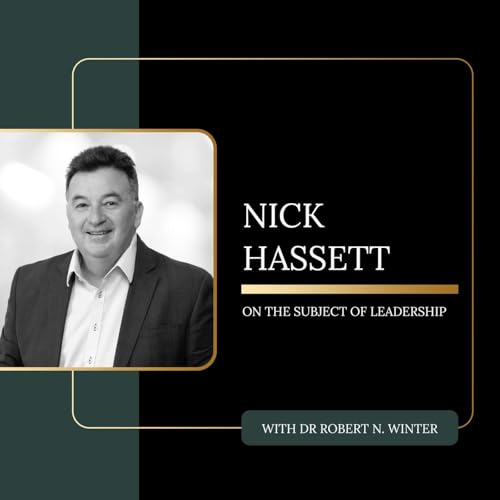
On the Subject of Leadership cover art

On the Subject of Leadership

On the Subject of Leadership

By: Dr Robert N. Winter
Listen for free

Summary

On the Subject of Leadership is a long-form conversation about what makes organisations work—and why much of what passes for leadership advice does not. Each episode features an executive or practitioner whose conclusions have been tested in consequential settings. The work is analytical, not anecdotal: incentives, power, trust, culture, and the limits of authority. Ideas are challenged, not affirmed. This is not motivational theatre. It is a search for what holds up under pressure. If you take leadership seriously and are sceptical of easy answers, this is for you.Copyright 2026 Dr Robert N. Winter Economics Management Management & Leadership Philosophy Social Sciences
Episodes
  • Pascal Uerlings: Good Thing, Bad Thing, Who Knows?
    May 12 2026

    Most technology transformations do not stall because the technology fails. They stall because no one in the room has resolved a prior question—what, precisely, is being changed, and who is accountable for that change surviving contact with the business. Pascal Uerlings has spent six years working at that unresolved question, building one of Australia's more prominent Salesforce and AI implementation consultancies in the process. This is a conversation about why most AI initiatives fail in the operating model rather than the server room, what genuine psychological safety actually requires of a leader, and the gap between the founder narratives one reads on LinkedIn and the slower, less photogenic work of building something that lasts.


    Takeaways

    1. The model that made Pascal walk: why a consultancy organised around revenue targets cannot, in practice, organise around customers
    2. Founding J4RVIS in April 2020, weeks before the pandemic — and why timing concerns were never the strongest argument against doing it
    3. The structural reasons AI pilots produce enthusiasm in strategy decks and entropy in operating models
    4. Voice agents and the architecture of agentic AI: why the future is multiple agents talking to each other, and why that resembles the integration challenges of the past at higher sophistication
    5. The mischaracterisation of Gen Z as disengaged — and how the complaint usually says more about the leaders making it
    6. What it actually takes to build a culture of safety in cross-cultural teams, particularly across Australia and the Philippines
    7. Imposter syndrome reframed not as a deficit but as evidence of care — and why performing certainty is a worse leadership failure than admitting doubt

    Chapters

    [00:00] – Cold open
    [01:14] – Subscriber message
    [03:14] – Introduction
    [05:37] – From Belgium to Australia: the path to founding J4RVIS
    [13:00] – Building a people-centred consultancy: values before customers
    [19:15] – Pulling the trigger: launching weeks before COVID
    [23:09] – Imposter syndrome as a leadership superpower
    [29:19] – Why AI initiatives stall before production
    [39:04] – Voice agents and the architecture of agents talking to agents
    [48:22] – Leading across generations and cultures
    [57:12] – Identity, safety, and leading from who you are
    [01:02:56] – Good thing, bad thing, who knows? Lessons from six years
    [01:06:58] – Lightning round and close


    Guest Links & References

    • Pascal Uerlings — linkedin.com/in/puerlings/


    About the Show

    On the Subject of Leadership is a long-form conversation series examining leadership, governance, organisational life, and decision-making—without slogans or performative certainty.


    Hosted by Dr Robert N. Winter.


    Subscribe / Follow

    Newsletter / Website: robert.winter.ink

    LinkedIn: dr-robert-winter

    X: @DrRobertWinter

    Instagram: DrRobertWinter

    Mastodon: social.winter.ink/@robert

    YouTube: @OnTheSubjectOfLeadership


    Credits

    Recorded remotely via Riverside

    Music: The Hidden Thread by Roberto Prado / Artlist

    Show More Show Less
    1 hr and 9 mins
  • The Chair's Dilemma: When the Board Becomes the Problem
    May 8 2026

    A bonus release from the Inner Circle feed, made available to all listeners. Weekly article readings are normally reserved for Inner Circle members; this is one of the occasional pieces opened more widely. Join the Inner Circle at robert.winter.ink

    The most dangerous failure in corporate governance is rarely the rogue executive or the captured auditor. It is the quieter pattern of a board of intelligent, well-credentialled directors collectively unable to act on what each of them already privately suspects. This week's article works through how that silence forms, why governance codes cannot legislate against it, and what a chair can do about it before the crisis breaks rather than after.

    In This Article

    • Board failure usually looks ordinary. The dramatic governance scandal is rarer than the Monday meeting at which a softening result is referred to the next strategy session and nothing follows.
    • Pluralistic ignorance, not lack of information, is the principal mechanism. Directors privately hold concerns they fail to voice because they assume their colleagues do not share them.
    • Governance codes describe the architecture of a boardroom but say very little about its inhabiting. A board with every box ticked can still fail at the task its structure exists to enable.
    • Burke's 1774 distinction between trustee and delegate, addressed to the electors of Bristol, defines the office of director more accurately than any code currently on the books.
    • The markers of a healthy board are not exotic. They are visible to anyone who attends one for an hour, and the conditions for them are established years before any crisis arrives.

    A Thought With Which To Sit

    The director is a trustee of the company's long-term interest, not a delegate of the room's mood. Boards forget this and call the forgetting collegiality.

    Further Reading

    • Janis, I. L. — Victims of Groupthink (1972)
    • Westphal, J. D., & Bednar, M. K. — Pluralistic Ignorance in Corporate Boards, Administrative Science Quarterly (2005)
    • Sonnenfeld, J. A. — What Makes Great Boards Great, Harvard Business Review (2002)
    • Burke, E. — Speech to the Electors of Bristol (1774)
    Show More Show Less
    10 mins
  • Nick Hassett: The Problem Won't Be Solved by the Thinking That Created It
    Apr 28 2026
    Nick Hassett has spent more than three decades intervening in organisations under pressure—not as a theorist, but as someone called in when the politics are already difficult and the gap between what the board believes is happening and what is actually happening has grown wider than anyone has yet said aloud. His work spans banking, technology, essential infrastructure, and sport across Australia and Asia, covering the full arc of an organisation in trouble: mobilisation, intervention, and recovery.In this conversation, we explore why transformation programmes fail when the people leading the change are, in important respects, the architects of the conditions they are trying to fix. Drawing on Nick's extensive experience working at the intersection of boards, executive teams, and operational reality, we discuss what it actually takes to bring a different structure of thinking to bear—where alignment breaks down, why accountability cultures can paradoxically produce silos, and what boards are getting wrong about AI governance while their staff adopt it unsanctioned.TakeawaysWhy the thinking that built the current operating model cannot be the same thinking that dismantles it — and what a "different brand of leadership" requires in practice.How accountability cultures, left uncalibrated, create silos and destroy the cross-functional collaboration on which real execution depends.The fragility of organisational alignment — why consensus often evaporates at the boardroom door, and what that costs in misdirected effort.Where the board–CEO relationship breaks down during transformation, and why that single relationship is the first point of failure.What boards are missing about shadow AI adoption — and why banning a technology does not eliminate the risk.The question nobody asks at the start of a transformation: what does success look like, how will we measure it, and what is my exit strategy?Why the pattern repeats — Six Sigma, digital, AI — and what that tells us about the enduring nature of leadership problems beneath the technology of the moment.Chapters[00:00] – Cold open: every box ticked, still failing — the accountability trap that creates silos[01:14] – Subscriber message[01:41] – Show introduction: the thinking that built the problem cannot fix it[03:58] – A career forged by evolution: thirty-five years in strategy execution[05:22] – The constant is people: helping organisations think through problems[05:50] – The common thread across banking, infrastructure, technology, and sport: regulation and complexity[07:58] – Mobilisation, intervention, and recovery: how engagements begin[08:32] – "I'll see you in two years": why organisations that try to go it alone usually fail[10:54] – Headcount reduction as the lazy option, and strategy by "throwing wheat at the side of a barn"[13:13] – The humility to not compete on subject matter expertise[14:23] – Challenging the starting hypothesis: when the board's diagnosis is part of the problem[16:35] – Coaching through the valley of despair — and futures that don't include everyone[18:07] – Scientism versus the relational: why diagnosis alone does not produce change[18:49] – Case study: an accountability culture that siloed itself into failure[21:43] – True accountability is cross-functional: responsibility, ownership, and ramifications[22:42] – Getting off the dance floor and onto the balcony: input measures versus outcomes[23:59] – The disinterested third party: putting yourself in the MD's shoes[26:59] – Pragmatism and the rate of change an organisation can absorb[28:00] – Where alignment breaks down: the board–CEO relationship as first point of failure[31:36] – Translation risk: how board priorities wash through policy, management systems, and operations[33:41] – Alignment that is only room deep: when consensus evaporates at the door[35:08] – The investment in alignment: spend the time or guarantee the points of failure[36:02] – The board's information problem: filtered reporting and the limits of oversight[37:04] – How board directors discharge their obligations: questioning management[38:15] – Intergalactic battlestars: boards that bounce from issue to issue[39:15] – AI and the board: why workshopping how to use AI may be the worst thing a board could do[41:33] – Men in Black and collective panic: when AI-generated material is convincing but not plausible[43:49] – Shadow AI: banning a technology does not eliminate the risk[44:15] – Head in the sand: the competitive cost of inaction on AI[45:56] – Discussing failure rates: the reluctance to talk honestly about what is not working[47:10] – Digital déjà vu: ten years ago it was digital, twenty years ago it was Six Sigma[49:31] – The flight magazine and the sixteen black belts: impetuous adoption without thinking through implications[51:15] – The problem remains a leadership problem: replace the technology label, and the ...
    Show More Show Less
    1 hr and 5 mins
adbl_web_anon_alc_button_suppression_c
No reviews yet