• America is Going Ocean Blind: Critical Sensors Are Being Removed
    Jun 5 2026

    Another major setback to US Ocean research policy due to the Trump Administration’s attack on science.

    The federal government is dismantling much of the Ocean Observatories Initiative, a vast network of nearly 900 deep-ocean sensors that track ocean temperatures, marine heatwaves, fisheries conditions, carbon absorption, and changes in major ocean currents.

    Supporters say the move reflects changing priorities and a more flexible research strategy. Critics warn it could leave scientists, fishermen, coastal communities, and weather researchers with fewer tools to monitor a rapidly changing ocean.

    At the same time, proposed changes to federal grantmaking could fundamentally alter how scientific research is funded in the United States, raising questions about peer review, political oversight, international collaboration, and America’s future role in global climate and ocean science.

    In this episode of Meteorology Matters, we examine what’s being removed, what’s changing, who is affected, and what the long-term implications could be for weather forecasting, climate research, marine industries, and scientific leadership worldwide.

    Show More Show Less
    26 mins
  • The Hurricane Checklist Most People Forget: How to Make Your Home Survive the Storm
    Jun 1 2026

    Hurricane season is here, but real preparation is about more than buying water and batteries.

    In this episode of Meteorology Matters, created by meteorologist Rob Jones, we look at what actually helps homes survive hurricanes: sealed roofs, protected windows, stronger garage doors, hurricane shutters, flood barriers, backup power, insurance documentation, and the overlooked steps many people forget until a storm is already approaching.

    We also explain why the “building envelope” matters, how one failed opening can lead to major structural damage, why closing interior doors can reduce pressure on a roof, and how modern mitigation standards such as FORTIFIED construction can lower risk and reduce losses.

    The episode also looks back 100 years to the devastating 1926 Great Miami Hurricane and the October 1926 Cuba Hurricane, showing why historical storms still matter today as millions of people live in hurricane-prone areas.

    Preparedness is not panic. It is planning, mitigation, and giving your family and your home the best chance before the storm arrives.

    Show More Show Less
    58 mins
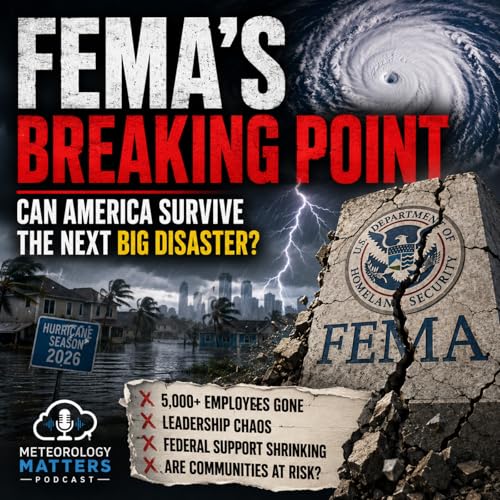
  • FEMA’s Breaking Point: Can America Survive the Next Big Disaster?
    May 29 2026

    As the 2026 hurricane season begins, FEMA faces one of the most turbulent periods in its history.

    More than 5,000 employees have left the agency since 2025. Leadership has changed repeatedly. Disaster-response staffing remains stretched, while a new federal reform plan proposes shifting more responsibility from Washington to states and local governments.

    Supporters say the changes could reduce bureaucracy and make disaster recovery more efficient. Critics warn they could leave vulnerable communities with fewer resources when major disasters strike.

    In this episode of Meteorology Matters, we examine FEMA’s readiness for the 2026 hurricane season, the agency’s workforce and leadership challenges, proposed changes to federal disaster policy, the future of flood insurance, and what these reforms could mean for hurricane-prone states like Florida and communities across America.

    As hurricanes, floods, wildfires, and other extreme weather events continue to test emergency management systems, one question looms over the season ahead:

    Is FEMA prepared for the next major disaster, or is the nation entering a new era of disaster response?

    Show More Show Less
    28 mins
  • Florida Homes Are Being Lifted Into the Sky Before Hurricane Season
    May 27 2026

    Florida is witnessing one of the biggest transformations in coastal housing history.

    Across the state, homeowners are spending hundreds of thousands of dollars to raise entire homes above floodwaters as hurricane risks, insurance costs, and storm surge threats continue to intensify. Some houses are being lifted 10, 15, even 20+ feet into the air.

    In this episode of Meteorology Matters, we break down the massive new Elevate Florida mitigation program, FEMA funding, NFIP flood insurance rules, breakaway wall engineering, and the race to protect homes before the next major storm strikes.

    Why are elevated homes becoming the future of coastal Florida? How do breakaway walls work during hurricane storm surge? Why can enclosed lower levels dramatically increase insurance premiums? And what happens to Florida communities if this trend accelerates over the next decade?

    From billion-dollar mitigation projects to the engineering behind lifting entire neighborhoods, this is the future of hurricane survival in Florida.

    Show More Show Less
    21 mins
  • Better Weather Forecasts, Growing Uncertainty
    May 23 2026

    Weather forecasting has never been more advanced. Yet many scientists say Earth’s atmosphere and oceans may be becoming more interconnected, nonlinear, and difficult to fully model.

    In this episode of Meteorology Matters, meteorologist Rob Jones explores the growing “tug of war” unfolding across global weather and ocean systems — from warming oceans and aerosol cleanup to low cloud feedbacks, El Niño (“el NEEN-yo”), rapid intensification, and long-term sea level rise.

    Topics include: • Why reducing air pollution may unintentionally accelerate warming in some regions • The surprising role aerosols and cloud reflectivity play in Earth’s temperature balance • Concerns surrounding weakening ocean circulation patterns like the AMOC • Why some recent temperature spikes are difficult for current forecast models to fully explain • New research suggesting sea levels may continue rising for centuries beyond 2300 • NOAA’s outlook for the 2026 Atlantic hurricane season • Why a “below-normal” hurricane season does not mean low risk • The growing challenge of rapid intensification forecasting

    The conversation also explores broader questions surrounding environmental policy, forecasting uncertainty, and whether current Earth-system models are fully equipped to capture the complexity of the future.

    Forecasting is improving. But the atmosphere and oceans may also be evolving in ways that are becoming harder to simplify.

    You’ve been listening to Meteorology Matters, created by meteorologist Rob Jones.

    Show More Show Less
    42 mins
  • When Politics Turns on Science Globally
    May 15 2026

    Weather scientists are increasingly being ignored, censored, arrested, or pushed aside by political movements around the world. From NOAA staffing cuts in the United States to jailed earthquake scientists in Italy and arrested climate activists in Europe, this episode explores the growing global conflict between science and political power.

    Meteorology Matters examines how attacks on scientific institutions can weaken disaster preparedness, public safety, weather policy, and public trust and why this pattern is no longer isolated to one country or one political system.

    Show More Show Less
    45 mins
  • 2026 Weather Shock: Super El Niño, Record Heat, and a Planet Running Hot
    May 8 2026

    A Super El Niño may be forming for 2026, and it could push global heat, extreme weather, flooding, drought, and hurricane impacts into dangerous new territory.

    A Super El Niño may be forming for 2026, and it could push global heat, extreme weather, flooding, drought, and hurricane impacts into dangerous new territory.

    In this episode of Meteorology Matters, we break down the 2026 global weather outlook and why scientists are watching the possibility of record heat, a historic El Niño, and accelerating warming across the planet. The forecast signals point toward a year that could challenge or surpass recent temperature records, with major implications for rainfall patterns, agriculture, food security, Atlantic hurricanes, and global weather extremes.

    We look at why the atmosphere and oceans are running hotter, how a powerful El Niño can reshape weather across North America, South America, Asia, Africa, and the tropics, and why warmer oceans and a more moisture-loaded atmosphere can intensify both drought and flooding. We also explain what a strong El Niño could mean for the 2026 Atlantic hurricane season, including fewer overall hurricanes but continued risk from Gulf storms, inland flooding, and the “one storm” rule.

    This is not just a forecast for one season. It is a look at how the old weather patterns are changing, why past El Niño events may no longer be reliable guides, and what 2026 could reveal about the future of extreme weather.

    Show More Show Less
    33 mins
  • AI Weather Forecasts Are Getting Smarter. So Why Are We Weakening NOAA?
    May 5 2026

    AI is revolutionizing weather forecasting. New models like Google DeepMind’s GraphCast and GenCast, ECMWF’s AIFS, and NOAA’s experimental AI-GEFS are producing faster, cheaper, and increasingly accurate forecasts, including major improvements in hurricane track prediction, ensemble forecasting, and global weather modeling.

    But there is a dangerous paradox at the center of this breakthrough.

    AI weather models do not replace the weather observing system. They depend on it. Satellites, weather balloons, ocean buoys, aircraft reconnaissance, radar, NOAA research, and experienced meteorologists are still the foundation of every forecast. Without high-quality data and the scientists who understand it, even the smartest AI system can start producing weaker guidance.

    In this episode of Meteorology Matters, we break down The Forecast Paradox: while artificial intelligence is making weather forecasts faster and more powerful, proposed cuts to NOAA, weather research, satellites, staffing, and atmospheric science infrastructure could weaken the very system that feeds and validates these models.

    We connect AI weather forecasting, hurricane prediction, rapid intensification, storm surge modeling, NOAA budget cuts, the future of the National Weather Service, and the growing competition between U.S. and European weather models. The big question: can AI help save weather forecasting if we dismantle the infrastructure it depends on?

    The future of forecasting is not AI versus meteorologists. It is AI plus observations, AI plus research, AI plus human expertise, and AI plus a strong national weather enterprise.

    Show More Show Less
    42 mins