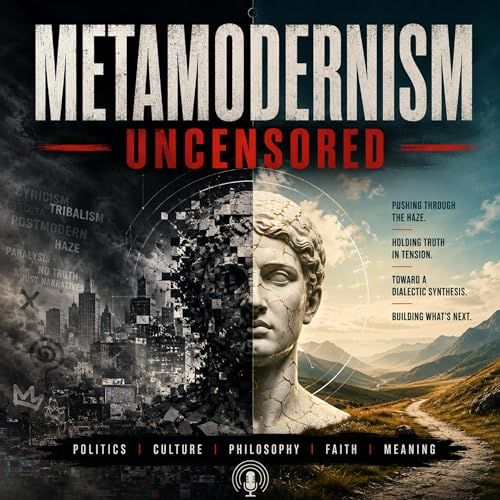
Metamodernism Uncensored cover art

Metamodernism Uncensored

Metamodernism Uncensored

By: Sean Dempsey
Listen for free

Metamodernism Uncensored is a podcast exploring the ideas, tensions, and cultural forces shaping life beyond postmodernism. Through candid conversations on politics, culture, philosophy, faith, and meaning, the show seeks to cut through the haze of cynicism, tribalism, and ideological paralysis that defines much of contemporary America. Rather than choosing sides in the culture war, Metamodernism Uncensored pursues a dialectical synthesis... holding competing truths in tension, seeking deeper understanding, and exploring what a more integrated, constructive future might look like.Sean Dempsey Political Science Politics & Government
Episodes
  • The First Postmodernist: How Michel Siffre Lost God in the Darkness
    Jun 13 2026

    This episode explores Sean Dempsey’s 2025 novel The Lost Tapes of Doctor Michel Siffre not merely as a historical thriller, but as a profound cultural allegory for the spiritual condition of the modern West. While Michel Siffre was a real French geologist who famously isolated himself deep underground in the 1960s and 1970s to study human perception of time, Dempsey transforms those experiments into something far more symbolic. The hosts argue that Siffre’s descent into the lightless depths of Midnight Cave mirrors civilization’s simultaneous descent into the intellectual darkness of postmodernism. As traditional sources of meaning—religion, objective truth, shared narratives, and cultural certainty—began to erode during the late twentieth century, Siffre found himself physically experiencing the very condition that philosophers were increasingly describing: a world untethered from fixed reference points. His loss of temporal orientation becomes a powerful metaphor for a culture losing its metaphysical bearings.


    Throughout the discussion, the hosts examine key passages from Siffre’s recordings and compare them to the emerging ideas of thinkers such as Michel Foucault, Jacques Derrida, and Jean-François Lyotard. The cave becomes a living embodiment of postmodern thought: a place where certainty dissolves, narratives fracture, and reality itself becomes suspect. What begins as a scientific inquiry slowly transforms into a confrontation with nihilism, loneliness, and the terrifying possibility that meaning is neither discovered nor guaranteed. The hosts pay particular attention to moments where Siffre questions the nature of truth, memory, and identity, arguing that his psychological unraveling parallels the broader cultural journey from modern confidence to postmodern skepticism.


    The episode concludes by tracing the evolution of postmodernism from Siffre’s era to the present day. What began as an intellectual critique of certainty eventually escaped the academy and reshaped politics, culture, religion, and personal identity. Yet the hosts argue that the story does not end in darkness. Just as Siffre ultimately emerged from the cave, contemporary culture appears to be searching for a path beyond pure deconstruction. The discussion explores whether newer movements such as Metamodernism represent an attempt to climb back toward meaning without abandoning the lessons learned in the darkness. In that sense, The Lost Tapes of Doctor Michel Siffre becomes more than a novel about a man trapped underground—it becomes a meditation on an entire civilization wandering through its own cave, searching for a way back to the light.

    Show More Show Less
    30 mins
  • Campaign Promises vs. Political Reality: When the Slogan Met the Swamp
    Jun 12 2026

    This episode of Metamodernism Uncensored asks the brutal question: when did America First become America Last? The hosts first dissect Donald Trump’s most sacred campaign promise (i.e. “no new wars!”) by walking through his own words from CPAC, the RNC, State College, and election night, where he repeatedly vowed to avoid foolish foreign wars and stop global conflict. They then contrast those promises with his decision to launch an unprovoked, undeclared, unconstitutional war on Iran on behalf of Israel, arguing that this marked the moral collapse of Trump’s America First brand.

    From there, the episode follows the money and the broken promises. The hosts examine the influence of pro-Israel megadonors, including Miriam Adelson, and Trump’s retreat from the antiwar figures who helped build his movement — Tucker Carlson, Megyn Kelly, Candace Owens, Alex Jones, and Thomas Massie — while embracing neoconservative voices like Lindsey Graham, Ted Cruz, Ben Shapiro, and Mark Levin. They also explore Trump’s reversal on the Epstein files, his softened stance on mass deportations after promising the largest deportation operation in American history, and the political destruction of Massie after he tried to hold Trump accountable to his own stated principles.

    The episode concludes with a grim diagnosis: Trump did not merely break a few campaign promises. He exposed the fragility of the entire America First project when confronted by money, ego, donor pressure, foreign influence, and the temptations of power. What began as a movement against endless wars, elite corruption, and globalist capture ended as a familiar Washington tragedy... the swamp survived, the neocons returned, Israel got its war, and “America First” quietly became “Israel First.”

    Show More Show Less
    34 mins
  • The Idiot and the Coach: Postmodernism Killed Innocence; Ted Lasso Brought It Back
    Jun 11 2026

    What if the problem with our age is not that we are too naïve, but that we are no longer innocent enough to be saved?

    This episode puts Dostoevsky’s The Idiot and the AppleTV comedy Ted Lasso into philosophical combat, asking why one holy fool is destroyed by the world while the other somehow redeems it. Prince Myshkin enters a diseased Russian society armed with radical goodness, only to be humiliated, manipulated, and spiritually crushed. Ted Lasso enters a world just as cynical, sarcastic, wounded, and self-protective, but instead of being devoured by it, he slowly infects it with decency. The contrast becomes a diagnosis of culture itself: modernism feared goodness could not survive corruption, postmodernism laughed at goodness as childish delusion, and metamodernism dares to ask whether sincerity might be revolutionary again.

    After fifty years of irony, deconstruction, therapy-speak, and fashionable despair, Ted Lasso feels almost scandalous because he refuses the central commandment of our age: thou shalt not be earnest. He is not stupid. He is not untouched by pain. His optimism survives divorce, panic attacks, loneliness, and failure, which makes it stronger than cynicism rather than weaker. This episode argues that the innocent fool may be returning as a cultural necessity, not because the world is pure, but because it is so obviously poisoned. Maybe the next rebellion will not be rage, irony, or ideological warfare. Maybe it will be the terrifying, unfashionable act of believing in people again.

    Show More Show Less
    32 mins
adbl_web_anon_alc_button_suppression_t1
No reviews yet