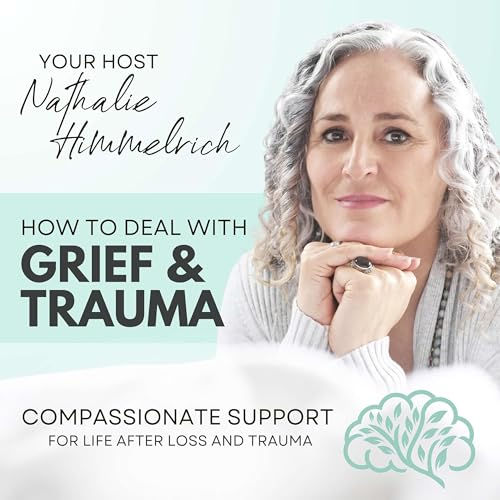
How To Deal With Grief and Trauma cover art

How To Deal With Grief and Trauma

How To Deal With Grief and Trauma

By: Nathalie Himmelrich
Listen for free

About this listen

You can't go through life without experiencing loss and trauma the question is how do we deal and live with the grief and pain? Join Nathalie Himmelrich, grief expert and author, talking to people who have experienced grief and trauma first-hand. If you want to be inspired by others who traveled through their grief and trauma, found that healing is possible, and came out the other end knowing they can survive and thrive in life after loss. For more info: www.nathaliehimmelrich.com

© 2026 How To Deal With Grief and Trauma
Hygiene & Healthy Living Psychology Psychology & Mental Health Social Sciences
Episodes
  • 184 Collective Grief and War Trauma: How Entire Populations Heal | Dr Imke Hansen
    Apr 13 2026

    Send us Fan Mail

    What happens when an entire nation is traumatised? How does collective grief differ from personal loss, and what does healing actually look like at that scale?

    In this episode, I speak with Dr Imke Hansen, trauma therapist, scholar of Eastern European History, and Deputy Director of the human rights organisation Libereco – Partnership for Human Rights. Nathalie and Imke first met in Zürich at a conference on collective grief and trauma with Dr Peter Levine and Thomas Hübl, and this conversation picks up where that encounter left off.

    Imke has worked with survivors of war and persecution for over two decades. Since 2014, she has led Libereco's psychosocial support work in Ukraine, supporting people living through one of the most devastating conflicts of our time. She is also a certified Somatic Experiencing Practitioner, a body-based approach to trauma healing developed by Dr Peter Levine.

    In this episode, we cover:

    • What collective grief looks like on the ground in Ukraine — and what most people in the West don't see
    • The difference between individual grief and collective trauma, and why that distinction matters for healing
    • What "resilience" really means — and when the word gets in the way
    • What it means to witness collective suffering in a way that helps rather than harms

    About today's guest

    Dr. Imke Hansen holds a doctorate in Eastern European History and is a Somatic Experiencing Practitioner specialising in trauma-informed mental health and psychosocial support for civil society activists and survivors of captivity and torture. She serves as Deputy Director of Libereco – Partnership for Human Rights, an independent German-Swiss NGO working in Belarus and Ukraine since 2009. She is the author of the comic book I CAN, available in English, Ukrainian, and Russian.

    Resources mentioned:

    • Libereco – Partnership for Human Rights: libereco.org
    • Comic book I CAN by Dr Imke Hansen — free download in English, Ukrainian, and Russian via Libereco's website
    • Somatic Experiencing International: somaticexperiencing.com

    Support the show

    💡 If today’s episode touched you, please share it with someone who might need it.

    🤝 Become a supporter of the show! Starting at $3/month & leave a review.

    Stay Connected

    • 🌐 Visit nathaliehimmelrich.com
    • 💌 Subscribe to the newsletter for resources and updates
    • 🎧 Never miss an episode—follow the podcast!
    • 💛 Socials Instagram Facebook

    Find Support Resources

    • 💜 For Grievers – Resources
      https://nathaliehimmelrich.com/grief-trauma-support/
    • 💜 For Supporters – Supporting someone https://nathaliehimmelrich.com/supporters-resources/
    • 💜 Books – Explore books on grief and healing https://nathaliehimmelrich.com/books/
    • 💜 Support – Offers - free and paid
      https://nathaliehimmelrich.com/free-resources-hub/
    Show More Show Less
    51 mins
  • 183 Preconceptions About Grief: The Beliefs You Bring Before Loss (Part 2 of 3)
    Apr 6 2026

    Send us Fan Mail

    Before a loss happens, most people already hold a set of beliefs about what grief will look like. These are not myths absorbed from the culture in general — they are something more personal: internalised convictions, absorbed through upbringing, family, religion, and lived experience, that then shape how a person enters and moves through grief.

    These are preconceptions. In Part 2 of this three-part series, Nathalie examines the ten most common preconceptions about grief and makes a precise distinction between preconceptions, grief myths, and presumptions that is crucial for understanding why each causes harm differently.

    What's covered in this episode

    • The definition of a preconception and how it differs from a grief myth and a presumption
    • Why preconceptions are harder to challenge than myths, because they feel personal, not cultural
    • How preconceptions relate to grief myths: myths are the cultural source; preconceptions are the individual's internalised version
    • The 10 most common preconceptions, each examined through: where it originates and what it aims to achieve, how it harms, a relatable example, and a reframe

    The 10 preconceptions covered

    1. Grief follows predictable stages
    2. Grief has a timeline
    3. Not crying means not grieving
    4. You must achieve "closure"
    5. Grief is only about death
    6. Staying strong protects others
    7. Time heals all wounds
    8. Grief is a private matter
    9. Returning to normal functioning means you are healed
    10. Trauma and grief are separate experiences

    The distinction explained in this episode

    A grief myth is a culturally shared false belief, something the culture transmits without adequate evidence. A preconception is personal: it is the individual's internalised version of that myth, often absorbed before they have any direct experience of loss.

    Myths can be corrected with information. Preconceptions require something more: recognising that the belief exists, tracing where it came from, and examining whether it still holds in the face of actual experience.

    A presumption (covered in Part 3) is different again: it is a real-time assumption made about someone else's grief, in the moment. Preconceptions are formed before. Presum

    Support the show

    💡 If today’s episode touched you, please share it with someone who might need it.

    🤝 Become a supporter of the show! Starting at $3/month & leave a review.

    Stay Connected

    • 🌐 Visit nathaliehimmelrich.com
    • 💌 Subscribe to the newsletter for resources and updates
    • 🎧 Never miss an episode—follow the podcast!
    • 💛 Socials Instagram Facebook

    Find Support Resources

    • 💜 For Grievers – Resources
      https://nathaliehimmelrich.com/grief-trauma-support/
    • 💜 For Supporters – Supporting someone https://nathaliehimmelrich.com/supporters-resources/
    • 💜 Books – Explore books on grief and healing https://nathaliehimmelrich.com/books/
    • 💜 Support – Offers - free and paid
      https://nathaliehimmelrich.com/free-resources-hub/
    Show More Show Less
    34 mins
  • 182 Lizzie Pickering | When Grief Equals Love
    Mar 31 2026

    Send us Fan Mail

    HOW TO DEAL WITH GRIEF AND TRAUMA is completely self-funded, produced, and edited by me, Nathalie Himmelrich.
    Consider making a small donation to support the Podcast: bit.ly/SupportGTPodcast. Thank you!

    For more information, please visit Nathalie’s website, join the podcast’s Instagram page, and subscribe to the newsletter to receive updates on future episodes here.

    About this week’s episode

    What does it look like to live well with grief, not despite it, but through it? Lizzie Pickering has spent over 25 years finding out.

    Since the death of her eldest son, Harry, Lizzie has become one of the UK's most experienced and sought-after voices on grief in life and in the workplace. She draws on more than two decades of direct experience: as a carer to Harry, as a long-term team member at Helen & Douglas House (the Oxford children's hospice where Harry died), and through her sustained work with bereaved parents, siblings, and professionals navigating loss.

    If you're like me, you will love listening to Lizzie's voice, giving us an insight into her journey over the past 25 years.

    About this week’s guest

    ​​Lizzie is a Grief Educator, Author and Film Producer
    She offers Grief Guidance to organisations and individuals, educating people about grief and helping them get back to life and work following major losses. Her clients are both UK-based and global. Since the death of her eldest son, Harry, 25 years ago, Lizzie has become passionate about changing the landscape for people who have to face life and work when they are living with grief. Her firm belief is that if grief is faced and worked through gradually, if people are well supported, there is a rich seam of energy to be found from not only surviving it but living well. Lizzie’s book, When Grief Equals Love, Long-term Perspectives on Living with Loss, was published in May 2023 and is available from bookshops, Amazon and Audible.

    • lizziepickering.com
    • www.instagram.com/lizzie.pickering/

    Support the show

    💡 If today’s episode touched you, please share it with someone who might need it.

    🤝 Become a supporter of the show! Starting at $3/month & leave a review.

    Stay Connected

    • 🌐 Visit nathaliehimmelrich.com
    • 💌 Subscribe to the newsletter for resources and updates
    • 🎧 Never miss an episode—follow the podcast!
    • 💛 Socials Instagram Facebook

    Find Support Resources

    • 💜 For Grievers – Resources
      https://nathaliehimmelrich.com/grief-trauma-support/
    • 💜 For Supporters – Supporting someone https://nathaliehimmelrich.com/supporters-resources/
    • 💜 Books – Explore books on grief and healing https://nathaliehimmelrich.com/books/
    • 💜 Support – Offers - free and paid
      https://nathaliehimmelrich.com/free-resources-hub/
    Show More Show Less
    54 mins
No reviews yet