Episodes

  • The App of the Future Is Voice — Not a Screen. Mitel's CTO Luiz Domingos Explains Why.
    May 28 2026

    Luiz Domingos has spent 25 years watching enterprise communications evolve, from IP telephony to cloud to AI, and his assessment of where things stand now is unusually concrete. Companies have moved past the strategy deck phase. AI is being embedded directly into contact centers, compliance workflows, and communication pipelines, and the question executives are asking has shifted from "which model is smartest" to "which deployment reduces friction and stays compliant." Domingos is direct about what gets in the way: you cannot pour AI into a legacy architecture and expect transformation, and cloud-only AI doesn't solve the latency or data sovereignty problems that regulated industries face every day.

    In this conversation with Craig Smith, Domingos covers the practical mechanics of how Mitel is applying AI across its portfolio, from real-time transcription and sentiment analytics in contact centers, to agentic workflows that turn conversations into automated tickets and follow-ups. He draws a clear line between AI agents (which give recommendations) and agentic AI (which takes actions), a distinction the market consistently confuses. He also makes a prediction worth noting: within five years, voice will replace the traditional app interface as the primary way people interact with enterprise AI systems. For any CIO or CTO trying to move from experimentation to real ROI, his framework - start with workflow friction, not pilots - is the most actionable takeaway in the episode.

    Show More Show Less
    55 mins
  • Is ChatGPT Conscious? A Pioneer of AI Explains | Dr. Terry Sejnowski
    May 28 2026

    A fly with 100,000 neurons can fly, find food, and reproduce. A $100 million supercomputer cannot. Dr. Terry Sejnowski used that observation to silence a room full of MIT AI researchers in the 1980s, and it remains just as sharp today. Sejnowski is one of the foundational figures in the history of deep learning, co-inventor of the Boltzmann machine, and a professor at the Salk Institute who has spent his career studying both the brain and the machines we build to imitate it. In this conversation with Craig Smith, he turns that dual perspective on ChatGPT, and what he finds is something genuinely clarifying: not a human mind, not a threat to humanity, but an alien intelligence that has absorbed more knowledge than any brain ever could while remaining fundamentally empty when nobody is talking to it.

    The conversation covers the full landscape of what current AI is missing - from goals and reinforcement learning to the constant self-generated flow of thought that defines consciousness - and why the word "understanding" is so ambiguous that even the world's top cognitive scientists can't agree on whether ChatGPT has it. Sejnowski also makes the case that hallucinations aren't a flaw to be engineered away but the flip side of creativity itself, that we are in a pre-Copernican era when it comes to understanding intelligence, and that the real future of AI lies not in scaling language models further but in looking at what nature has already solved, from field mice to fruit flies. His new book is written for the general public and available now.

    Subscribe to Eye on A.I. for weekly conversations with the people building and deploying the future of AI.

    Show More Show Less
    57 mins
  • Your Child's Data Profile Starts Before They're Born | Eamonn Maguire of Proton
    May 28 2026

    Your child's data profile doesn't start when they get their first phone. It starts before they're born, the moment a parent emails a gynecologist or visits a fertility clinic website. That's the core argument behind Born Private, Proton's new initiative that lets parents reserve an email address for their child at birth, anchoring their digital identity in a privacy-preserving ecosystem before the profiling machine gets started. Craig Smith sits down with Eamonn Maguire, Engineering Director, Machine Learning & AI at Proton, who has spent his career at the intersection of data, security, and visualization to explore what's really happening to our data and what, if anything, we can do about it.

    The conversation covers the mechanics of how just three email sign-ups can allow Google to infer your age, politics, and religion; why OpenAI and Anthropic have shown "not much regard for the law" when it comes to training data and copyright; and why social media platforms are operating like unregulated gambling companies - engineering addiction with no structural incentive to stop. It's one of the most grounded, specific, and genuinely alarming conversations about digital privacy you'll hear, and it ends with a simple, actionable proposition: privacy should be a decision you make at birth, not a problem you try to solve after the damage is done.

    Subscribe to Eye on A.I. for weekly conversations with the people building and deploying the future of AI.

    Show More Show Less
    56 mins
  • Training AI Models Without a Billion-Dollar Data Center | Steffen Cruz of Macrocosmos
    May 25 2026

    Training a frontier AI model today requires hundreds of thousands of GPUs, months of compute time, and a budget that only a handful of companies on earth can afford. Steffen Cruz, co-founder and CTO of Macrocosmos, thinks that model is about to break, and he's spending his time building what comes next. His project IOTA, operating within the BitTensor blockchain ecosystem, uses distributed training to split large language models across thousands of devices located around the world, coordinated by blockchain, and powered by surplus cheap energy wherever it exists. After nine months of research, the system can reproduce baseline benchmark performance using what Cruz calls "wonky vegetables" - unreliable, churning, globally distributed compute - and turn it into something indistinguishable from centralized training if you use the right approach.

    The conversation with Craig Smith covers the mechanics of how this actually works, why the blockchain's role is far narrower and more practical than most people assume, and why the Mac mini stockpiling trend creates an unexpected supply of distributed compute that can earn passive income when idle. Cruz's target: a 70 billion parameter model by mid-2025, trained at 10-20% of what it would cost through a hyperscaler, and aimed squarely at the legal firms, hospitals, and cash-strapped startups that have been waiting to train their own sovereign models but couldn't afford the price tag.

    Subscribe to Eye on A.I. for weekly conversations with the people building and deploying the future of AI.

    Show More Show Less
    47 mins
  • The Single Biggest Barrier to AI Adoption Isn't the Technology — It's This | Errol Gardner of EY
    May 22 2026

    Errol Gardner has spent 35 years advising the world's largest organizations through major technology transitions, and his assessment of where enterprise agentic AI actually stands is one of the most grounded you'll hear anywhere. His number: less than 1 out of 10 on a maturity scale. Not because the technology isn't ready, but because deploying agentic AI across an organization doesn't tweak how it works, it requires rebuilding how it works. And that is a fundamentally different kind of challenge than anything the AI hype cycle is currently acknowledging.

    In this conversation with Craig Smith, Gardner walks through why cloud adoption still hasn't reached 7 out of 10, what that means for agentic AI timelines, why the single biggest barrier to adoption is human resistance rather than technical limitation, and why governments will ultimately have to step in to manage workforce displacement at scale. He also raises a question that almost nobody is asking: is the value exchange between the technology sector and traditional industries sustainable in the long run? It's a conversation that doesn't just describe where AI is, it explains why the gap between the narrative and the reality has never been wider.

    Subscribe to Eye on A.I. for weekly conversations with the people building and deploying the future of AI.

    Show More Show Less
    55 mins
  • Oliver Dial of IBM: Quantum Advantage Is Happening This Year
    May 19 2026

    IBM's VP of Quantum Systems, Oliver Dial, has spent his career building quantum computers from the ground up, and he's unusually direct about what they can and can't do. In this conversation with Craig Smith, Oliver Dial walks through where the field actually stands in 2026: quantum utility was achieved in 2023, quantum advantage is the target for this year, and a fully error-corrected machine capable of tackling the hard problems is on IBM's roadmap for 2029. That last milestone, Dial says, now feels both achievable and terrifying.

    The episode is worth your time because Dial doesn't hype. He explains why IBM built a 1,000-qubit computer and then took it apart almost immediately, why Google's quantum advantage claims remain scientifically contested, and how a new error-correcting code IBM developed just reduced the qubit overhead required for fault-tolerant quantum computing by an order of magnitude. For anyone trying to understand what quantum computing will actually mean for their industry, and when, this is the clearest map of the road ahead available right now.

    If this conversation changed how you think about the future of computing, subscribe to Eye on A.I. for weekly conversations with the researchers and builders shaping what comes next.

    Show More Show Less
    51 mins
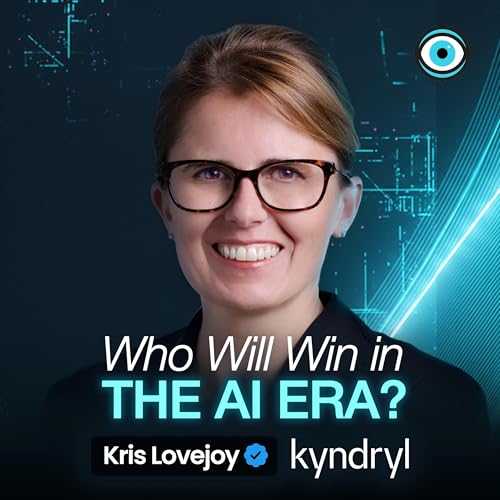
  • Why Agentic-First Startups Won't Disrupt Enterprises as Fast as Everyone Thinks | Kris Lovejoy
    May 15 2026

    Kris Lovejoy, Global Strategy Leader at Kyndryl, has spent her career at the intersection of IT infrastructure and security. Right now, she's one of the people enterprises call when they want to move from AI experimentation to real deployment. Her diagnosis is clear: agentic AI is a bullet train sitting on tracks built for 30 miles per hour. The technology is ready. Most organizations aren't, and the gap between a successful pilot and a production system running at scale is far wider than the hype suggests.

    In this conversation with Craig Smith, Lovejoy walks through why IT service management is the smartest entry point for agentic adoption, how cost savings of up to 90% in that area can fund broader modernization, and why the security risks in agentic systems are less about sophisticated hackers and more about misconfiguration, bad context, and human error. She closes with a specific prediction: half of traditional IT administration tasks will be handled by AI agents by 2031, and a surprising take on who will actually thrive in the agentic era: not coders, but people trained to ask the right questions.

    For anyone making decisions about AI adoption, this is the most practical conversation available right now.

    Subscribe to Eye on A.I. for weekly conversations with the people building and deploying the future of AI.

    Show More Show Less
    57 mins
  • Loris Degioanni: Why AI Is Breaking Cybersecurity, and What Comes Next
    May 6 2026

    AI has fundamentally changed the cybersecurity threat landscape, not by inventing new attack types, but by collapsing the timeline. The same tools that make software developers more productive are now being used by attackers to move from vulnerability disclosure to active exploit in a matter of hours. That shift, argues Loris Degioanni, CTO and founder of Sysdig, changes everything about how defense needs to work.

    In this episode, Craig Smith talks with Loris Degioanni about why human-centered security is becoming a structural liability, what "headless cloud security" means in practice, and why the coding agent (tools like Claude Code or Codex) may become the new operating system through which all enterprise security workflows run. It's a conversation about architecture, urgency, and what it actually means to fight a tank when you've been trained to use a baseball bat.

    If this conversation made you think differently about AI and security, subscribe to Eye on A.I. for weekly conversations with the people building and defending the future.

    Show More Show Less
    51 mins