Emergency Medicine Cases cover art

Emergency Medicine Cases

Emergency Medicine Cases

By: Dr. Anton Helman
Listen for free

Emergency Medicine Cases – Where the Experts Keep You in the Know. For show notes, quizzes, videos and more learning tools please visit emergencymedicinecases.comMedicine Cases Education Hygiene & Healthy Living Physical Illness & Disease Science
Episodes
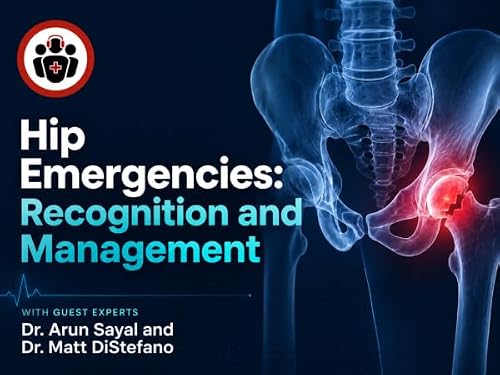
  • Ep 219 Hip Emergencies: Recognition and Management
    Jun 16 2026
    Hip complaints are bread-and-butter emergency medicine—but every so often they are anything but straightforward. The obvious shortened, externally rotated leg after a fall is one thing; the patient with acute hip pain, a normal x-ray, unremarkable blood work, and no clear diagnosis is another. Hip fractures are also far from benign, carrying a 30-day mortality of 6–7% and a 1-year mortality of about 20%, often triggering a cascade of pain, immobility, delirium, deconditioning, and death. But hip fractures are only the tip of the iceberg. In this EM Cases episode, Dr. Arun Sayal and Dr. Matt DiStefano go beyond “get an x-ray and call ortho” to tackle hip fractures, occult injuries, atraumatic hip pain, and hip dislocations. We answer questions like: Why do so many patients never return to baseline after a hip fracture? What can we do in the ED to avoid delaying surgery? What are the best pain management and delirium prevention strategies? Which physical exam findings help diagnose an occult hip fracture? How do we distinguish hip from pelvic fractures clinically? When is a normal x-ray not enough, and when should we proceed to CT or MRI? What is POCUS useful for in the painful hip? How should hip fractures be classified to change ED management? How should we approach atraumatic hip pain? How do native and prosthetic hip dislocations differ? What clinical position suggests posterior versus anterior dislocation? Which reduction technique should we choose? What is the Whistler technique? What are the nuances of post-reduction management? And much more. Please consider a donation to EM Cases to support ongoing high-quality Free Open Access Medical Education: https://emergencymedicinecases.com/donation/
    Show More Show Less
    1 hr and 25 mins
  • Journal Jam 24 Antibiotics for Strep Throat: Evidence, Myths and Misperceptions
    Jun 2 2026
    Antibiotics for strep throat seem like a simple decision—but the evidence is anything but simple. In this Journal Jam podcast with Dr. Casey Parker and Dr. Justin Morgenstern, we critically appraise the literature behind one of the most common infections seen in emergency medicine. Do antibiotics meaningfully improve symptoms? Do they prevent peritonsillar abscess, post-streptococcal glomerulonephritis, or rheumatic fever? How reliable are the studies informing our practice? We explore publication bias, limitations of the Centor score, antibiotic harms, and the importance of local epidemiology, helping clinicians move beyond dogma toward more nuanced, evidence-based decision-making... Please consider a donation to EM Cases to ensure ongoing high quality free open access medical education here: https://emergencymedicinecases.com/donation/
    Show More Show Less
    1 hr and 19 mins
  • Ep 218 Substance Use Disorder in the ED – Stigma, Compassion and System Change
    May 19 2026
    Emergency physicians pride themselves on recognizing and treating life-threatening illness under pressure. Yet one of the most lethal, common, and treatable conditions presenting to our EDs still often receives fragmented, stigmatized care: substance use disorder. The opioid crisis has evolved into an era of increasingly toxic and unpredictable drug supplies, including ultra-potent synthetic opioids such as nitazenes. Between 2016 and 2021, more than 27,000 Canadians died from opioid toxicity, while opioid-related ED visits continue to rise sharply. Patients discharged with untreated opioid use disorder face mortality rates approaching 5% within 12 months. Despite this, substance use disorder is still not consistently approached with the same urgency and systems-based care as other chronic high-risk illnesses. In this episode, Dr. Bjug Borgundvaag, Tish Mizon and Kari Herbert discuss how stigma affects care in the ED and how trauma-informed communication, person-first language, compassionate care, peer navigators and Bridge-style addiction programs can improve outcomes for both patients and clinicians. Please support EM Cases ongoing Free Open Access Medical Education learning platform with a donation here: https://emergencymedicinecases.com/donation/
    Show More Show Less
    1 hr and 1 min
adbl_web_anon_alc_button_suppression_t1
No reviews yet