Don DeLillo Should Win the Nobel Prize cover art

Don DeLillo Should Win the Nobel Prize

Don DeLillo Should Win the Nobel Prize

By: Jeffrey Severs & Michael Streit
Listen for free

With episodes in which two devoted readers (Jeffrey Severs and Michael Streit) unpack his deadpan, hilarious, and disturbing works one by one, DDSWTNP is dedicated to the idea that Don DeLillo, the greatest of living writers, deserves every serious reader’s attention. Contact: ddswtnp@gmail.com. @delillopodcast. **Support our work and our trip to DeLillo's archive**: https://www.buymeacoffee.com/delillopodcast Art Literary History & Criticism
Episodes
  • Episode 36: Ratnerama
    Jun 7 2026

    Transmission incoming from the insane world of Ratner’s Star, DeLillo’s fourth novel, a major change in his fiction and his most difficult text, underappreciated as precedent for his later turns on encyclopedic form in Libra and Underworld. Ratner’s also has, though, tons of connections to earlier works like Americana and End Zone. In this episode DDSWTNP celebrate Ratner’s fiftieth anniversary with a wholly new re-reading of a book that remains for us hilarious, pleasurable, and a huge reading challenge. We consider how Ratner’s Star, like any masterpiece, teaches us how to read its fabulations from its first page on. We examine its relentless juxtaposition of minds and bodies, as well as its dissection of the impulses toward pattern, order, and other “convenient fictions.” We ask what kinds of narrative experimentation with time and perspective DeLillo carries out, especially in the quest for an ultra-logical metalanguage in Part 2. We wonder about how science and math as fields of knowledge and uncertainty relate to DeLillo’s later turns to examining history. We do our best to try to understand the relationships of DeLillo’s “mohole” physics to Einstein’s relativity, and we offer a reading of a Jesuit’s interrogation of “red ant metaphysics” and “premature genuflection” that marks a new turn in DeLillo’s satires of his Catholic education. We close by disagreeing with a 1976 panning review of the novel as a pale imitation of Pynchon.

    As we say in the episode, Ratner’s fiftieth makes for a great transition into our Summer of Underworld – look for a string of episodes on that big novel from us in the next few months! Enjoy the Ratnerama rendition of our intro music, too. And the rats and the bats and the stars. And in a nod to all ARS Extants out there, this episode is being sent into the podcast universe at exactly 14:28:57 (China Standard Time).

    Texts mentioned and discussed in this episode:

    David Cowart, Don DeLillo: The Physics of Language. Athens: U. of Georgia P., 2002.

    Frank Kermode, The Sense of an Ending: Studies in the Theory of Fiction. New York: Oxford UP, 1967.

    Tom LeClair. In the Loop: Don DeLillo and the Systems Novel. U. of Illinois P., 1987.

    Mark Osteen, American Magic and Dread: Don DeLillo’s Dialogue with Culture. Philadelphia: U. of Pennsylvania P., 2000.

    Peter S. Prescott, “Mandarin’s Apprentice” [review of Ratner’s Star]. Newsweek, June 7, 1976, p. 88.

    Show More Show Less
    2 hrs and 15 mins
  • Episode 35: "Creation"
    Apr 26 2026

    Anticipating a summer to be spent exploring Underworld, DDSWTNP in Episode 35 take a small detour to a DeLillo short story, “Creation,” which distills DeLillo’s omnipresent motifs of Romanticism and Christian mythos, transports literal and figurative, and disillusionment with the maintenance of Edenic experience — perhaps especially for the American tourist trying to escape from, rather than into, their vacation world. This 1979 story of infidelity, manipulation, and fantasy depicts repeated journeys to a small, jammed Caribbean airport that draw thoughts about godliness, meaning, and mortal fear from an unnamed narrator who has the impulse to write but perhaps not the skills and honed perception. In “Creation” we find many unexpected things: stirring parallels to the space orbits of “Human Moments in World War III”; a precursor to the voice of James Axton to emerge amid Mediterranean islands three years later; and of course new turns on the key DeLillo topos of plane travel and the contingencies of leaving the earth for the sky. Elements of journeys in Americana, Mao II, Cosmopolis, and Valparaiso come up, and we conclude that Rupert the cab driver may be the hero of this tale, or the figure who understands these affairs the best. We give listeners quite a few reasons to read or re-read this under-appreciated story that DeLillo would later choose to place first in The Angel Esmeralda: Nine Stories (2011).


    The cover image incorporates part of Where Do We Come From? What Are We? Where Are We Going? (1897-98) by Paul Gauguin, who seems the likely reference point when the narrator of “Creation” says of his canceled seat on a flight out, “I’ll marry a native woman and learn how to paint.”

    Show More Show Less
    1 hr and 24 mins
  • Episode 34: An Interview with Tom LeClair
    Mar 11 2026
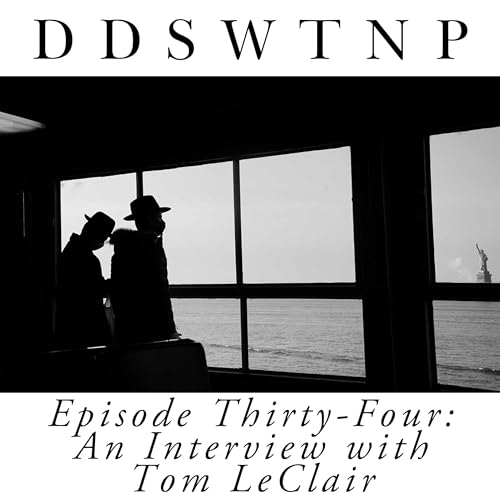
    In Episode 34 DDSWTNP sit down for a revelatory talk with Tom LeClair, a founding critic in the study of DeLillo, his longtime friend and liaison to the literary world, and a figure who has both written fiction shaped by DeLillo’s and (he suggests) seen his own stories turned into scenes and dialogue by DeLillo himself. We get into LeClair’s relationship with DeLillo going back more than forty years, starting from the time the author sent him a copy of Ratner’s Star and proceeding to a 1979 interview in Athens that illuminated a then rather reclusive and secretive writer, including the story behind a card DeLillo handed out in those years reading “I don’t want to talk about it.” We also ask LeClair questions about his many readings of DeLillo’s and others’ works over the years, starting from his major books In the Loop: Don DeLillo and the Systems Novel (1987) and The Art of Excess: Mastery in Contemporary American Fiction (1989), studies that initiated LeClair’s career-long examination of encyclopedic works that form categories of “systext,” “monsterpiece,” and others he has defined in his many major magazine and newspaper reviews and in his current substack. What does LeClair make of the many mentions of “systems” in Underworld? What does a line from Point Omega suggest to him about the possibility someday of a DeLillo biography? What does LeClair mean when he calls DeLillo a thoroughly “intuitive” writer and an artist obsessed his whole life with embodiment, birth, death, and fear? Is “mystery” the right word for what drives DeLillo’s narrative seeking, and is Catholicism a useful lens? What to make of the ending of Zero K? Why did DeLillo want to visit Beirut with LeClair? And what do these two talk about when they have lunch together? The interview also gets into depth on the many comparisons LeClair sees with his own fiction, its set of Kierkegaardian maneuvers through the Greece-based world of basketball player Michael Keever, the hero of Passing Off (1996) who begins for LeClair a series of examinations of games, terrorism, and some familiar DeLillo territory that extends through the four other Passing novels that LeClair has published in the thirty years since. Cover photograph by Kinga Owczennikow. A native of Poland, Kinga Owczennikow is currently based in New York City. She holds a BA (Hons) in Photography from the University for the Creative Arts in the UK. Kinga is an Associate of the Royal Photographic Society, a member of the Center for Photographic Art in Carmel and an exhibiting member of the Soho Photo Gallery in New York City. Kinga had a solo exhibition “The secret paths of Hong Kong” at the Asia and Pacific Museum in Warsaw, in 2011. Her photographic work has also been exhibited internationally in group shows. Her first photobook "Framing the World" was published by Ephemere in Tokyo, in 2025. Texts by Tom LeClair and others discussed in this episode: “Don DeLillo: The Word, The Image, The Gun.” BBC, 1991. https://www.imdb.com/title/tt4029096/ Amy Hungerford, “Don DeLillo’s Latin Mass.” Contemporary Literature 47.3 (Autumn 2006): 343-380. Tom LeClair and Larry McCaffery, eds. Anything Can Happen: Interviews with Contemporary American Novelists. U. of Illinois P., 1983. Tom LeClair. In the Loop: Don DeLillo and the Systems Novel. U. of Illinois P., 1987. ---. The Art of Excess: Mastery in Contemporary American Fiction.U. of Illinois P., 1989. ---. “Me and Mao II” (1993). https://perival.com/delillo/meandmaoii.html ---. Passing Off. Permanent Press, 1996. ---. “An Under-history of Mid-Century America” (review of Underworld). The Atlantic, October 1997. ---. “Two On One: Writing a Basketball Novel.” In What to Read (and Not): Essays and Reviews. Dzanc Books, 2014. ---. “Serious But Not Dangerous Don DeLillo” (review of The Silence). American Book Review 42.4 (May/June 2021): 10-11. —-. Harpooning Donald Trump: A Novelist’s Essays. Mediacs, 2017. ---. Passing Again. 2022. Tom LeClair’s Substack: https://tleclair.substack.com/ Vince Passaro, “Dangerous Don DeLillo.” New York Times Magazine, May 19, 1991. https://www.nytimes.com/1991/05/19/magazine/dangerous-don-delillo.html Lawrence Weschler, Mr. Wilson’s Cabinet of Wonder: Pronged Ants, Horned Humans, Mice on Toast, and Other Marvels of Jurassic Technology. Vintage, 1995.
    Show More Show Less
    1 hr and 48 mins
adbl_web_anon_alc_button_suppression_t1
No reviews yet