Episodes

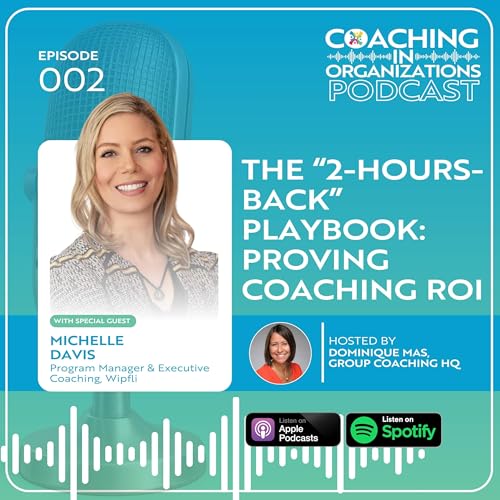
  • The "2-Hours-Back" Playbook: Proving Coaching ROI with Michelle Davis
    May 5 2026
    📝 EPISODE SUMMARY How do you prove coaching works without reducing people development to a single performance score? In this episode of Coaching in Organizations, Michelle Davis (Program Manager for Executive Coaching at Wipfli) shares how her firm built an internal coaching practice, launched a group coaching pilot focused on strategic time management, and translated results into business language leaders trust. You’ll hear what she measured, what she stopped measuring (and why), and how manager involvement strengthens impact while protecting confidentiality. If you’re passionate about coaching cultures, internal coaching, or building capacity through group coaching in organizations, this episode is a must-listen. 🧠 5 KEY TAKEAWAYS What if your coaching ROI story started with a simple question leaders actually care about: “How many hours did we get back?” Michelle Davis, Program Manager for Executive Coaching at Wipfli, breaks down what it really takes to measure coaching impact inside a professional services firm where “metrics are the language.” Start your ROI story with a metric leaders care about: translate coaching outcomes into business language, like time saved. Internal coaching changes the contract: hold the coachee’s agenda while staying aligned to organizational priorities and context. Build group coaching around a clear, repeatable business need: the strategic time management pilot targeted high-potential leaders. Measure what you can defend: engagement, time management satisfaction, and hours saved created a credible impact case for expansion. Protect confidentiality while involving managers: use alignment up front, midpoint check-ins, and post-engagement feedback to strengthen results without exposing coaching conversations. “The business priorities and goals are the frame, and I get to work with my clients within that frame.”   ↪️ WHAT WE COVER IN THIS EPISODE 02:29 Michelle’s Coaching Origin Story: Michelle shares what led her to become a coach and her transition from an external to an internal coach. 07:49 Accountability to Business Outcomes: Michelle discusses how her role shifted when she became an internal coach and accountable for business outcomes. 09:30 Coaching Culture at Wipfli: Michelle describes the coaching culture at Wipfli, including who receives coaching and the types of programs offered. 13:17 The Group Coaching Pilot: Michelle details the group coaching pilot, its participants, and the business needs it addressed. 14:40 Measuring Impact of the Pilot: Michelle explains the three key metrics used to measure the pilot’s impact: engagement, satisfaction with time management, and time saved. 19:48 Translating Impact to ROI: Michelle discusses how they translated the pilot’s results into ROI for leadership, combining quantitative and qualitative data. 21:38 Removing Performance as a Metric: Michelle explains why the decision was made to remove overall performance as a measurement in coaching programs. 23:19 Including Managers in Impact Measurement: Michelle describes how managers are involved in measuring the impact of coaching engagements. 26:26 Personal Realizations as an Internal Coach: Michelle shares her personal insights and shifts experienced while building the coaching culture at Wipfli. 28:06 Managing the Dual Role of Internal Coach: Michelle addresses the challenge of being both a coach and an employee, and how she manages boundaries when learning sensitive information. 🗝️ KEY THEMES Coaching ROI that leaders trust Time management as a high-leverage coaching topic Designing group coaching programs around a clear business need Simple, measurable outcomes (and what they tracked) Scaling coaching access through multiple modalities Dropping “performance” as a coaching metric Manager involvement without breaking confidentiality Internal coach boundaries + ethical escalation How to build a coaching culture pragmatically ABOUT MICHELLE DAVIS Transforming people and workplaces from functioning to flourishing drives Michelle's work as an internal coaching leader. She envisions the workplace as a space where professionals can live out their values, cultivate meaning, and become their best selves. Michelle leads the internal coaching practice at Wipfli, a professional services and advisory firm, where the practice's mission is to empower associates to realize their highest potential and live the lives they imagine. Prior to becoming a certified coach, she spent 15 years in business development at the University of Michigan. 🤝 CONNECT WITH MICHELLE Wipfli: https://www.Wipfli.com/ Email: michelle.davis@Wipfli.com LinkedIn: https://www.linkedin.com/in/michelle-bard-davis/ 📩 STAY CONNECTED WITH GROUP COACHING HQ! Receive updates about future episodes and events!  Join our ...
    Show More Show Less
    33 mins
  • Create Your Organization's Coaching Culture Intentionally with Katherine Lord
    Apr 6 2026
    📝 EPISODE SUMMARY What does a coaching culture actually look like inside an organization? In this episode, Katherine Lord, Director of Organizational Member Experience, unpacks why a coaching culture is not a branded initiative or a sign that everyone has a coach. It is an environment where leaders and employees use coaching mindsets and behaviors in daily decisions, management, and collaboration, all in service of business results. Katherine shares how her background in social work shapes her systems view of organizations, why behavior matters more than optics, how leaders can assess maturity without turning it into a competition, and why pilots are often the smartest place to start. For talent leaders, L&D teams, and internal coaches, this coaching podcast offers a practical foundation for building coaching cultures and thinking about where group coaching can become a scalable lever. 🧠 5 KEY TAKEAWAYS Start with the culture you want, not the coaching program you want. Coaching should support what matters most to the organization.A coaching culture shows up in behavior. It is less about branding and more about how leaders and employees consistently act, manage, and collaborate.Maturity is a roadmap, not a scoreboard. Ad hoc, emerging, developing, and integrated can all be useful depending on the organization’s needs.You do not need a perfect formal program to begin. Community, pilot programs, and a few meaningful data points can create momentum fast.Group coaching does not have to be the starting point to matter. Organizations can move their culture forward through coaching behaviors first, then scale into broader modalities over time. “A coaching culture is an environment where leaders and employees consistently use coaching mindsets and behaviors.” ↪️ WHAT WE COVER IN THIS EPISODE 03:09 Katherine’s Journey: Katherine shares her path from social work to her current role at the International Coaching Federation.07:12 Social Work Principles in Coaching: Katherine discusses how her social work background, particularly the “person and environment” framework, influences her approach to organizational coaching.10:04 Defining a Coaching Culture: Katherine defines a coaching culture as an environment where leaders and employees use coaching mindsets and behaviors to drive business results.11:46 Intentional Coaching Culture: Katherine explains that building a coaching culture requires intentionality, starting with a desire to address organizational challenges and an openness to coaching.14:11 The Coaching Culture Compass Assessment: Katherine details the ICF’s assessment tool, which helps organizations evaluate their coaching culture based on exhibited behaviors.15:40 Four Levels of Coaching Culture Maturity: Katherine outlines the four categories of coaching culture maturity: ad hoc, emerging, developing, and integrated.19:45 Surprising Assessment Results: Katherine shares insights into common surprises organizations experience when seeing their assessment results, often finding they are further along than expected.22:27 Advice for Building a Coaching Culture: Katherine offers two key pieces of advice: connect with other organizations and “befriend the pilot” by experimenting with pilot programs.24:17 The Importance of ICF Core Competencies: Katherine stresses the value of rooting coaching programs in the ICF core competencies for a strong foundation.25:34 Personal Transformation Through Coaching: Katherine reflects on her personal growth since joining the coaching world, highlighting her belief in coaching’s power to create global impact. 🗝️ KEY THEMES Defining coaching culture through behaviorSystems thinking in coaching and organizationsIntentionality and sponsorshipMeasurement and maturityProgress before perfectionPilot-led program designAccess and democratization of coachingGroup coaching as part of a broader coaching culture ABOUT KATHERINE LORD Katherine Lord is Director of Organizational Member Experience at the International Coaching Federation. She works with organizations and coaching program leaders to help them strengthen coaching cultures, share best practices, and navigate common challenges. Her background spans community engagement, association leadership, and social work, giving her a strong systems lens on how people, leadership, and organizational environments interact. Prior to this role, she held positions with the Council on Social Work Education and the Club Management Association of America. 📚 RESOURCES The Coaching Culture Compass: The ICF Coaching Culture Compass and Coaching Culture Designation showcase an organization’s commitment to building a strong, research‑based coaching culture. Grounded in ICF and Human Capital Institute field research and validated through ICF’s assessment and benchmarking process, the Designation offers a clear, credible way to demonstrate coaching culture maturity. At ...
    Show More Show Less
    30 mins