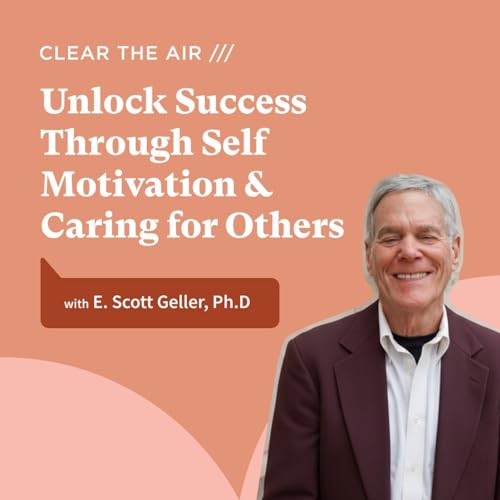
Clear the air cover art

Clear the air

Clear the air

By: Clearhead
Listen for free

Hosted by Dr Angela Lim, Clearhead co-founder and medical doctor, Clear the Air is a mental health and wellbeing podcast covering those experiences in your life or questions you have that you feel too vulnerable to share with those around you.

We speak with experts to share the science behind what you’re experiencing and explore the answers to those questions. Together we get real and raw on the existential questions covering mental health and wellbeing that have puzzled humans for millennia.

Follow the podcast to get notified as we drop new episodes monthly.

Clearhead is an innovative employee wellbeing platform with a social mission to ensure personalised mental health and wellbeing support is accessible to everyone. Making it easier for you to build self-awareness and be guided to either digital self-help tools or book therapy on the Clearhead platform when and where you need it.


Have a burning question about mental health that you want us to answer?
Email us at contact@myclearhead.com, or visit our website: www.myclearhead.com
Copyright Clearhead
Hygiene & Healthy Living Psychology Psychology & Mental Health
Episodes
  • 45: Closing the Leadership Gender Gap with Dr. Amanda Sterling
    Jun 2 2026
    Women continue to face unique pressures, balancing professional, family, and social expectations while carrying the often-invisible mental and emotional load. In this webinar, we’ll explore the experiences of women in leadership roles and what organisations can do better to support women into senior roles and maintain their wellbeing.

    In this episode, we sit down with leadership coach and consultant, Dr. Amanda Sterling, to delve into questions on gender equity in the workplace and closing the gender representation gap. Dr. Amanda will share insights from both her research findings on women in leadership and her own experiences in the field.

    Amanda's Biography:
    Dr Amanda Sterling is an award-winning consultant who partners with organisations to remove barriers for women into leadership and create inclusive workplaces where people and businesses thrive.

    Amanda combines her decades of experience working in corporate leadership development and culture change, as well as deep expertise on leadership, gender, and inclusion, to help organisations attract and retain more women in leadership and close their gender pay gaps.
    Amanda’s groundbreaking PhD research (completed in 2023) revealed critical insights into what is still holding women back from leadership roles and the opportunities to address this. Her research has been featured in multiple media channels such as RNZ, and was highlighted by Global Women and the University of Auckland.

    Amanda is originally from the Kaipara region but has called Tāmaki Makaurau | Auckland home for the last 20 years. She is also a proud parent to one son.


    0:00 – Introduction
    2:20 – Why Amanda decided to research women's leadership
    4:35 – What barriers prevent women from becoming leaders?
    6:05 – What assumptions perpetuate these barriers?
    7:55 – How can we challenge societal assumptions about mothers in leadership roles?
    9:30 – Why men are key to increasing leadership opportunities for women
    11:00 – How can we help men feel comfortable being part of the solution?
    14:05 – How can women influence men in the workplace to change the status quo?
    16:50 – Why women's leadership development programmes alone are not enough
    17:55 – Why representation does not equal inclusion
    20:00 – How to develop the measures needed to drive organisational change
    21:15 – The case for men's leadership development programmes
    22:20 – What are the benefits of having more diverse teams?
    23:55 – Why women leaders leave leadership positions
    25:45 – The false assumptions behind the belief that women are less confident than men
    28:05 – Are organisations acknowledging the additional emotional burden women face?
    30:00 – The four-factor framework for increasing women in leadership roles
    31:55 – Factor 1: Flexible work
    32:19 – Factor 2: Partner support
    33:10 – Factor 3: Manager support
    33:35 – Factor 4: Women's leadership development programmes
    34:40 – How workplaces can shift gender expectations around parental leave
    37:00 – When is there a place for women-only safe spaces?
    39:15 – What can workplaces do to create more supportive managers?
    42:45 – How the four factors change across career stages
    44:33 – Making the case for change in the workplace
    46:15 – Case study: Z Energy
    49:20 – What are the long-term measures for assessing the impact of inclusive teams?
    50:04 – What is one thing organisations can do to create change?
    51:00 – Amanda's one wellbeing practice

    Learn more about Amanda
    https://dramandasterling.com/

    Learn more about Clearhead
    https://www.myclearhead.com/
    Show More Show Less
    52 mins
  • 44 - What Drives Motivation? Psychology, Leadership and Actively Caring for People with E. Scott Geller
    Apr 30 2026
    Bringing out the best in ourselves and others is something many of us strive for - but how do we realistically work towards it, especially in the workplace? In this episode, behavioural psychologist Dr. Scott Geller explores how motivation, Actively Caring for People (AC4P), and evidence-based behaviour-change strategies can support personal wellbeing, leadership, and more connected, high-functioning teams. This episode highlights the role of community and coaching in empowering both ourselves and those around us.

    Scott’s biography:
    Professor Scott Geller is Professor Emeritus of Psychology at Virginia Tech and the former Director of the Center for Applied Behavior Systems. He has authored 55 books and more than 300 research articles looking at behavior-based interventions to improve human welfare on a large scale. His talent is well-recognised and he has received multiple awards for his work.

    In this episode, we dive deep into answering the following thorny questions.
    00:00 – Introduction
    02:10 – Why Scott became a behavioural psychologis?
    03:35 – What is the definition of motivation?
    05:00 – The three factors that drive self‑motivation.
    08:15 – Applying the 3C framework to motivate yourself to go to the gym.
    10:30 – The importance of learning and social support when trying something new.
    13:00 – How to stay motivated to help others when you’re struggling.
    14:30 – Self‑transcendence and the top of Maslow’s hierarchy.
    18:00 – What is the Actively Caring for People (AC4P) framework?
    20:50 – How to give corrective feedback with empathy.
    21:40 – The COACH framework for inspiring people to care at work.
    24:50 – The role of leaders in creating a safety culture.
    26:55 – How to build interdependent communities where everyone benefits.
    7:45 – Three steps to empowering employees to try something new.
    31:05 – How to get teams to actively care.
    32:25 – The role of leaders in encouraging active caring.
    34:35 – How to sustain choice, competence, and community in an organisation.
    36:35 – Example: eliminating bullying in a school using caring principles.
    38:00 – Summary and final reflections.

    Learn more about Scott: https://www.linkedin.com/in/scott-geller-3045211/
    Learn more about Clearhead https://www.myclearhead.com/
    Show More Show Less
    40 mins
  • 43- How Māori Experience Mental Health: Identity, Tikanga, and Access to Support
    Apr 7 2026
    The representation and inclusion of indigenous models of hauora (health) in mainstream medicine is vital to ensuring culturally-safe health services. In this episode, we delve into Māori mental health specifically from the lens of Ngāti Whātua Ōrākei. We discuss the importance of whakapapa; knowing who you are, where you come from and your sense of belonging to hauora and ways that services can shift to a preventive care model for whānau, hapū and iwi.

    Our guest speaker, Tūrakawa Bartlett, addresses common narratives about Māori wellbeing and offers insights on how te ao Māori (Māori worldview) is beneficial for everyone, not just Māori. Together, we discuss what signs to look out for when someone you know may be struggling or how to know when you are struggling yourself.

    In this episode, we dive deep into answering the following thorny questions:
    00:00 – Introduction
    03:05 – Framing today’s session from a Ngāti Whātua Ōrākei iwi lens
    06:00 – Mental health from a Māori worldview
    12:40 – Barriers preventing Māori from connecting with their true identity
    19:00 – What help is available for Māori experiencing mental health challenges
    22:50 – How support services can make it easier for Māori to reach out
    25:00 – Signs to look for when checking in on someone who may be struggling
    27:50 – Internal signs that you might be struggling yourself
    30:50 – What non‑Māori can do to create culturally safe support spaces
    39:00 – Definitions of kawa and tikanga
    42:35 – Differences in how Māori and non‑Māori experience health services
    46:50 – Why a bicultural Māori and non‑Māori health model is essential
    49:30 – Signs someone may need professional help
    52:30 – Rose, Letica, and Turaukawa’s personal wellbeing practices

    Leticia, from Ngāti Whātua Ōrākei and Kaipara, has completed her training as an Intern Clinical Psychologist and is currently working on research. Her approach to psychological well-being and oranga is shaped by clinical expertise and lived experience, with a strong focus on Māori mental well-being and previous experience in community alcohol and drug (AOD) services.

    Tūraukawa, from Ngāti Whātua ki Tāmaki, is the CEO and Director of MANAVATION, a kaupapa Māori hauora service supporting Tangata Whenua and Tangata Tiriti in achieving their wellbeing goals through cultural and language revitalisation. Tūraukawa has received numerous recognitions, including the Bob Henare Award for Individual Excellence in Māori Mental Health and DAPAANZ Best Newcomer to the Addictions Sector. He also facilitates reo Māori wellbeing retreats to enhance cultural foundations and promote holistic wellbeing.

    Rose, a graduate Enrolled Nurse from Ngāti-Whātua Ōrākei and Ngāti Kahu ki Whangāora, draws from her lived experience of losing two siblings to suicide, which drives her commitment to providing compassionate care.
    Show More Show Less
    54 mins
adbl_web_anon_alc_button_suppression_c
No reviews yet