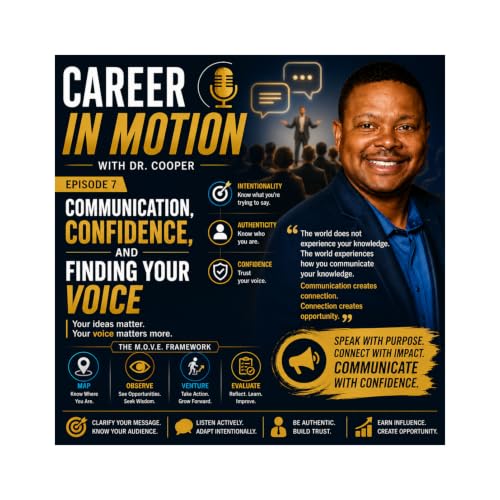
• Communication, Confidence, and Finding Your Voice | Careers in Motion with Dr. Cooper
    Jun 26 2026

    Episode 7 – RSS Show Notes

    Dr. Cooper explores one of the most important professional skills:

    Communication

    Not simply public speaking.

    Not simply presentations.

    Not simply email.

    Communication is how your experiences, knowledge, skills, and ideas come alive in other people's minds.

    You can have tremendous expertise, experience, and credentials. But if you cannot communicate, the world may never fully understand the value you bring.

    As Dr. Cooper explains:

    Communication is not simply talking. Communication is translation.

    It is the ability to take what is in your mind and intentionally help another person understand it.

    Every interaction involves:

    • a sender
    • a message
    • an audience
    • context
    • perceptions
    • noise
    • interpretation
    • feedback

    Communication is wonderfully messy.

    Within the M.O.V.E. framework, communication falls under:

    E = Evaluate

    Great communicators are constantly evaluating.

    They ask:

    • Am I being understood?
    • Does this message fit my audience?
    • What feedback am I receiving?
    • Should I pivot?
    • Is my message landing?

    Communication, like career movement, requires adaptation.

    The episode also explores three essential ingredients of effective communication:

    • Intentionality
    • Authenticity
    • Confidence

    Listeners are reminded that communication is about connecting.

    Dr. Cooper also challenges the idea that communication is a natural talent, but a developmental skill that can be practiced and improved through:

    • message organization
    • tone
    • delivery
    • listening
    • presence
    • persuasiveness
    • feedback
    • reflection

    At the center of the episode is an important realization:

    The world does not experience your knowledge. The world experiences how you communicate your knowledge.

    Listeners become more intentional, authentic, and confident communicators in their everyday interactions.

    Key Topics Discussed

    • Why communication is a critical career skill
    • Communication as translation and connection
    • The communication process and its complexities
    • Intentionality, authenticity, and confidence
    • Communication as a developmental skill
    • The importance of feedback and adaptation
    • Presence, delivery, and persuasiveness
    • Communication and career movement

    Listener Takeaways

    • Communication is much more than speaking.
    • Great communicators continuously evaluate and adapt.
    • Confidence in communication is built, not inherited.
    • Communication improves through practice and reflection.
    • Intentionality and authenticity matter more than perfection.
    • Listening is just as important as speaking.
    • Strong communication creates connection, trust, and opportunity.

    Career in Motion Challenge

    Choose one communication interaction this week.

    After it is over, spend five minutes reflecting:

    • What was my intended message?
    • Was I understood?
    • Did I adapt to my audience?
    • What feedback did I observe?
    • What would I do differently next time?

    Repeat this process for one week.

    Then ask yourself:

    “Am I becoming more intentional, authentic, and confident in my communication?”

    Show More Show Less
    18 mins
  • When Opportunities Quietly Appear | Career in Motion with Dr. Cooper
    Jun 13 2026

    Episode Description / RSS Show Notes

    Welcome back to Career in Motion with Dr. Cooper — a podcast about careers, confidence, strategy, and movement.

    In Episode 6, Dr. Cooper explores one of the most overlooked yet powerful skills in career development:

    Opportunity Recognition

    Many people spend the early stages of their careers chasing opportunities: jobs, promotions, credentials, and experiences. But over time, something begins to shift.

    Opportunities do not necessarily become more abundant.

    We become better at seeing them.

    As Dr. Cooper explains:

    “Many opportunities do not arrive with a spotlight on them. Sometimes opportunities quietly appear through observation, conversations, timing, awareness, and preparation.”

    This episode explores why opportunities are often misunderstood. Opportunities do not always mean a new job, more money, or a promotion.

    They are hidden within relationships, conversations, projects, problems, responsibilities, learning experiences, and quietly reappearing patterns.

    Dr. Cooper introduces Eleven Ways Opportunities Tend to Appear:

    • Consensus Among Others
    • Necessity
    • Anxiety
    • Avoiding the Obvious
    • Fear of Letting Yourself Down
    • Pattern Recognition
    • Deliberate Planning
    • Expectations
    • Going for the Improbable
    • Passion
    • Persistence

    Through personal stories and reflections, listeners are challenged to think differently about how opportunities materialize and why some people recognize them while others walk right past them.

    At the center of the episode is an important realization:

    The rewards of recognizing and seizing opportunities often lag the moment of opportunity itself.

    Opportunity recognition is not luck; it's a skill.

    The episode closes with a practical challenge designed to help listeners identify opportunities that may already be quietly operating in their current roles and lives.

    Key Topics Discussed

    • What opportunity recognition means
    • Why opportunities often appear quietly
    • The difference between chasing opportunities and recognizing opportunities
    • Why opportunities are more than jobs and promotions
    • Eleven ways opportunities tend to materialize
    • Pattern recognition and awareness
    • Passion and persistence as opportunity catalysts
    • The role of preparation and timing
    • Creating an Opportunity Recognition Map
    • How awareness changes careers

    Listener Takeaways

    • Opportunities often emerge through observation and preparation
    • Rewards frequently lag the moment of opportunity
    • Opportunity recognition is a learnable workplace skill
    • Relationships and conversations can become significant opportunities
    • Patterns and recurring themes deserve attention
    • Courage often precedes confidence

    Career in Motion Challenge

    Create your own Opportunity Recognition Map.

    Step 1:

    Write down the eleven opportunity principles discussed in the episode.

    Step 2:

    Identify one example of each from your own career, education, or personal life.

    Step 3:

    Determine which principle may be quietly operating in your current role right now.

    Step 4:

    Take one action this week that moves you toward that opportunity.

    Then ask yourself:

    “What opportunity is quietly appearing in my life that I have not fully recognized yet?”

    Show More Show Less
    20 mins
  • Confidence Comes from Movement, Specifically Consistency | Career in Motion with Dr. Cooper
    Jun 9 2026

    Episode Description / RSS Show Notes

    Welcome back to Career in Motion with Dr. Cooper — a podcast about careers, confidence, strategy, and movement.

    In Episode 5, Dr. Cooper explores a topic that many professionals misunderstand:

    Where does confidence actually come from?

    Many people assume confidence comes from credentials, titles, achievements, status, or recognition. While those things may influence confidence, Dr. Cooper argues that true confidence is often built somewhere much simpler:

    Confidence comes from movement. Specifically, consistency.

    Drawing from personal experiences, reflections on career setbacks, and lessons learned throughout his professional journey, Dr. Cooper discusses how confidence is often the byproduct of repeatedly showing up, doing the work, and continuing to move forward, even when no one is watching.

    The episode explores three guiding principles that have influenced his life:

    • Let no one define your story.
    • Stay curious and question assumptions.
    • Keep moving forward, especially when things do not go your way.

    Dr. Cooper also shares a powerful insight inspired by a story about Arnold Schwarzenegger, who described success not in terms of outcomes, but in terms of showing up and completing the work.

    Sometimes the win is not the result.

    Sometimes the win is simply:

    • doing the work
    • taking the step
    • showing up
    • maintaining consistency

    Within the M.O.V.E. philosophy, this episode focuses on the relationship between:

    Movement → Activity → Consistency → Confidence

    Listeners are encouraged to think differently about confidence as repeated intentional behavior over time.

    The episode also explores:

    • self-efficacy
    • self-trust
    • self-esteem
    • personal accountability
    • consistency as a professional skill

    At the center of the conversation is one important realization:

    “Self-confidence is trust in yourself”

    Key Topics Discussed

    • The relationship between movement and confidence
    • Why confidence is often misunderstood
    • Self-efficacy and self-trust
    • Consistency as a professional advantage
    • Building momentum through repeated action
    • Accountability and discipline
    • Daily wins and long-term growth
    • The role of intentional activity in career development

    Listener Takeaways

    • Confidence is often built through action rather than waiting for certainty
    • Consistency creates momentum and self-trust
    • Small daily wins compound over time
    • Self-efficacy grows through repeated practice
    • Professional confidence is connected to reliability and follow-through
    • Movement and activity help restore motivation during difficult periods
    • Career growth often comes from doing the work when no one is watching

    Career in Motion Challenge

    This week's Career in Motion Challenge:

    • Identify one skill, responsibility, or task you consistently avoid.
    • Ask yourself why you avoid it.
    • Break it into one small daily action.
    • Commit to doing that action every workday for two weeks.

    Then reflect:

    • Do you feel more capable?
    • Do you feel more confident?
    • Has the task become easier?
    • Has your perception of yourself changed?

    Finally, ask yourself:

    “Was my confidence waiting for success, or was my confidence built through consistency?”

    Show More Show Less
    19 mins
  • Mentors and Mentoring | Career in Motion with Dr. Cooper
    Jun 4 2026

    Episode Description / RSS Show Notes

    Welcome back to Career in Motion with Dr. Cooper — a podcast about careers, confidence, strategy, and movement.

    In Episode 4, Dr. Cooper temporarily steps away from the M.O.V.E. framework to explore one of the most powerful influences on professional growth:

    Mentors and Mentoring

    Inspired by a recent conversation with a seasoned professional who had spent more than five decades mastering his craft, Dr. Cooper reflects on the role mentors have played throughout his own life and career.

    What is a mentor?

    More importantly, how do mentors shape the way we think, grow, learn, and navigate our professional journeys?

    Drawing from personal stories and experiences, Dr. Cooper discusses the teachers, leaders, executives, and professionals who helped shape his development over the years. Their lessons extended beyond technical knowledge and included confidence, professionalism, rigor, passion, and personal growth.

    This episode explores mentoring through the lens of the O in the M.O.V.E. Framework — Observe, where opportunity often begins by observing the people around us who possess knowledge, skills, experiences, and perspectives we admire.

    Listeners are encouraged to think critically about:

    • Who they learn from
    • What qualities they admire in others
    • How mentoring relationships develop
    • The responsibilities of both mentors and mentees
    • How mentoring accelerates learning and career growth

    Dr. Cooper also breaks down the practical value of mentoring, including:

    • knowledge transfer
    • shortened learning curves
    • professional support
    • organizational insight
    • career guidance
    • navigating workplace dynamics

    As Dr. Cooper reminds listeners:

    “We are the sum of those who poured into us.”

    The episode closes with a practical challenge designed to help listeners identify potential mentors and begin building meaningful professional relationships.

    Key Topics Discussed

    • What mentoring means in career development
    • The difference between formal and informal mentoring
    • The role of trust, guidance, and experience
    • Personal mentors who shaped Dr. Cooper’s development
    • Mentoring through the lens of the M.O.V.E. Framework
    • Mentor and mentee responsibilities
    • The importance of observing excellence in others
    • Knowledge transfer and accelerated learning

    Listener Takeaways

    • Mentors provide guidance, perspective, and professional wisdom
    • Strong mentoring relationships are built on trust and mutual respect
    • Mentoring can significantly shorten learning curves
    • Observing successful professionals creates developmental opportunities
    • Both mentors and mentees have responsibilities within the relationship
    • Mentorship can help navigate organizational and professional challenges

    Career in Motion Challenge

    This week's Career in Motion Challenge is simple:

    Identify someone you admire professionally.

    Ask yourself:

    • What specifically do I admire about this person?
    • What knowledge, skills, or attitudes would I like to develop?
    • Is this person approachable?
    • Would a formal or informal mentoring relationship make sense?

    Then take action.

    Invite them for coffee, schedule a conversation, or simply begin building the relationship.

    Opportunity often begins with a conversation.

    Show More Show Less
    26 mins
  • The M in Movement | Career in Motion with Dr. Cooper
    Jun 2 2026

    Episode Description / RSS Show Notes

    Welcome back to Career in Motion with Dr. Cooper — a podcast about careers, confidence, strategy, and movement.

    In Episode 3, Dr. Cooper takes a deeper dive into the first and perhaps most foundational component of the podcast’s signature framework:

    M.O.V.E.

    Map → Observe → Venture → Evaluate

    This episode focuses specifically on:

    The M in Movement

    What is movement? Why does movement matter? What does it truly mean to stay in motion professionally, intellectually, and personally?

    Drawing from his experiences as a professor, consultant, researcher, entrepreneur, author, and lifelong learner, Dr. Cooper reflects on the reality that career movement is often much larger than a job title or organizational role.

    He discusses the tension between:

    • responsibility and aspiration
    • structure and creativity
    • stress and growth
    • productivity and purpose

    Listeners are invited into a more personal and reflective conversation about:

    • internal motivation
    • self-actualization
    • discipline
    • identity
    • momentum
    • and the internal drive to continue building, learning, and creating

    Throughout the episode, Dr. Cooper explains how movement is not simply about being busy. True movement is intentional, connected, and growth oriented.

    The episode explores how movement can mean:

    • showing up consistently
    • stretching beyond comfort zones
    • managing competing priorities
    • staying creatively engaged
    • remaining mentally present
    • continuously developing skills
    • and building a life aligned with deeper purpose

    Dr. Cooper also introduces the practical side of movement, explaining that:

    • movement creates possibility
    • movement creates momentum
    • movement creates adaptability
    • movement creates opportunity recognition

    Key Topics Discussed

    • Why movement is larger than employment status
    • Internal motivation and self-actualization
    • Career identity and purpose
    • Creativity under pressure
    • Stress, discomfort, and growth
    • Movement as presence and engagement
    • Continuous skill development and refinement
    • Momentum as a subconscious driving force

    Listener Takeaways

    • Stress and stretching can become catalysts for growth
    • Internal motivation is often more sustainable than external validation
    • Being present matters just as much as planning
    • Momentum is built through repeated intentional action
    • Career growth involves ongoing refinement and self-awareness
    • Creativity often emerges through movement and constraint

    Career in Motion Challenge

    This week’s Career in Motion Challenge is practical and action-oriented:

    Step 1:

    Identify three important projects or goals currently connected to your life or career.

    Step 2:

    Define what meaningful progress would look like for each one.

    Step 3:

    Spend focused one-hour work sessions actively engaging each project throughout the day.

    Step 4:

    Evaluate yourself honestly:

    • Did you make real progress?
    • Did movement occur?
    • Were you intentional?
    • What needs refinement?

    Remember:

    “Movement creates momentum.”

    Show More Show Less
    15 mins
  • The Activity is the Progress | Career in Motion with Dr. Cooper
    May 28 2026

    Episode Description / RSS Show Notes

    Welcome back to Career in Motion with Dr. Cooper — a podcast about careers, confidence, strategy, and movement.

    In Episode 2, Dr. Cooper expands on one of the central ideas introduced in the first episode:

    “The activity is the progress.”

    This episode explores why career growth is not simply about reaching a destination, but about learning how to continuously move, adapt, observe, and evolve throughout the journey.

    Drawing from personal reflections during graduate school and years of experience in human resources, leadership development, consulting, and higher education, Dr. Cooper introduces the podcast’s signature framework:

    M.O.V.E.

    Map → Observe → Venture → Evaluate

    Listeners are encouraged to rethink careers not as static paths, but as dynamic systems that require:

    • continuous awareness
    • intentional movement
    • self-reflection
    • adaptability
    • opportunity recognition

    Dr. Cooper discusses how many opportunities in life and work do not arrive with obvious signs or certainty. Instead, opportunities often emerge quietly through:

    • conversations
    • timing
    • observation
    • networking
    • preparation
    • consistent activity

    The episode also explores the importance of self-actualization and reflective career development, asking listeners to think more deeply about:

    • who they are becoming
    • what movement they are creating
    • how they respond to uncertainty
    • whether fear or action is guiding their decisions

    At the center of the episode is one important realization:

    “Movement creates momentum.”

    Careers are rarely built through standing still. They are built through intentional activity, reflection, learning, adjustment, and the willingness to continue moving forward even when the full path is still unfolding.

    The episode closes with a challenge for listeners to reflect on opportunities they may have missed, which appeared to be closed doors rather than hidden openings.

    Key Topics Discussed

    • Why “activity” is often misunderstood in career development
    • Careers as dynamic systems rather than fixed destinations
    • The psychology of movement and momentum
    • Introducing the M.O.V.E. Framework:
    • How opportunities quietly reveal themselves over time
    • Reflection and self-actualization in professional growth
    • Fear, uncertainty, and career hesitation
    • Continuous learning and adaptive thinking
    • Why intentional action matters even when already employed
    • The relationship between awareness and opportunity recognition

    Listener Takeaways

    • Career movement requires consistent intentional activity
    • Opportunities often emerge through observation and awareness
    • Standing still can create fear and stagnation
    • Reflection helps clarify direction and purpose
    • Career development is an ongoing process of evaluation and adjustment
    • Movement creates confidence and momentum over time
    • Self-actualization should remain part of career decision-making

    Career in Motion Challenge

    Reflect on this question:

    “What opportunity once appeared to be a closed door, but later revealed itself as a hidden opportunity?”

    Then ask yourself:

    • Why did I initially miss it?
    • Was I prepared to recognize it?

    Show More Show Less
    16 mins
  • The Activity Is the Progress | Career in Motion with Dr. Cooper
    May 25 2026

    Episode Description / RSS Show Notes

    Welcome to the very first episode of Career in Motion with Dr. Cooper — a podcast about careers, confidence, strategy, and movement.

    In this introductory episode, Dr. Cooper shares the inspiration behind the podcast and reflects on the deeper question many professionals and students face:

    Who is truly navigating your career?

    Drawing from over two decades of experience in human resources, consulting, higher education, mentoring, and leadership development, Dr. Cooper introduces the foundational philosophy behind the show:

    • Careers are rarely built in a straight line
    • Momentum matters
    • Confidence is developed through action
    • Career growth requires intentional movement

    Dr. Cooper also introduces the podcast's structure and the practical framework future episodes will use to help listeners think strategically, assess opportunities, adapt to challenges, and continue moving forward in their professional journey.

    The episode closes with an important reminder:

    “Keep learning. Keep moving. Keep building your career in motion.”

    Key Topics Discussed

    • Why Dr. Cooper launched the podcast
    • The intersection of HR, consulting, education, and career development
    • The importance of career ownership and intentionality
    • Why movement and activity matter more than perfection
    • The role of mentorship, networking, and opportunity recognition
    • Introducing the podcast framework:
      • Assess
      • Patterns
      • Path
      • Feedback
      • Adjust
    • Careers as adaptive journeys rather than linear paths
    • Real-time decision-making and navigating unexpected situations

    Listener Takeaways

    • Career progress often comes from consistent activity and adjustment
    • Strategic movement matters more than waiting for perfect conditions
    • Reflection and adaptability are critical professional skills
    • Networking and mentorship play major roles in career growth
    • Learning how to assess situations calmly is valuable both professionally and personally

    Career in Motion Challenge

    Ask yourself:

    “What intentional action can I take this week to move my career forward?”

    Then take one concrete step:

    • send a networking message
    • update your resume
    • research a company
    • reach out to a mentor
    • apply strategically
    • reflect on your direction

    Movement creates momentum.

    Quotes from the Episode

    “Careers are not built in a straight line.”

    “Who is in charge of navigating my career?”

    “The activity is the progress.”

    “Keep learning. Keep moving. Keep building your career in motion.”

    Show More Show Less
    12 mins