• Legal Recruiting 101: Navigating the Job Market and Negotiating Your Career
    Apr 20 2026


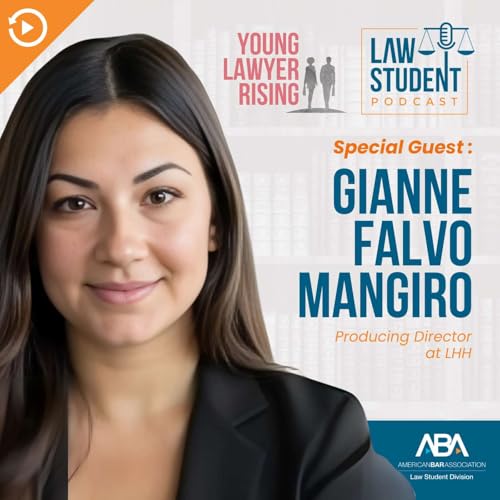
    Navigating the legal job market can feel like a full-time job, but you don't have to do it alone. In this episode of the ABA Law Student Podcast, hosts Todd Berger, Eve Albert, and Nayeli Diaz learn more about the world of legal recruiting by revisiting the ABA Young Lawyer Rising’s Montana Funk’s conversation with Gianne Falvo Mangiro, Producing Director at LHH.

    Gianne, a former practicing attorney, pulls back the curtain on how recruiters act as personal career advocates at no cost to the candidate. We explore exactly when a law student or young associate should seek out a recruiter, how to uncover unposted job opportunities, and the best ways to handle tricky counteroffers.

    The conversation also dives into essential tips for 3Ls navigating the "noise" of job portals, how to evaluate a law firm's culture through their billable hour requirements, and the growing field of "JD-Plus" careers. Whether you are prepping for your first year-end review or looking to pivot your practice area, this episode provides a foundational guide to building a successful career arc.

    Special thanks to the ABA Young Lawyers Division and the ABA Young Lawyer Rising Podcast.

    • (00:00) - – Intro: The Challenges of the Legal Job Market
    • (00:53) - – Networking and LinkedIn Connections
    • (02:15) - – Why Law Students Need Foundational Knowledge of Recruiting
    • (03:13) - – Introducing Gianne Falvo Mangiro and Young Lawyer Rising
    • (04:21) - – From Practice to Recruiting: An Entrepreneurial Career Pivot
    • (06:37) - – How Recruiter Agreements and Law Firm Fees Work
    • (07:59) - – The Benefits: Resumes, Interview Prep, and Advocacy
    • (09:04) - – When to Use a Recruiter: Junior Associates vs. New Graduates
    • (09:58) - – Full-Service Support: Scheduling and Confidence-Building
    • (12:40) - – The Initial Call: Understanding Experience and Personality
    • (13:47) - – Personality Matches and Casting a Wide Net
    • (14:54) - – Pivoting Practice Areas and Independent Searches
    • (15:37) - – Researching Recruiter Credibility and Diligence
    • (16:33) - – Navigating Negotiating Representation
    • (17:44) - – Salary Ranges and State Disclosure Laws
    • (18:29) - – Interview Etiquette: When to Discuss Numbers
    • (19:43) - – Understanding Lockstep Salary Models
    • (20:35) - – Appropriate Counter-Offering and Risks
    • (22:29) - – Evaluating the Full Compensation Package: Benefits and PTO
    • (23:30) - – Negotiating Non-Salary Terms: WFH Flexibility
    • (24:33) - – Strategies for Negotiating Raises at Your Current Firm
    • (26:55) - – Red Flags: Identifying Misconduct in Recruiting
    • (27:49) - – Recruiter Support for Pivoting Outside of Practice
    • (28:47) - – Recruiting Considerations for Judicial Clerks
    • (29:30) - – Overview of Professional Recruiting Services
    • (31:40) - – Host Debrief: Key Takeaways from the Interview
    • (32:57) - – Navigating the Noise of Job Portals as a 3L
    • (35:31) - – Tips for Handling Direct Outreach from Recruiters
    • (38:19) - – Gauging Law Firm Culture Through Billable Requirements
    • (42:24) - – Why Attorneys Make Credible Recruiters
    • (45:12) - – Alternative JD-Plus Career Paths and Dual Degrees
    • (46:03) - – Closing and ABA Law Student Division Resources

    Click here to view the episode transcript.

    Show More Show Less
    47 mins
  • Plaintiff’s Law 101: Building Career Community and Fighting for the Wronged
    Mar 16 2026

    From the first day of 1L year, the pressure to compete with your peers can feel overwhelming. But what if the secret to a fulfilling legal career isn't a higher grade, but a deeper connection?


    In this episode of the ABA Law Student Podcast, host Eve Albert sits down with Spencer Pahlke, a trial attorney at WalkUp, Melodia, Kelly, and Schoenberger and a lecturer at Berkeley Law. Spencer breaks down the realities of a plaintiff’s side practice—from representing those who have suffered catastrophic injuries to the chaotic, exciting "mishmash" of a typical workday.

    We dive deep into the power of the plaintiff’s bar, the importance of pay transparency in the legal field, and how the National Plaintiff’s Law Association (NPLA) is helping students get their foot in the door. Plus, learn about fortheplaintiff.org, a platform offering students paid opportunities to work on real-world projects. Whether you're a 3L weighing your career options or a 1L looking for community, this conversation offers a roadmap for finding passion and purpose beyond the classroom.

    • (00:00) - Intro: Shifting from Competition to Community
    • (01:22) - Meet Spencer Pahlke: Trial Attorney and Berkeley Law Lecturer
    • (03:32) - Defining Plaintiff’s Side Practice and Catastrophic Injury Law
    • (05:30) - The Human Element: Advocating for the Wronged
    • (07:30) - A Day in the Life: From Jury Consultants to Engineering Classes
    • (09:40) - Business of Law: Small Firms and Business Development
    • (11:38) - The Power of Plaintiff Bar Associations
    • (13:32) - Inside the National Plaintiff’s Law Association (NPLA)
    • (14:50) - Paid Opportunities for Students via fortheplaintiff.org
    • (17:44) - The Fight for Pay Transparency in the Legal Field
    • (20:44) - Balancing Practice with Passion Projects and Teaching
    • (24:54) - Advice for Students: Viewing Classmates as Partners, Not Rivals
    • (27:31) - Host Debrief: Career Stability vs. Personal Fulfillment
    • (31:10) - The Value of 1L Summer Internships (Even the "Bad" Ones)
    • (32:53) - Finding Your "Why": Persevering Through Law School
    • (35:58) - Closing: ABA Membership and Next Steps

    Click here to view the episode transcript.
    Show More Show Less
    46 mins
  • From Superfund to Solar: Prof. Michael Gerrard on the Evolution of Environmental Law
    Feb 16 2026

    Environmental law has shifted dramatically over the last few decades. What started as a battle against pollution and hazardous waste has evolved into a massive sector focused on the energy transition and infrastructure development. Michael Gerrard shares stories from his 30-year career in private practice, including his work on the environmental permitting for the World Trade Center redevelopment after 9/11.

    Key Takeaways:

    • Rebuilding History: The unique challenges of managing environmental review for the World Trade Center site.
    • The Energy Transition: How the field is moving from "anti-pollution" lawsuits to facilitating the construction of renewable energy and transmission.
    • Collaborative Practice: The intellectual reward of working alongside engineers, hydrologists, and biologists to solve complex problems.
    • The "Adjacent" Fields: Why students should look into Water Law (especially in the West) and Toxic Torts.

    • (00:00) - Introduction: Why Environmental Law is the Most Tangible Field
    • (02:45) - From West Virginia to Big Law: Michael Gerrard’s Career Path
    • (05:45) - Case Study: Permitting the World Trade Center Redevelopment After 9/11
    • (07:23) - Myth Buster: Do You Need a Science Degree to Practice Environmental Law?
    • (08:56) - The Shift: Moving from Pollution Control to the Energy Transition
    • (12:15) - Shared Values: Working in NGOs vs. Large Law Firms
    • (14:24) - Specialization: Clean Air Act, Water Law, and Toxic Torts
    • (18:58) - 1L Advice: Why You Should Take "Tax" and "Corporations"
    • (22:42) - Best Resources: Legal Planet, Grist, and Student Journals
    • (24:02) - Current Landscape: Navigating Regulatory Changes and Political Shifts
    • (25:37) - Finding Hope: Solar Prices, EVs, and the Role of Law in the Climate Crisis
    • (28:08) - Host Debrief: Why Environmental Law Touches Every Practice Area
    • (32:59) - Curriculum Chat: Water Law and Renewable Energy Courses

    Click here to view the episode transcript.
    Show More Show Less
    38 mins
  • The Law Student's Secret Weapon: Understanding How the ALI's Restatements Can Streamline Your Legal Research
    Jan 19 2026

    Common law can feel like a chaotic patchwork of 50 different jurisdictions. But for the last century, the American Law Institute (ALI) has worked to distill that chaos into clear, persuasive principles. We sit down with Mark Hall, the lead reporter for the Restatement of the Law Third, Torts: Medical Malpractice, to discuss how these influential texts are written and why they often carry more weight than a standard law review article.


    In this episode, we cover:

    • The "Goldilocks" Standard: How the ALI synthesizes the "best" version of the law from conflicting state approaches.
    • Medical Malpractice Deep Dive: Defining the "Standard of Care" and navigating the controversial Loss of Chance doctrine.
    • A "Secondary" Source with Primary Power: Why judges often rely on Restatements to settle issues of first impression.
    • The Laboratory of the States: Why a little legal variation across the country is actually a good thing for the profession.

    • (00:00) - Introduction: The Chaos of Common Law and the Role of the ALI
    • (03:24) - What is a Restatement? Harmonizing 50 States into One Principle
    • (04:36) - The Legacy of Torts: How the ALI Created Products Liability Law
    • (07:17) - Defining the Standard of Care: "Competent" vs. "Average"
    • (09:55) - The "Loss of Chance" Doctrine: Can You Sue for a Reduced Probability of Survival?
    • (12:14) - Study Tips: Using Restatements to Outline for Finals and Understand Nuance
    • (16:24) - Litigation Strategy: Making Arguments When the Law is Unsettled
    • (20:00) - The "Laboratory of the States": Why Legal Variation is Beneficial
    • (24:32) - Curriculum Design: Will Professors Teach from the Restatement?
    • (27:38) - Host Debrief: How to Use Restatements as a Research Shortcut for Briefs
    • (34:40) - Evidence vs. Torts: Why Codified Rules Feel Easier to Learn
    • (42:02) - Networking Hacks: Using the ALI Member List to Find Mentors

    Click here to view the episode transcript.
    Show More Show Less
    45 mins
  • The Evolving Copyright Practice: From Static Rules to Global Strategy
    Dec 15 2025

    Copyright law used to be considered a quiet, "boutique" field—but things have changed. With the rise of AI and global digital marketplaces, copyright has transformed into a high-stakes battlefield. We sit down with Kristyn Webb, a copyright litigator at Fishman Stewart, to discuss how technology is rewriting the concept of ownership and why firms are desperate for new experts in "Soft IP".

    In this episode, we cover:

    • The AI Revolution: How the legal world is grappling with training data, generated outputs, and the lack of global consensus on AI copyright.
    • Global Enforcement: Why copyright lawyers need to look beyond lawsuits and work with Customs and Border Protection to stop infringing goods before they enter the country.
    • The Human Element: The importance of understanding "moral rights" and protecting an artist's legacy (and immortality).
    • Career Advice: Why you shouldn't be discouraged if you don't land an IP job immediately, and how "side quests" like clerking can make you a better litigator.

    Click here to view the episode transcript.

    • (00:00) - Introduction: Copyright Law’s Evolution in the Age of AI
    • (01:44) - Meet Kristyn Webb: Copyright Litigator & Soft IP Expert
    • (03:27) - Breaking into IP: A Non-Linear Career Path to Copyright Law
    • (05:11) - Future of IP: Concierge Services and Artificial Intelligence
    • (06:42) - Legal Job Market: The Growing Demand for Trademark & Copyright Attorneys
    • (08:44) - IP Strategy: Using Copyright for Border Enforcement & Brand Protection
    • (12:54) - Day in the Life: Litigating Diverse Cases from Cartoons to Digital Rights
    • (15:34) - Moral Rights & Legacy: The Human Element of Intellectual Property
    • (21:42) - Global Copyright: AI Training Data and International Jurisdiction
    • (25:03) - Student Resources: The Copyright Claims Board & Law School Clinics
    • (26:59) - Career Advice: Leveraging Clerkships and "Side Quests" for IP Jobs
    • (31:45) - Host Debrief: The Broad Scope of Copyrightable Works (including Dance)
    • (38:43) - Conclusion: Balancing Artistic Passion with Legal Career Practicality
    Show More Show Less
    43 mins
  • The IP Career Path: Blending Law, Biotech, and Business Strategy with Jenna Matheny
    Nov 17 2025


    Want a legal career blending Intellectual Property (IP), Biotechnology, and Business? We sit down with Jenna Matheny (Vice-President & Managing Director at APIOiX) to break down the path to a high-impact career in medical innovation. This episode is essential listening for law students and those interested in patent law who also have a passion for science, revealing a world of opportunities beyond traditional law firm life.

    In this episode, we discuss:

    • The Innovation Lifecycle: How lawyers are involved from invention disclosure and patent strategy to regulatory approval (FDA) and commercialization.
    • The Business of IP: The critical, often-overlooked importance of contracting and compliance in developing and licensing medical technology.
    • Finding Your Niche: Jenna's unique career path through university Tech Transfer offices, incubators, and accelerators—and how law students can get their foot in the door.
    • Beyond Science: The growing field of social innovation and how non-science majors can find rewarding IP careers focused on copyright and trademark.
    • Practical Law School Advice: Which broad-based courses (like securities and international tax) set you up for success, and the value of clinics and residencies.

    • (00:00) - Introduction: Blending Law, Science, and Business in an IP Career
    • (01:43) - Meet Jenna Matheny: Expert in Medical Technology IP and Tech Consulting
    • (04:28) - Defining Biotech vs. MedTech: Law's Role in FDA Approval
    • (05:42) - The Core Practice Areas: Patents, Contracting, and Regulatory Compliance
    • (10:09) - Career Pivot: From Medicine Interest to Patent Attorney Path
    • (11:32) - Tech Transfer Offices (TTOs): How Law Students Can Gain Experience
    • (14:28) - Incubators & Accelerators: Consulting and Internship Roles for Attorneys
    • (20:39) - Practical Advice: Essential Law School Courses (Securities, Tax) and Clinics
    • (24:26) - Serendipity & Networking: How Connections Change the Course of a Legal Career
    • (25:59) - Social Innovation: IP Opportunities without a Science Background (Copyright & Trademark)

    Click here to view the episode transcript.
    Show More Show Less
    42 mins
  • Tribal Law 101: Why It's Essential for Every Law Student
    Oct 20 2025

    Host Nayeli Diaz sits down with tribal attorney Leah Jurss to demystify the vast and often-overlooked world of tribal law. Leah shares her unique perspective from working both in a firm serving tribes and as in-house counsel for the Bay Mills Indian Community.


    In a candid and informative interview, Leah dispels common myths and explains why a foundational understanding of tribal sovereignty is essential for all legal professionals, no matter their field. She highlights the wide range of legal issues that intersect with tribal communities and offers a clear roadmap for how law students can start learning about this fascinating and rewarding area of law.

    In this episode, we discuss:

    • Federal Indian Law vs. Tribal Law: The key differences between the laws governing the relationship with the U.S. government and the laws tribes use to govern themselves.
    • The Right Terminology: Why "Indian law" is still used and when it's appropriate to identify a specific tribe.
    • Effective Advocacy: Leah's experience working with non-native lawyers and her advice on how to be an effective advocate for a tribal community by respecting cultural norms.
    • A Rewarding Career: Why a career in tribal law is never boring, offering a chance to touch on many different practice areas, from family and environmental law to legislation and business development.
    • Resources for Students: Actionable steps you can take today to learn more, including which law school classes to take and the value of joining organizations like the Native American Law Students Association (NALSA).

    • (00:00) - Introduction: The Importance of Tribal Law for Law Students
    • (01:36) - Introducing Guest Leah Jurss & The Topic of Tribal Law
    • (03:53) - The Term "Indian Law": Why Is It Still Used?
    • (04:40) - The Difference Between Federal Indian Law and Tribal Law
    • (06:19) - In-House vs. Law Firm Practice: The Differences
    • (08:14) - Being a Non-Native in Indian Law: A Discussion on Allyship
    • (10:20) - The Importance of a Baseline Understanding for All Lawyers
    • (13:12) - Resources for Learning Tribal Law in Law School
    • (16:28) - Leah's Career Path: From Law Student to Tribal Attorney
    • (19:35) - A Day in the Life of a Tribal Attorney
    • (23:57) - A Favorite Project: Drafting a Judicial Ethics Code
    • (26:22) - Final Takeaways: The Importance of Sovereignty
    • (27:33) - Conclusion & Outro

    Click here to view the episode transcript.
    Show More Show Less
    39 mins
  • Relocating After Law School: How to Prepare and Thrive
    Sep 29 2025

    Relocating after law school can be daunting. For whatever reason you find yourself in a new city, you often have to rebuild networks, learn the local rules, and figure out how you’re going to excel while you’re still finding your way around.

    For our first episode of the new season, we welcome new hosts Nayeli Diaz and Eve Albert, who sit down with Kimberly Wolf Price, who brings her years of experience derived from working in law school career services, hiring new talent, and having been a young associate who went through the same challenges. Together, they explore how law students can face their anxieties, make all the necessary preparations to successfully set themselves up for success, and engage with local attorneys to find their place.

    • (00:00) - Introduction & Meet the Hosts
    • (01:45) - Nayeli Diaz's Background & Interests
    • (02:57) - Eve Albert's Background & Interests
    • (03:59) - Introducing Guest Kimberly Wolf Price & The Topic of Relocation
    • (07:17) - The First Question: "Is This Even Possible?"
    • (08:17) - Navigating the Bar Exam for Another State
    • (09:59) - Networking Tips for Relocating Law Students
    • (12:39) - Advice for Students Unsure of Where to Relocate
    • (13:42) - The Importance of Proactivity in Your Career
    • (14:53) - A Message from the Legal Community: Lawyers Want to Help
    • (15:50) - The Role of Technology in Networking
    • (16:53) - The Benefits of Relocating After Law School
    • (18:01) - Specialization & Clerkships as a Strategic Move
    • (19:06) - When to Start Talking to Career Services
    • (20:32) - Addressing Apprehension About Out-of-State Experience
    • (22:28) - How to Talk About Relocation in Your Cover Letter
    • (23:54) - Long-Distance Networking Tips for Law Students
    • (25:11) - The Merit of Working as an Associate Before Relocating
    • (27:14) - The Importance of Authenticity & Not Burning Bridges
    • (28:19) - Final Advice: Take a Deep Breath & Just Start
    • (30:56) - Conclusion & Outro

    Show More Show Less
    32 mins