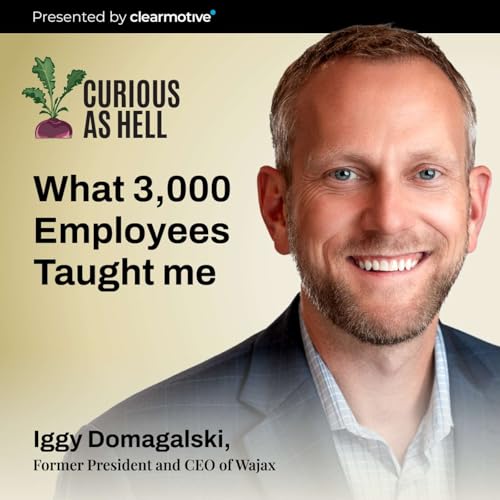
Curious as Hell S01E02: The Leadership Lessons I Didn't Learn Until 3,000 Employees cover art

Curious as Hell S01E02: The Leadership Lessons I Didn't Learn Until 3,000 Employees

Curious as Hell S01E02: The Leadership Lessons I Didn't Learn Until 3,000 Employees

Listen for free

View show details
When a senior leader retires, their phone stops ringing. Almost immediately. Iggy Domagalski noticed this and built his entire personal mentorship network around it. He maintains relationships with between 10 and 15 mentors and connects with each of them every six months with a written list of questions. The group most willing to give their time was available and brought value to every single conversation. That is one idea from this conversation. The rest is equally powerful.Iggy was part of the team that acquired Tundra Process Solutions in 2006 and scaled it to 150 people before its acquisition, then spent four years as CEO of Wajax, one of Canada's oldest companies at 168 years old. He came in as an outsider, visited 80 of the company's 100-plus branches in his first three months, and spent the next four years learning what actually happens when you try to shift the leadership culture of a 168-year-old organization.Not everything landed the way he intended. He is honest enough to say exactly what he would do differently.Key themes from this episode:On the hubris of the early leader: "I just had some opinions on things, the way I thought that things should be done based on not very good information or experience." That line from Iggy is worth sitting with.On the recently retired mentor sweet spot: when someone exits a senior role, their phone stops ringing almost overnight. If you are the one calling, you have their full attention and the benefit of everything they learned.On culture change and unintended consequences: a leadership initiative meant to strengthen culture started to erode the performance expectations beneath it as the language spread deeper into the organization. Iggy walked it back deliberately and explained how.On making decisions without perfect information: "We don't have all the information here, but this is good enough. This is what we're doing. And when we walk out of here, we need everyone aligned and singing from the song sheet."On the think day: Iggy has been scheduling deliberate, phone-off, handwritten thinking sessions at a coffee shop for years. Every single time, he left telling himself it was the best use of his time. Every single time, the urgency of the week pulled him back.On closing the feedback loop: when a decision does not work out, telling your team "here is what we changed and why, and here is the new outcome" goes further than most leaders realize.Chapters:0:00 — Welcome and Iggy's background1:02 — The risk of certainty: how leaders get addicted to having the answers2:56 — When you grow past 50-75 people and lose the pulse4:23 — Hubris: opinions dressed up as knowledge5:23 — Mirror moments: how you actually figure out you're the problem7:53 — Mentor Mike and the 26-year business partnership10:10 — "So how often are you going to come out here?" "Well, never."11:26 — Picking up behaviours you admire without becoming someone else12:33 — How critical mentorship is at every stage of a career13:25 — Finding the right mentor at the right level15:20 — The roster of 10-15 mentors and why recently retired leaders are the best16:25 — "The king is dead, long live the new king"17:35 — Why Iggy stopped giving advice and started telling stories19:48 — Asking: whose decision is this really?20:27 — Narrowing the fairway: values and strategy as guardrails21:35 — How hard is this to undo? The reversibility test22:55 — Closing the feedback loop: telling people what changed and why23:22 — RACI and why consulted and informed are the underrated columns25:14 — Coming in as the underdog: building credibility as the new Wajax CEO25:48 — 80 branches in 3 months: going to the front lines first26:40 — No written values at a 163-year-old company27:31 — "People First" and how it got weaponised29:49 — What it actually takes to course-correct culture at scale32:39 — The previous CEO Mark: directive versus collaborative leadership34:33 — Inheriting a team that expects clear marching orders37:40 — Why new leaders bring their own people (it's not what you think)40:41 — Remote work before and after COVID43:35 — Creating space for people to think: the hardest leadership challenge44:24 — The think day: Iggy's deliberate practice at the coffee shop46:06 — The manager who said he was too busy to think48:04 — Five minutes of preparation changes every conversation49:07 — Tyler's ChatGPT mock podcast hack on the way to the ski hill50:00 — The Copilot prompt that builds a weekly briefing on everyone you're meeting52:11 — React vs. reflect: "sometimes poorly."55:08 — The HiPPO: pulling quiet voices into the room56:06 — "Start your sentence with: I'm not an expert in this, but..."57:13 — Making decisions without perfect information and walking out aligned59:47 — Teaser: the CEO and the board1:01:15 — The sabbatical, the twins, and country living1:04:56 — Closing advice: run your own raceConnect with Iggy: linkedin.com/in/...
adbl_web_anon_alc_button_suppression_t1
No reviews yet